






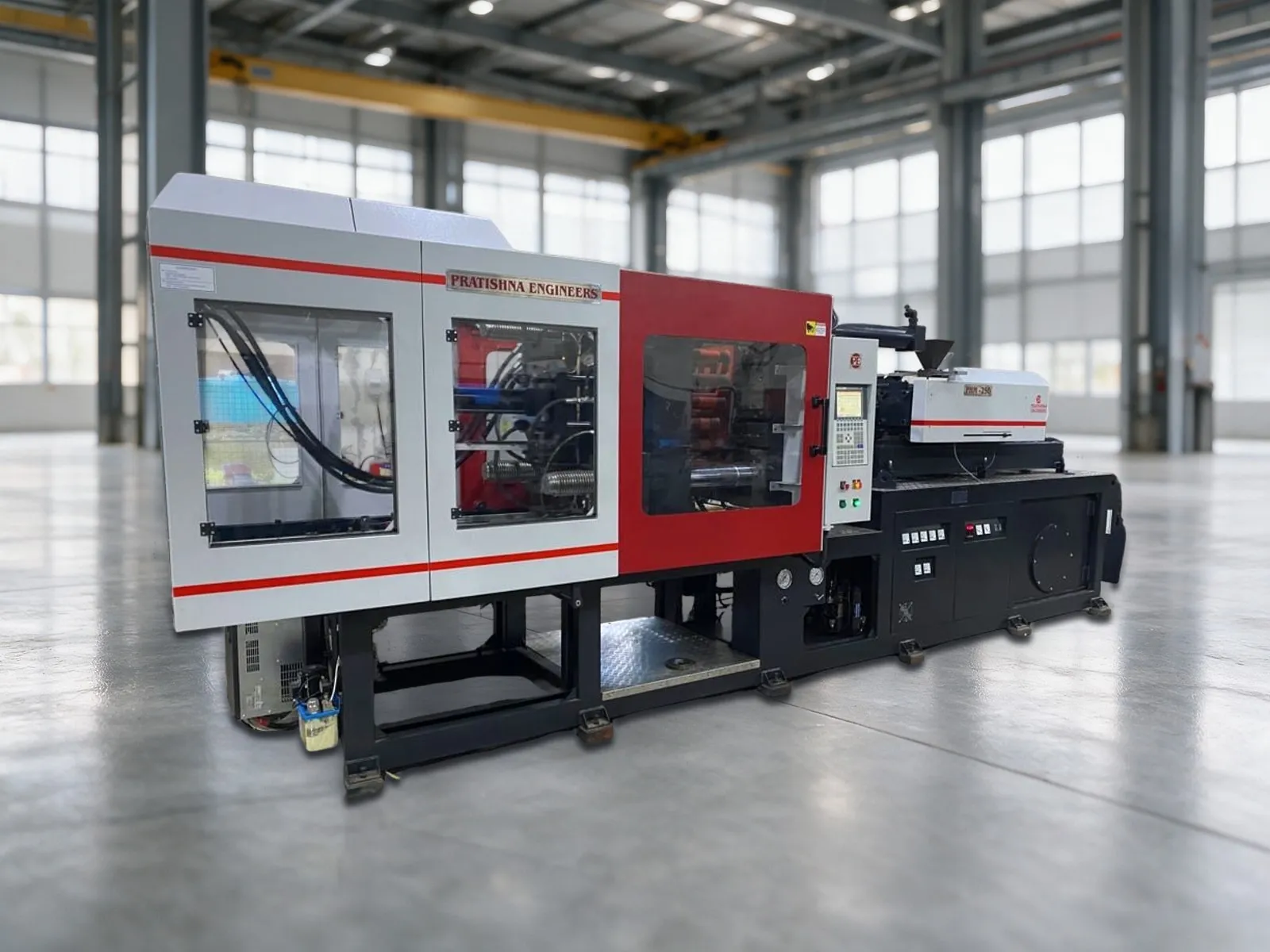

Take a PP crate of 600 × 400 mm with a 50% open base. Its projected area is about 1,200 cm², and at a tonnage factor of 2 to 3 US t/in² plus a 10% margin (a starting margin, not a rule) it needs roughly 371 to 557 t of clamp. That one number narrows the choice before you open a brochure. Two platen machine specifications follow the same logic: start from the part, then check clamp force, tie-bar clearance, daylight and mould height, shot size, injection pressure, mould weight and drive power, in that order.
Key Takeaways
- Clamp force comes from projected area times a material tonnage factor, plus a margin you choose.
- On a two platen machine, usable opening is daylight minus mould height, so check daylight on your tallest mould.
- Size the barrel by volume so the shot sits between about 20% and 65% of capacity.
- Compare plastic injection pressure, not hydraulic pressure, and ask for measured power on a cycle like yours.
Which two platen machine specifications matter most?
The two platen machine specifications that decide fit are clamp force, clear distance between tie bars, maximum daylight, minimum and maximum mould height, shot size, injection pressure, maximum mould weight and pump drive power. Check them against your mould and part, in that order, before comparing price or features.
Specifications to check on a two platen quote
| Specification | Why it matters | How to check |
|---|---|---|
| Clamp force (t) | Holds the mould shut against cavity pressure | Projected area × tonnage factor + margin |
| Tie-bar clear distance (mm) | Mould must pass between the bars; part area must sit inside them | Mould width plus loading clearance; avoid very small moulds |
| Maximum daylight (mm) | Mould and opening share it on a two platen machine | Daylight minus mould height ≥ 2.5 × part height |
| Min and max mould height (mm) | The mould must lock within this range | Mould shut height inside both limits |
| Shot size (g PS) | The barrel must suit the shot volume | Shot at about 20% to 65% of barrel capacity |
| Injection pressure (kg/cm²) | Fills long flows and thin sections | Plastic pressure for the screw you choose |
| Maximum mould weight (kg) | Platens and guides must carry the mould | Limit for both platens and both halves |
| Pump drive and power (kW) | Sets running cost | Drive type and measured kW on a similar cycle |
How do you size clamp force for a large part?
Multiply the projected area of all cavities plus any cold runner by a tonnage factor for the material, then add a reserve. SPE Plastics Engineering gives factors from 2 to 8 US tons/in² by material, with PP at 2 to 3.
Polyethylene sits at the low end of that range and polycarbonate toward the high end. In metric, 2 US t/in² is 0.281 t/cm² and 3 is 0.422 t/cm². Thin walls and long flow paths push the factor up, so use the higher end until trials say otherwise. Cored-out openings in the part, such as the holes in a crate base, are subtracted from the area.
Do not swing the other way and buy far more tonnage than the part needs. The SPE article warns that excess clamp force can crack hydraulic cylinder mounting plates, deform platens and fracture the machine frame. A real case of a mould splitting under over-clamping is in the hydro-mechanical clamping article in this series.
How do you check tie-bar clearance, daylight and mould height?
Check that the mould passes between the tie bars with loading clearance, that its shut height sits between the minimum and maximum mould height, and that daylight minus mould height leaves at least 2.5 times the part height as opening for removal.
MoldMaking Technology adds two details. The projected area of the parts must sit inside the tie bars, because platens can pull in near the bars and wear the parting line. And on piston-type clamps such as two platen machines, maximum stroke is reached only at minimum shut height. Check the maximum mould weight for both platens too, and the bolt and ejector patterns against your mould. For tall crates, add the ejector stroke and any robot take-out clearance to the opening you need.
Daylight is the spec I would check first on a two platen quote. The opening comparison with a toggle is worked through in the two platen vs toggle article in this series.
How do you match shot size and injection pressure?
Work in volume, not grams. Convert the shot to cm³ using melt density, add 10% for check-valve leakage and melt uniformity, then pick a barrel where the shot sits between about 20% and 65% of capacity. Compare plastic injection pressure, which depends on screw diameter, not hydraulic pressure.
Shot ratings are usually given in grams of PS. Melt density is 0.945 g/cm³ for PS and about 0.74 for PP, so the same barrel holds about 22% less PP by weight. Plastics Technology columnist John Bozzelli also warns against buying the biggest screw, since bigger screws usually mean lower plastic pressure. On the same injection unit, pressure scales with 1/D², so going from a 70 mm to an 80 mm screw leaves about 77% of the plastic pressure.
If one machine must run several moulds, check the smallest shot as well. A shot below about 20% of the barrel stays in the barrel for many cycles and can degrade; a second, smaller barrel is the fix, as the FAQs below explain.
Last, ask for the pump drive and measured kW on a cycle like yours, and price the energy at your own tariff. In Maharashtra, MERC issued an order on 25 March 2026 on MSEDCL's tariff petition after court remands, affecting HT and LT industrial consumers, so use your latest bill for rates rather than an old figure.
What should you send to get a correct specification?
Send the part drawing, material grade, number of cavities, shot weight, mould dimensions and weight, tallest part height and target cycle. A supplier can then fill the table above for your job and show where each figure on the quote comes from. Ask for that working in writing. See the two platen injection moulding machine range.
Frequently Asked Questions About Two Platen Machine Specifications
What does maximum daylight mean on a two platen machine?
Maximum daylight is the largest distance between the platens when fully open. On a two platen machine the mould sits inside that distance, so usable opening is daylight minus mould height. A machine with generous daylight can still be short of opening if your mould is tall, so always subtract mould height.
Should I buy extra clamp tonnage for future moulds?
Some reserve helps, but tonnage far above the job brings risks: excess clamp force can crack cylinder mounting plates, deform platens and damage the frame if it is set too high. Size for the moulds you can name today, add a margin, and confirm the machine can be set to the lower tonnage each mould needs.
Is the injection pressure on a spec sheet the plastic pressure?
Check the label. Some sheets quote hydraulic pressure, which must be multiplied by the intensification ratio to get plastic pressure. The ratio changes with screw size, so the same unit with a bigger screw gives lower plastic pressure. Ask for plastic pressure for each screw option offered on the quote.
Can one machine take two barrel sizes?
Injection units can be offered with alternative screw and barrel sets. Bozzelli notes that a second barrel ordered with a new machine can be low cost, and a skilled operator can swap one in under 30 minutes, even hot. It is a practical way to cover small and large shots on one machine.
What mould weight can a two platen machine carry?
It depends on the platen design and guidance, so check the stated maximum mould weight and confirm it covers both halves. MoldMaking Technology advises checking the limit for both platens. Large crate and furniture moulds are heavy, so send the mould weight with your enquiry and ask how the moving platen is supported.
Related Articles
- What Is a Two Platen Injection Moulding Machine?
- How Does Hydro-Mechanical Clamping Work?
- Two Platen vs Toggle Injection Moulding Machines: Key Differences
- Applications of Two Platen Injection Moulding Machines
Sources & References
- SPE Plastics Engineering, A. Urbina: Mastering Clamping Force Calculation (Mar 2024)
- Plastics Technology, J. Bozzelli: A Simpler Way to Calculate Shot Size vs. Barrel Capacity (2017, updated 2022)
- MoldMaking Technology, B. Catoen: Machine Sizing and Specification for Optimal Mold Performance, Part 1 (Aug 2025)
- Deccan Chamber of Commerce, Industries and Agriculture, Pune: Circular No. 085: MERC Order dated 25 March 2026 (27 Mar 2026)
Technical Disclaimer
Disclaimer: The information provided in this document is for general informational and educational purposes only. It is based on technical references and industry information available at the time of preparation and may be subject to change. It does not constitute engineering, technical, commercial or professional advice, nor does it constitute a quotation, specification, warranty or contractual commitment by Pratishna Engineers.
Actual injection moulding machine and process requirements vary according to the component design, material, mould, production volume, machine configuration and operating conditions. The information, examples, calculations and recommendations provided should be independently evaluated and verified for the specific application before making any equipment, process or production decision. Information obtained from third-party sources remains subject to the accuracy and limitations of those sources.
Limitation of Liability: Pratishna Engineers makes no representation or warranty, express or implied, regarding the completeness, accuracy or suitability of the information for any particular application. To the extent permitted by applicable law, Pratishna Engineers shall not be liable for any loss, damage, cost or consequence arising from reliance on or use of the information contained in this document. Final machine selection, configuration and application suitability should be confirmed with Pratishna Engineers based on complete and accurate project requirements.

