






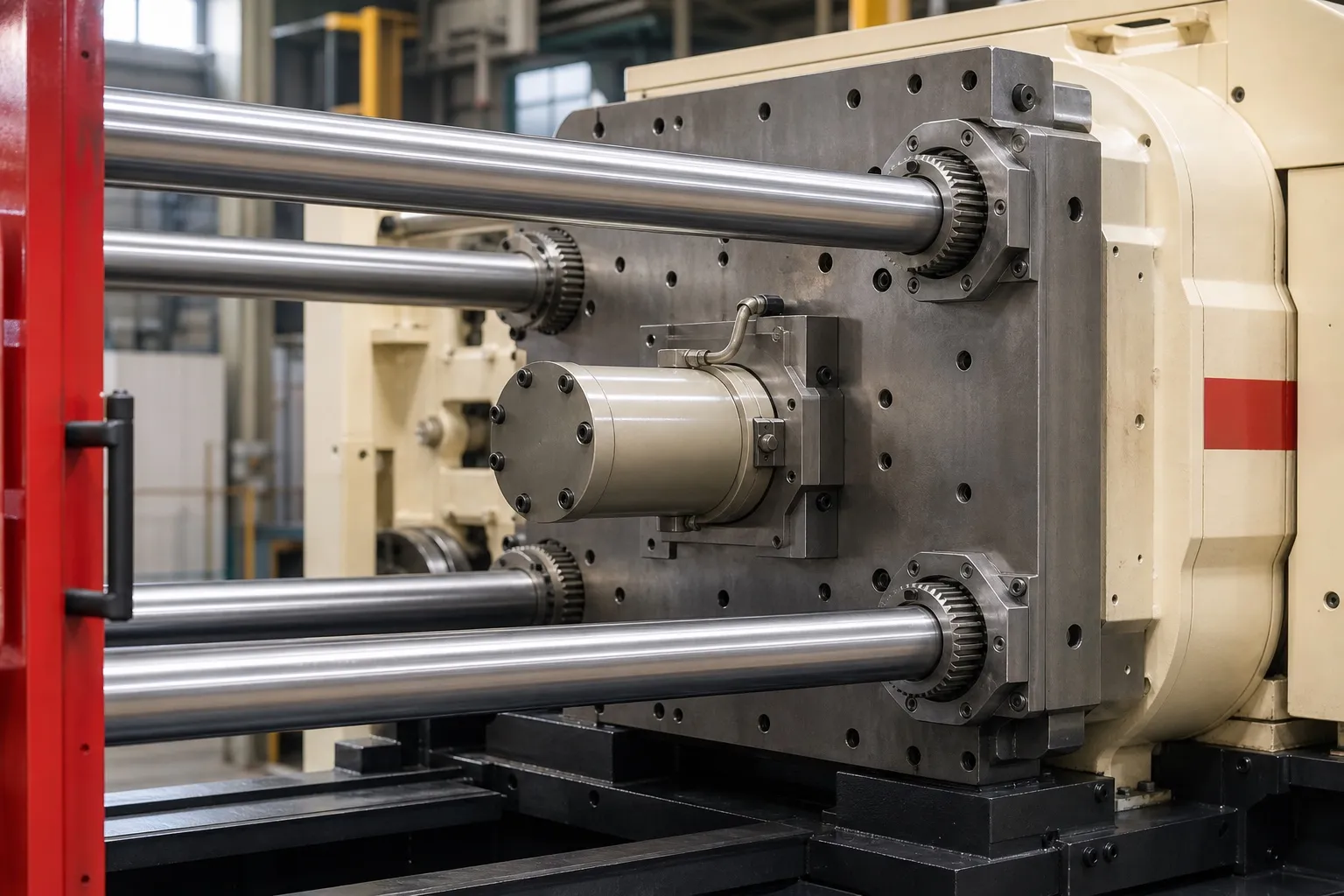

Two platen machines are used for large part injection moulding: crates, bins, pails, chairs, table tops, pallets, automotive panels and appliance bodies. Run your job through this checklist first.
Quick checklist: does your job point to a two platen machine?
| Check | Points to two platen when |
|---|---|
| Part size | The projected area needs a few hundred tonnes of clamp or more |
| Part depth | The opening needed (2.5 × part height) is more than a toggle stroke gives |
| Mould size | The mould is wide or heavy and needs wide tie-bar spacing |
| Tonnage control | You run several moulds and want tonnage set for each one |
| Floor space | Bay length is tight for a long machine |
If two or more apply, start your search with two platen machines. If only floor space applies, a compact toggle layout may still do the job.
Key Takeaways
- Large area, deep walls and heavy moulds are the three signs that a job belongs on a two platen machine.
- Clamp force for PP parts follows projected area at 2 to 3 US t/in², plus a margin.
- Rigid plastic packaging faces recycled-content targets that rise from 30% to 60% by 2028-29.
- Size the machine to the biggest mould you will run, then set tonnage per mould.
Which products use large part injection moulding on two platen machines?
Two platen machines suit crates and bins, paint pails and large buckets, chairs and table tops, pallets, automotive bumpers and panels, and appliance bodies such as cooler cabinets. What links them is large projected area, deep walls or heavy moulds, often all three together.
The table below shows the clamp each part needs, so you can see where a job sits before you look at machines.
Clamp figures for typical large PP parts (factor 2 to 3 US t/in², plus 10%)
| Part | What drives the machine choice | Clamp needed |
|---|---|---|
| Crate 450 × 300 mm, 40% open base (810 cm²) | Large area, deep walls | 250 to 376 t |
| Crate 500 × 350 mm, 40% open base (1,050 cm²) | Area and depth | 325 to 487 t |
| Pail with 350 mm rim (962 cm²) | Deep part, long opening | 297 to 447 t |
| Two pails with 230 mm rims (831 cm²) | Two cavities double the area | 257 to 386 t |
These figures use the 2 to 3 US t/in² range that SPE Plastics Engineering gives for PP, converted to 0.281 to 0.422 t/cm², plus 10% as a starting margin, not a rule. Thin walls or long flow paths push the factor up, so treat the lower figure as a floor that only easy-flow parts with short flow can use.
Automotive and appliance parts follow the same logic with tougher materials. Engineering resins such as PC sit higher in the tonnage factor range than PP, so the same area can need much more clamp. Chairs add another twist: a seat-and-back shell is deep in two directions, so opening and core pulls matter as much as tonnage.
Why do deep parts like pails and crates suit a two platen machine?
Deep parts need long opening: MoldMaking Technology sets opening stroke at 2.5 times part height or more. A 350 mm pail needs 875 mm. On a two platen machine, usable opening is daylight minus mould height, which can exceed a toggle stroke when moulds are tall.
The opening comparison is worked through in the two platen vs toggle article in this series. Mould width matters as much as depth: a crate mould with slides on all four sides can be far wider than the crate itself, and the parts must sit inside the tie bars. Ejection adds to depth as well, so allow for the ejector stroke and robot reach when you work out the opening.
Material choice follows the use. Reliance lists Repol C120MN, a PP impact copolymer with a good impact-stiffness balance, for paint pails and luggage, and C080MA, which has high impact strength, for furniture, luggage and paint pails.
How does recycled content change large part moulding in India?
Under the Plastic Waste Management (Amendment) Rules notified on 31 March 2026, rigid plastic packaging must contain at least 30% recycled material in 2025-26, rising to 60% by 2028-29. Pail makers and other rigid packaging moulders may need to run recycled blends on large machines.
Recycled feed can vary from lot to lot, so leave room in the process: a barrel that keeps the shot in its working range, injection pressure in reserve, and tonnage you can adjust for each mould. Watch melt temperature and time in the barrel, since recycled PP has already seen one heat history. Colour can drift too, so plan darker or masterbatch-matched colours where the recycled share is high.
The rules also allow 2025-26 shortfalls to be carried forward for up to three years, and give exemptions where FSSAI and similar rules restrict recycled content. Check which category your product falls under before you plan the material mix.
What should you avoid when moving a job onto a large machine?
Avoid running a small mould on a very large machine just because it is free. Set tonnage to the calculated figure, keep the mould within the tie-bar and minimum mould size limits, and check the shot sits within the barrel working range.
Over-clamping damages moulds and machines; the specifications article in this series covers the warning signs, and the hydro-mechanical clamping article covers a mould that split. A small shot in a big barrel also stays in the melt longer, which can degrade the resin.
My view: size the machine to your biggest real mould, then stop. Buying one size up for a mould that may never come ties up money and floor space today.
Run the same check in reverse when a new mould arrives: confirm it fits the tie bars, the mould height range and the daylight before the trial date, not on the day.
What should you send for a large part enquiry?
Send the part drawing with projected area and height, the material grade and any recycled share, the mould size and weight, the number of cavities and your target output. If the part is new, send the 3D model, since projected area and flow length come straight from it. See the two platen injection moulding machine range for the sizes that cover large parts.
Frequently Asked Questions About Two Platen Machine Applications
Can pallets be moulded on a two platen machine?
Yes. Pallets are a large part injection moulding job, with a very large projected area, heavy shots and big moulds. The clamp figure follows the same method as any part: projected area times a tonnage factor, plus a margin. Ribbed and open decks cut the area, so measure the real projected area from the drawing.
Are two platen machines used for automotive parts?
Large automotive parts such as bumpers, door panels and instrument panels need high tonnage, big platens and long opening, which matches the two platen layout. Materials range from talc-filled PP to PC/ABS. Check the tonnage factor for the actual grade, since engineering resins such as PC need more clamp per cm² than PP.
Does a two platen machine suit multi-cavity pail moulds?
It can, if the tonnage and tie-bar space suit the layout. Two cavities double the projected area, so two pails with 230 mm rims need about 257 to 386 t at a PP factor of 2 to 3 with a 10% margin. Check that the wider mould still fits between the tie bars.
What changes when the part is a cooler body or appliance cabinet?
These parts combine large area with deep sides and, for coolers, a water-holding tank that must not leak or crack. Expect high tonnage, long opening and a heavy mould. Pay attention to wall thickness, gating and cooling, since stress cracking and warpage can show up later in service.
Do large parts always need hot runners?
No. A hot runner cuts runner waste and means only cavity area counts toward clamp force, while a cold runner adds its full area. With recycled or mixed feed, larger gates and cold runners can be safer, because small contaminants can block hot-runner tips. Decide this with your mould maker early.
Related Articles
- What Is a Two Platen Injection Moulding Machine?
- How Does Hydro-Mechanical Clamping Work?
- Two Platen vs Toggle Injection Moulding Machines: Key Differences
- Important Specifications to Consider Before Buying a Two Platen Machine
Sources & References
- SPE Plastics Engineering, A. Urbina: Mastering Clamping Force Calculation (Mar 2024)
- MoldMaking Technology, B. Catoen: Machine Sizing and Specification for Optimal Mold Performance, Part 1 (Aug 2025)
- Polymerupdate, D. K. Jha: India eases plastic recycling regulations (8 Apr 2026)
- UL Prospector: Polypropylene (PP): REPOL grade listing
Technical Disclaimer
Disclaimer: The information provided in this document is for general informational and educational purposes only. It is based on technical references and industry information available at the time of preparation and may be subject to change. It does not constitute engineering, technical, commercial or professional advice, nor does it constitute a quotation, specification, warranty or contractual commitment by Pratishna Engineers.
Actual injection moulding machine and process requirements vary according to the component design, material, mould, production volume, machine configuration and operating conditions. The information, examples, calculations and recommendations provided should be independently evaluated and verified for the specific application before making any equipment, process or production decision. Information obtained from third-party sources remains subject to the accuracy and limitations of those sources.
Limitation of Liability: Pratishna Engineers makes no representation or warranty, express or implied, regarding the completeness, accuracy or suitability of the information for any particular application. To the extent permitted by applicable law, Pratishna Engineers shall not be liable for any loss, damage, cost or consequence arising from reliance on or use of the information contained in this document. Final machine selection, configuration and application suitability should be confirmed with Pratishna Engineers based on complete and accurate project requirements.

