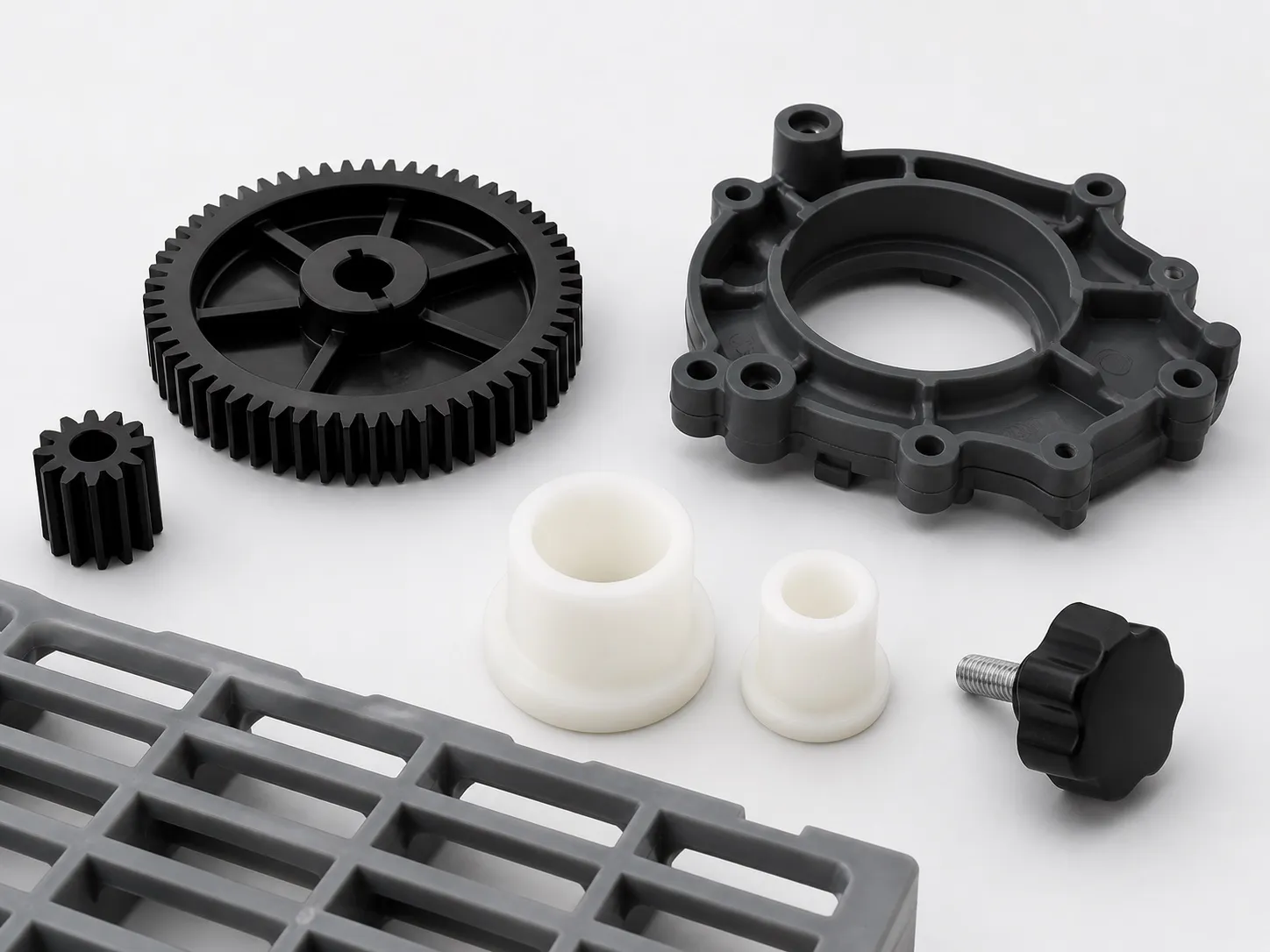
Vertical injection moulding machines make insert moulded products and overmoulded parts: plugs and sockets with brass pins, housings with threaded bushes, needle hubs, cable ends and grommets, tool handles and terminal blocks. Run your part through this checklist first.
Quick checklist: does your part point to a vertical machine?
| Check | Points to vertical when |
|---|---|
| Inserts | Metal or plastic parts go into the mould before each shot |
| Insert count | Several small inserts per shot need to sit by gravity |
| Cable or wire | A cable runs through the mould and is overmoulded |
| Part size | The part and mould fit a small to mid-size clamp |
| Changeovers | Short runs with frequent part changes and manual loading |
If the first two apply, a vertical machine is the default starting point.
Key Takeaways
- Vertical machines earn their place on parts that carry inserts, pins, cables or cannulas.
- Hoop stress from plastic shrinking onto metal is the main long-term risk; estimate it before approving a design.
- Medical hub parts sit inside the device maker's regulated quality system in India.
- On small multi-cavity parts, loading time and table layout limit output more than clamp force.
Which insert moulded products are made on vertical machines?
Insert moulded products made this way include electrical plugs, sockets and terminal blocks with brass pins, housings with threaded bushes, needle hubs over steel cannulas, overmoulded cable ends and strain reliefs, tool handles over steel shanks, and connectors with moulded-in contacts. Each needs inserts placed before the shot.
Application examples and what to watch
| Product | Insert | Watch point |
|---|---|---|
| Plug top or socket | Brass pins, terminals | Pin position, heat and fire tests in the product standard |
| Housing with threaded bush | Brass or steel threaded insert | Pull-out and torque-out, hoop stress |
| Needle hub | Stainless steel cannula | Leak-free joint, pull strength |
| Cable end or strain relief | Cable and conductors | Insulation damage from heat and pressure |
| Tool handle | Steel shank | Retention, shrinkage around the metal |
Across all of these, the plastic shrinks onto the metal as it cools. DuPont guidance summarised by PlasticsToday names delayed cracking from hoop stress as the most common complaint with moulded-in metal, and gives a quick estimate: mould shrinkage times flexural modulus. For acetal at 0.025 mm/mm, that comes to about 52.4 MPa, roughly 75% of its tensile strength.
Plugs and sockets bring their own tests on top of that. Pins have to stay in position through repeated insertion and through heat tests, so pin location and retention in the moulded body are the points to agree with your customer before the tool is built. Threaded housings are judged on pull-out and torque-out, and cable ends on how well they protect the conductors where the cable bends.
How do you check an insert part for hoop stress?
Estimate hoop stress as mould shrinkage times flexural modulus, then compare it with the material strength. If the stress is a large share of strength, preheat the insert, choose a toughened grade, round the insert edges and test parts through temperature cycling before you approve the tool.
Run it for nylon 66. Using a shrinkage of 0.016 mm/mm from the DuPont guidance, and BASF's dry tensile modulus of 2,440 MPa for an impact-modified PA66 as a stand-in for flexural modulus, the estimate is about 39 MPa, which is 61% of that grade's 63.5 MPa yield stress. That is lower than acetal, but not small.
Treat the result as a screening number, not a design value. Real stress depends on how hot the insert is when the melt meets it, wall thickness around the insert and weld line position. If the estimate is above about half of yield (a starting threshold, not a rule), a temperature-cycling test on moulded parts is worth more than another calculation.
Filled grades shrink less, 0.005 to 0.010 mm/mm, but are much stiffer, and heavily filled weld lines may keep only 60% of unfilled strength. The same guidance sizes the boss at 1.5 times the insert diameter for inserts up to 12.9 mm. PA66 is also hygroscopic, so dry it as the datasheet says before moulding round metal.
What do medical needle hubs need from the process?
A needle hub joins a stainless steel cannula to a plastic hub with a joint that must not leak. Insert moulding the cannula into the hub is time-consuming and expensive and must be very accurate to avoid leak paths, so some makers bond the cannula into a moulded hub instead.
Hub materials listed by MD+DI include ABS, acrylic, PC, PE, PP, polysulfone and PU. In India, a CDSCO notice of June 2017 confirmed disposable hypodermic syringes and needles, IV cannulae and scalp vein sets as notified devices, with the Medical Devices Rules, 2017 in force from 1 January 2018. Its annexed draft risk list placed the single lumen hypodermic needle and IV cannula in Class B.
A moulder supplying hubs works inside the device maker's quality system, so process records, material traceability and clean handling matter as much as cycle time.
Which jobs are better left to horizontal machines?
Plain parts with no inserts, large housings and high-volume caps or containers are better on horizontal machines, where parts drop clear and cycles are short. The vertical machine earns its place only when something must be placed in the mould before the shot.
A mixed plant can split jobs this way: the enclosure body on a horizontal machine, the insert-carrying sub-part on a vertical one. The full comparison is in the horizontal vs vertical article in this series.
The same goes for very large insert parts. If the part needs a big clamp and a long opening, a horizontal or two platen machine with a robot placing the insert can be the better route, even though loading on a vertical face is harder.
My view: if loading the inserts takes longer than the moulding cycle, fix loading first with a shuttle or rotary table, a feeder or a second operator, before you buy a faster machine.
What should you send for an insert part enquiry?
Send the part and insert drawings, the plastic grade, inserts per shot, cavities, target output and any product standard or customer specification the part must meet. See the vertical injection moulding machine range for clamp sizes and table options.
Frequently Asked Questions About Vertical Machine Applications
Can cables be overmoulded on a vertical machine?
Yes. Cable ends, strain reliefs and grommets are overmoulded with the cable laid in the lower half. Horizontal injection into the parting line suits cables running across the mould. Protect the conductors and insulation from heat and pressure, and check the strain relief against any cord pull test in the product standard.
What materials suit insert moulded products?
Choices include PA6 and PA66 for strength, PBT for electrical parts, PC and ABS for housings, PP and PE for low-cost parts, and TPEs for soft overmoulds. Pick a toughened grade where hoop stress is high, and dry hygroscopic grades such as nylon and PBT before moulding.
How are threaded inserts tested on moulded parts?
The two key figures are pull-out force and torque-out force. Longer inserts resist pull-out better and larger diameters carry more torque, while the knurl pattern balances the two. Test on moulded parts, including after temperature cycling, rather than relying on catalogue values for the insert alone.
Do medical moulding jobs need a cleanroom?
It depends on the device and the customer quality system. Hub and syringe parts may be moulded in controlled environments, and the device maker sets the requirement. Ask for their specification on particulates, handling and packaging before you plan the cell, since it changes machine choice, guarding and part handling.
Can one vertical machine run several insert products?
Yes, if the table, clamp and shot range suit all of them. Keep spare lower halves and fixtures for each product, write loading instructions with photos, and plan changeovers around the table. A second barrel can help when shot weights differ widely between products on the same machine.
Related Articles
- What Is a Vertical Injection Moulding Machine?
- How Does Insert Moulding Work on a Vertical Machine?
- Horizontal vs Vertical Injection Moulding Machines: Key Differences
- Important Specifications to Consider Before Buying a Vertical Machine
Sources & References
- PlasticsToday (IMM), summarising A. Miller, DuPont: Design and material advice from the pros, Part 3: Insert molding essentials (Sept 2005)
- BASF via Material Data Center (M-Base): Ultramid A3L HP datasheet
- MD+DI, C. M. Salerni and J. A. Serenson: Light-Cure Adhesives for Needle Assembly (Sept/Oct 2003)
- CDSCO: Notice dated 29 June 2017 with draft risk-class list
Technical Disclaimer
Disclaimer: The information provided in this document is for general informational and educational purposes only. It is based on technical references and industry information available at the time of preparation and may be subject to change. It does not constitute engineering, technical, commercial or professional advice, nor does it constitute a quotation, specification, warranty or contractual commitment by Pratishna Engineers.
Actual injection moulding machine and process requirements vary according to the component design, material, mould, production volume, machine configuration and operating conditions. The information, examples, calculations and recommendations provided should be independently evaluated and verified for the specific application before making any equipment, process or production decision. Information obtained from third-party sources remains subject to the accuracy and limitations of those sources.
Limitation of Liability: Pratishna Engineers makes no representation or warranty, express or implied, regarding the completeness, accuracy or suitability of the information for any particular application. To the extent permitted by applicable law, Pratishna Engineers shall not be liable for any loss, damage, cost or consequence arising from reliance on or use of the information contained in this document. Final machine selection, configuration and application suitability should be confirmed with Pratishna Engineers based on complete and accurate project requirements.