






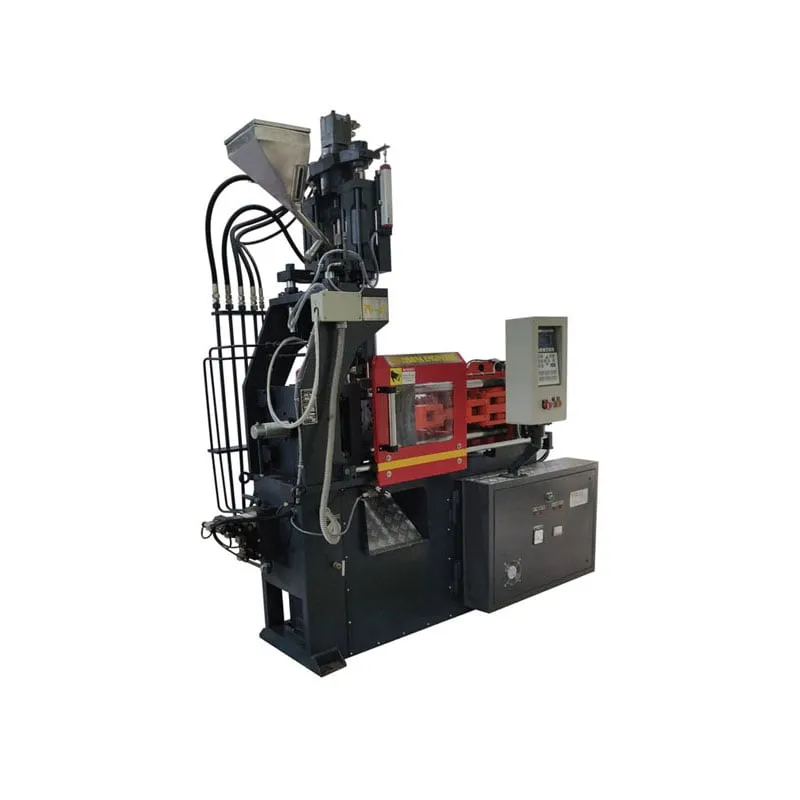

Take a PP glovebox lid with 600 cm² of projected area. At a tonnage factor of 2 to 3 US t/in² (0.281 to 0.422 t/cm²), it needs about 169 to 253 t of clamp, or 185 to 279 t with a 10% reserve, which is a starting margin, not a rule. That one line of arithmetic is where choosing an injection moulding machine for automotive parts begins: clamp from projected area, shot from part volume, then repeatability from the process. This guide works through PP, ABS and nylon parts and the quality systems automotive customers expect from moulders.
Key Takeaways
- Clamp comes from projected area times a material tonnage factor, plus cold runner area, not from part weight.
- Size the barrel so the shot lands between 25% and 65% of capacity, working in volume rather than grams.
- PP parts keep shrinking for up to two days, so measure critical dimensions after they settle.
- IATF 16949:2016 is the automotive quality system standard, used as a supplement to ISO 9001:2015.
How do you size clamp force for PP, ABS and nylon parts?
Multiply the projected area of one part, minus through holes, by the cavity count, add the cold runner area, then multiply by the material's tonnage factor. Factors run from about 2 to 8 US t/in², low for polyolefins and higher for stiff, viscous resins such as polycarbonate.
The method above follows Williams of RJG in Plastics Technology, who suggests 3 US t/in² as a starting point when data is missing. Flow length, wall thickness and gate layout move the factor up or down. Datasheets give tighter ranges for specific grades. Extra clamp is not a free margin: Williams describes a mould that needed about 100 t clamped at a 400 t machine's maximum, and the cavity block split in two places. Burns, crushed vents and broken inserts are other signs of too much clamp.
Tonnage factors from published sources
| Material | US t/in² (t/cm²) | Source |
|---|---|---|
| PP | 2 to 3 (0.281 to 0.422) | SPE Plastics Engineering |
| ABS (Lustran ABS 248) | 2 to 4 (0.281 to 0.562) | INEOS ABS datasheet via UL IDES |
| PC (Makrolon 2558) | 3 to 5 (0.422 to 0.703) | Covestro datasheet via IDES |
| PA66 | Check the grade datasheet | Injection pressure 35 to 125 MPa on BASF Ultramid A3L HP |
For large PP mouldings, an Indian grade worth knowing is Reliance Repol B300MN, a high-crystalline impact copolymer with an MFR of 30 g/10 min. Its datasheet lists automotive and appliance parts among its uses and notes high flow and fast crystallisation for large articles with lower cycle times.
How much shot capacity does an injection moulding machine for automotive parts need?
Enough that the shot uses 25% to 65% of barrel capacity. Below that, melt uniformity suffers; above it, unmelted resin and long recovery appear. Work in volume, because machine shot ratings are usually given in grams of polystyrene, and PP melt is far lighter than PS melt.
Bozzelli gives melt densities of 0.945 g/cm³ for PS and about 0.74 g/cm³ for PP, and suggests adding 10% to the shot for check-valve leakage and melt uniformity before sizing the barrel. The worked example below applies that method to a two-cavity door pocket.
Nylon needs dry resin as much as shot volume. BASF's datasheet for Ultramid A3L HP, an impact-modified PA66 used for fasteners and clamps, states processing moisture at or below 0.2%, so a dryer belongs in the machine budget for PA parts.
What keeps automotive part dimensions repeatable?
A stable process and a design that shrinks evenly. Constant wall thickness, hold pressure applied while the gate is still open, steady mould temperature and consistent cooling time keep parts within tolerance. Machine repeatability matters, but it cannot correct a part that is designed to warp.
LyondellBasell lists mould shrinkage of 1.0% to 2.5% for PP, 0.7% to 1.8% for nylon 66 and 0.4% to 0.9% for ABS. Semi-crystalline PP and PA shrink more and are more sensitive to process changes than amorphous ABS. Thick sections cool slower and shrink more, so uneven walls lock in stress that shows up later as warp.
EnviroTech, a US custom moulder, notes that PP shrinkage occurs mostly within the first 48 hours, and that some pigments act as nucleators, so different colours can give different dimensions. Our flat advice: measure PP parts after they have settled, and qualify each colour separately.
Which quality systems do automotive customers expect?
IATF 16949:2016, the automotive quality management standard, replaced ISO/TS 16949 when it was published in October 2016. ISO describes it as a supplement to ISO 9001:2015, not a stand-alone standard, so a certified moulder meets both. Your customer's supplier manual says which approvals it requires.
For machine selection, that means records. Process settings, cycle data and part checks should be traceable to each lot, and the machine should hold settings without drift between shifts.
Ask the machine supplier what data the controller can record and export, such as cushion, injection time and peak pressure for each shot. Those values are what a quality engineer trends when a dimension drifts, so a machine that logs them makes audits and root-cause work faster.
What should you prepare before choosing a machine?
Prepare the part drawing with projected area, wall thickness and critical dimensions, the resin grade and its datasheet, the mould layout with cavities and runner type, and the yearly volume. With those, clamp, shot and drying can be calculated before any machine is discussed. For a new part, ask the toolmaker for mould weight and shut height as well, because they limit the choice as much as clamp does. See automotive moulding applications for the parts and materials covered.
Frequently Asked Questions About Machines for Automotive Parts
What clamp tonnage do automotive plastic parts need?
It depends on projected area and material, not on the vehicle segment. Multiply the projected area of all cavities plus the cold runner by a tonnage factor, typically 2 to 3 US t/in² for PP and higher for stiffer resins, then add a reserve. A small clip and a door panel need very different machines.
Can one machine mould both PP and nylon parts?
Often yes, if the screw, barrel temperatures and clamp suit both. Nylon is hygroscopic, so it needs a dryer and controlled moisture before moulding, while general PP usually does not. Check that the shot for each part falls within the barrel window, and plan purging when you change materials.
Why do PP automotive parts change size after moulding?
PP is semi-crystalline and keeps crystallising after it leaves the mould, with most of the shrinkage in the first 48 hours. Wall thickness, mould temperature, packing pressure and even pigment choice affect the result. Measure critical dimensions after the parts settle and set tolerances on those settled values.
Does a moulder need IATF 16949 certification for automotive work?
IATF 16949:2016 is the automotive quality management standard, used together with ISO 9001:2015. Whether your customer requires it depends on its supplier requirements and the parts involved. Check the customer's supplier quality manual before you quote, because certification takes time to put in place.
How do I check a machine is repeatable enough for automotive parts?
Run a trial with your own mould and resin long enough for the process to settle. Weigh every shot or a regular sample, record cushion and cycle time, and measure critical dimensions after the parts settle. Small spread in shot weight and cushion across the run is a good first sign.
Related Articles
- Injection Moulding Machine Manufacturers in Mumbai
- Injection Moulding Machinery Suppliers Mumbai Maharashtra
- Plastic Injection Moulding Machines for Automotive Battery Parts
- Injection Moulding Machine for Automotive and Aerospace
Sources & References
- Plastics Technology, J. Williams (RJG): Clamp Tonnage: More Is Better...Right?
- Plastics Technology, J. Bozzelli: A Simpler Way to Calculate Shot Size vs. Barrel Capacity
- LyondellBasell: Technical Tip: Mold Shrinkage
- ISO: A new evolution for quality management in the automotive industry (IATF 16949:2016)
Technical Disclaimer
Disclaimer: The information provided in this document is for general informational and educational purposes only. It is based on technical references and industry information available at the time of preparation and may be subject to change. It does not constitute engineering, technical, commercial or professional advice, nor does it constitute a quotation, specification, warranty or contractual commitment by Pratishna Engineers.
Actual injection moulding machine and process requirements vary according to the component design, material, mould, production volume, machine configuration and operating conditions. The information, examples, calculations and recommendations provided should be independently evaluated and verified for the specific application before making any equipment, process or production decision. Information obtained from third-party sources remains subject to the accuracy and limitations of those sources.
Limitation of Liability: Pratishna Engineers makes no representation or warranty, express or implied, regarding the completeness, accuracy or suitability of the information for any particular application. To the extent permitted by applicable law, Pratishna Engineers shall not be liable for any loss, damage, cost or consequence arising from reliance on or use of the information contained in this document. Final machine selection, configuration and application suitability should be confirmed with Pratishna Engineers based on complete and accurate project requirements.

