







Four checks before you order from injection moulding machinery suppliers Mumbai buyers shortlist
| Check | What you should see | Warning sign |
|---|---|---|
| Factory visit | Machining, assembly and test bays in use | A showroom or store only |
| Trial on your mould | Your mould, your resin, a timed run | A demonstration mould only |
| Service network | Named engineers and a written response plan | A promise with no name attached |
| Spares stock | Heaters, thermocouples, seals on the shelf | Every spare ordered after a breakdown |
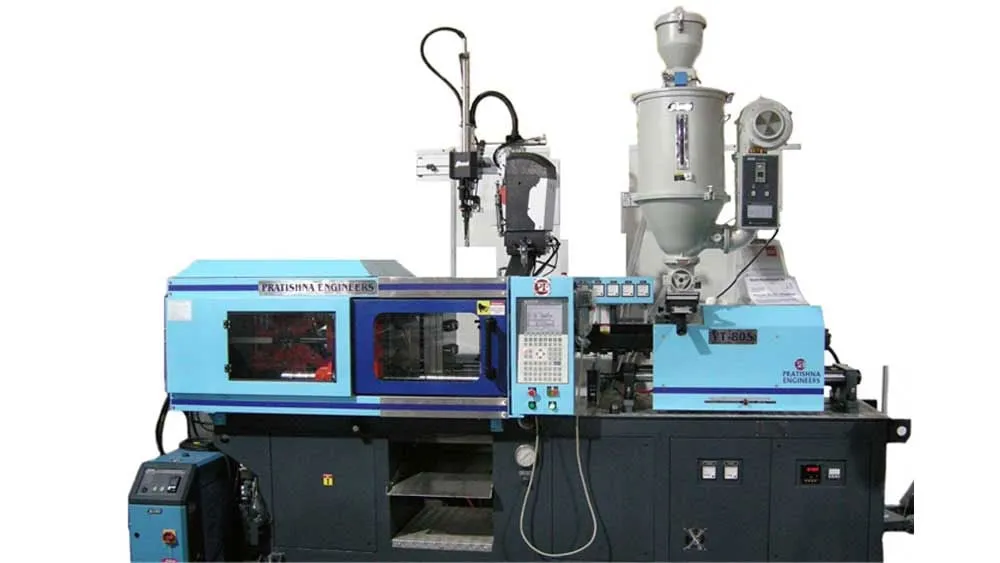
The table is the short answer. Visit the supplier's works, run your own mould and resin on the offered machine, find out who answers a breakdown call, and look at the spares shelf yourself. Pratishna Engineers designs, builds and services machines in Mumbai, and this guide sets out the checks we would expect any buyer to run on us or anyone else.
Key Takeaways
- A factory visit shows you what a supplier actually makes, tests and keeps in stock, which a brochure cannot.
- Trial with your own mould and your usual resin grade, not a demonstration mould chosen by the supplier.
- Get the service plan in writing: who responds, from where, and what happens if the first visit does not fix the fault.
- Ask which wear and electrical spares are held locally, because a missing heater band can stop a press for days.
What should you look for on a factory visit?
Look for work in progress, not finished machines on display. Frames being machined, hydraulic units being piped, machines running on a test bay and inspection records at each stage tell you the supplier controls quality. A clean showroom tells you only that the supplier can sell.
Ask to see the assembly area with a machine part-built, so you can judge how hydraulic lines, wiring and guards are routed. Ask how a finished machine is tested before dispatch: dry cycles, a run under load, pressure and temperature checks, and a signed test record. A supplier with nothing to show at this step is relying on its own supplier's tests. If the supplier says it makes its own screws, barrels or platens, ask to see one on a machine tool, not only in finished stock.
Check the quality paperwork too. Written procedures, calibration records for gauges and a named person who signs off each machine are signs of a system rather than a habit. Note how open the staff are when you ask about a failure they have fixed in the past; a frank answer is worth more than a perfect demonstration.
How do you run a fair trial on your own mould?
Bring your production mould, your usual resin grade and a target cycle time, then run long enough for the process to settle. Weigh parts across the run, measure critical dimensions after they have cooled, and record the settings. A short demonstration on a supplier's mould proves very little.
Before the trial, confirm the mould fits. A guide by Catoen in MoldMaking Technology says the parts' projected area must sit fully inside the tie bars, the mould must suit the minimum and maximum shut height, and opening stroke should be at least 2.5 times the part height. Plastics Technology adds a rule of thumb that the mould should cover at least 70% of the distance between tie bars, or the platens can bow and flash the centre of the mould.
Run the resin you buy, not a substitute. If you mould a nucleated PP homopolymer such as Reliance Repol H110MAS, with an MFR of 11 g/10 min and a melt range of 200 to 250 °C on its datasheet, set the barrel within that range and judge fill and cycle on that grade. A different MFR on trial day hides the very problems you want to find.
Check the shot against the barrel. Bozzelli warns that shots below 20% of barrel capacity sit in the heat too long and degrade, while shots above 65% bring melt-quality problems; a shot outside that window on the trial machine points to the wrong screw for your part, even if the parts look good on the day. Keep the trial record. Settings, part weights and dimensions from the supplier's floor become the reference at commissioning in your plant, and any gap between the two is easier to settle with numbers in hand.
What service cover should injection moulding machinery suppliers Mumbai buyers shortlist offer?
Ask for named service engineers, the location they work from, how a call is logged and the response plan for a stopped machine. Ask what happens if the first visit does not fix the fault. Get the answers in writing as part of the order, not as a verbal promise.
Distance matters less than ownership of the problem. A supplier that designed the hydraulic circuit and wrote the control software can trace a fault to its root. A supplier that resells a machine has to pass the question up a chain, and your press waits while it travels.
Ask for two references from plants that have called for service in the last year, and ask those plants how long the machine was down. Ask also whether the supplier keeps machine-wise records, so an engineer arriving at your plant knows its build, software version and history before opening a panel.
A practical test is to call the service number before you order and describe a common fault, such as a heater zone that will not reach temperature. Note how the call is handled and how quickly a technical person comes on the line. The answer you get as a prospect is usually the best you will get as a customer.
Which spares should a supplier hold in stock?
Hold the parts that fail or wear in normal running: heater bands, thermocouples, hydraulic seals, the non-return valve on the screw tip, solenoid coils, contactors and fuses. If any of these must be ordered after a breakdown, your downtime is set by the supplier's lead time, not by repair work.
Ask the supplier for a recommended spares list for your machine, with part numbers, and ask which items are stocked locally. A starter kit delivered with the machine is cheaper to arrange at the order stage than in an emergency. Keep a small stock of your own as well, sized by the number of identical machines you run.
Consider a second barrel if you run very different shot weights. Bozzelli notes that a second barrel ordered with a new machine can be low in cost, and that a skilled operator can swap a barrel in under 30 minutes, even hot. That turns a screw mismatch from a rebuild into a shift-change job.
What you can check at Pratishna Engineers in Mumbai
Pratishna Engineers has manufacturing facilities in Mumbai of about 25,000 sq ft, with CNC turning centres, vertical and horizontal machining centres, jig boring machines, precision conventional machine tools, and assembly and testing facilities. Ask to see each of them when you visit, and judge us against the checklist above.
An independent quality assurance department works to written SOPs, and accredited external laboratories are used when required. Design is done in-house on SolidWorks, Creo and AutoCAD, and service is handled by our own team, so the people who answer a breakdown call have the drawings for the machine in front of them.
Over 35 years we have supplied more than 9,000 machines to more than 1,000 customers in India and international markets. The range covers horizontal, vertical, PET, two-platen, hybrid and special purpose machines, so a trial can be planned on a machine type that suits your mould.
What should you send before a visit or trial?
Send the mould drawing with its width, height, shut height and locating ring size, the part drawing with height and projected area, the resin grade and your target cycle and output. With those, a supplier can confirm the right trial machine before you load the mould on a truck. If the mould is too heavy or delicate to move, send photographs of its plates, ejector pattern and water connections instead. Start with the injection moulding machine range to see which machine type suits your part.
Frequently Asked Questions About Injection Moulding Machinery Suppliers in Mumbai
What should I bring to a machine trial?
Bring the production mould, enough of your usual resin grade for a settled run, a part drawing with critical dimensions and your target cycle time. Bring a scale and gauges if you want your own measurements. Agree in advance who supplies dryer time, mould temperature control and operators, so the trial starts on time.
How many suppliers should I shortlist?
Shortlist enough to compare, but few enough to visit each one properly. Three is a practical number, because you can run the same checks, send the same specification and compare written offers line by line. More than that often means shallow visits and rushed trials.
Is a trial on the supplier's own mould good enough?
It shows the machine runs, but not that it suits your part. A supplier's demonstration mould is chosen to look good. Your mould, resin and cycle target reveal fit, shot share, clamp margin and cooling, which are the things that decide whether the machine works for you.
Which spares should arrive with a new machine?
Ask for a starter kit covering the parts that wear or fail in normal running: heater bands, thermocouples, hydraulic seals, the screw tip non-return valve, solenoid coils, contactors and fuses. Ask for a full recommended spares list with part numbers, and which items the supplier stocks locally for quick dispatch.
How can I check a supplier's service record before buying?
Ask for references from plants that called for service in the past year, then ask those plants how quickly an engineer came and whether the first visit fixed the fault. Ask the supplier how calls are logged and whether machine-wise service records exist, then compare the answers you hear.
Does Pratishna make its machines in Mumbai?
Yes. Pratishna Engineers designs, manufactures, assembles, tests and services its machines in-house, with manufacturing facilities in Mumbai of about 25,000 sq ft. The works include CNC turning, vertical and horizontal machining centres, jig boring machines and assembly and testing facilities. Our address is in Andheri (E), Mumbai.
Related Articles
- Plastic Injection Moulding Machine Price in Mumbai
- Injection Moulding Machine Manufacturers in Mumbai
- Injection Moulding Machine Exporters from Mumbai
- Injection Moulding Machine Dealers in Mumbai
Sources & References
- MoldMaking Technology, B. Catoen: Machine Sizing and Specification for Optimal Mold Performance, Part 1
- Plastics Technology, P. Witaszek et al.: How to Mount an Injection Mold
- Plastics Technology, J. Bozzelli: A Simpler Way to Calculate Shot Size vs. Barrel Capacity
- Reliance Industries: Repol H110MAS Technical Data Sheet
Technical Disclaimer
Disclaimer: The information provided in this document is for general informational and educational purposes only. It is based on technical references and industry information available at the time of preparation and may be subject to change. It does not constitute engineering, technical, commercial or professional advice, nor does it constitute a quotation, specification, warranty or contractual commitment by Pratishna Engineers.
Actual injection moulding machine and process requirements vary according to the component design, material, mould, production volume, machine configuration and operating conditions. The information, examples, calculations and recommendations provided should be independently evaluated and verified for the specific application before making any equipment, process or production decision. Information obtained from third-party sources remains subject to the accuracy and limitations of those sources.
Limitation of Liability: Pratishna Engineers makes no representation or warranty, express or implied, regarding the completeness, accuracy or suitability of the information for any particular application. To the extent permitted by applicable law, Pratishna Engineers shall not be liable for any loss, damage, cost or consequence arising from reliance on or use of the information contained in this document. Final machine selection, configuration and application suitability should be confirmed with Pratishna Engineers based on complete and accurate project requirements.

