






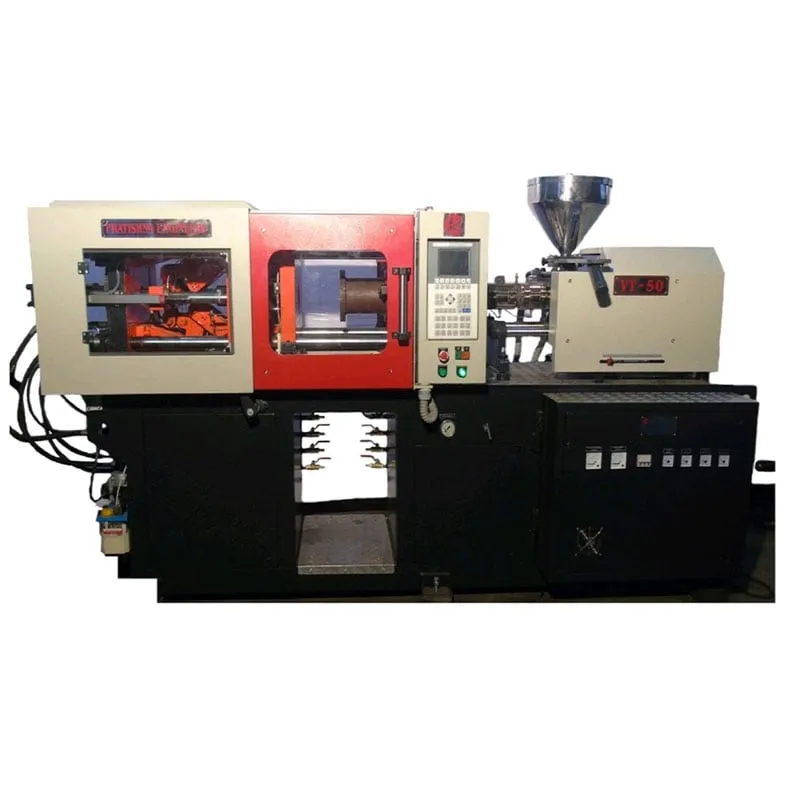

Moulding machine for battery containers: what each part asks of the machine
| Battery part | Usual material | What it asks of the machine |
|---|---|---|
| Container (monobloc box) | PP copolymer | Large shot, deep opening stroke, even filling of thin partitions |
| Lid or cover | PP copolymer | Wide flat area, flatness for heat sealing to the container |
| Vent plugs and caps | PP | Small shots, many cavities, short cycles |
| Handles and small fittings | PP | Small shots, often run on a separate machine |
The container drives the choice. A starter battery box is deep, has thin internal partitions and must hold acid without leaking, so the moulding machine for battery containers is sized around a large shot and a long opening stroke more than around clamp force. Lids and small parts usually run on smaller machines.
Key Takeaways
- Battery cases are moulded in PP because it combines impact strength, heat and dimensional stability and good weldability for sealing the lid.
- Size the barrel first and the clamp second. A deep container needs a shot that many machines of the same tonnage cannot deliver.
- Opening stroke must clear the full container depth plus the core. Check daylight before you check tonnage.
- Leaks start at weld lines and thin partitions. Gate layout, venting and steady melt temperature matter more than extra pressure.
Why are battery containers moulded in polypropylene?
PP gives the mix a battery case needs: impact resistance for drops, heat and dimensional stability under the bonnet, resistance to the acid inside and weldability, so the lid can be heat sealed to the container. Resin makers supply grades with extra heat stabilisation and better resistance to stress whitening.
One resin maker lists starter, traction and stationary battery cases among its PP applications, including AGM, forklift and emergency batteries. The properties it names are the ones your mould and machine must protect: dimensional and heat stability, high impact resistance and good weldability.
Indian buyers also have local grades to compare. For example, Reliance lists Repol B300MN, a high-crystalline PP impact copolymer with an MFR of 30 g/10 min, as suitable for large articles with lower cycle times and names automotive parts among its uses. Confirm any grade against your battery customer's specification before trials.
Check the container standard too. In India, IS 1146 sets requirements and test methods for rubber and plastics containers for lead-acid storage batteries, covering single-cell and monobloc designs. BIS lists a third revision, IS 1146:2026, so ask your customer which edition they test to.
How do you size a moulding machine for battery containers?
Work out three numbers before you look at any machine: clamp force from the projected area, barrel size from the shot volume, and opening stroke from the container height. For deep battery boxes, the shot and stroke usually decide the machine. Clamp force follows from the footprint.
Clamp. Projected area is the container footprint seen from the clamp direction, because the base is solid. Multiply it by a tonnage factor. For PP, published factors are about 2 to 3 US tons per square inch, which is 0.281 to 0.422 t/cm². Add a 10% reserve, a starting margin, not a rule.
Shot. Machine shot ratings are usually given in grams of polystyrene. PP melt is much lighter than PS melt (about 0.74 against 0.945 g/cm³), so work in volume. Add about 10% for check-valve leakage, then pick a barrel where the shot uses no more than about 65% of its stroke.
Do not overshoot the barrel either. Shots below about 20% of barrel capacity sit in the barrel too long and can degrade. If the same machine must also run lids, check that the lid shot still lands inside the useful window of the container barrel.
Stroke. A common guide is an opening stroke of at least 2.5 times the part height, so the container can be ejected and taken out cleanly. A battery box that is tall for its footprint can need more daylight than the tonnage alone suggests.
Where do weld lines and leaks come from in battery cases?
Weld lines form wherever two melt fronts meet, and in a monobloc container that happens around every partition and opening. If the fronts meet cold, the joint is weak and can crack or seep. Gate position, venting and melt temperature decide how well those fronts fuse.
Venting is the first thing to check when a container fails a leak test. Trapped gas at the end of fill stops the fronts from fusing and can leave voids. Vent depth has no fixed number; it is tuned on the mould, step by step, until just before flash appears.
Wall design plays a part as well. Thick sections cool slower and shrink more than thin ones, so a container with uneven walls warps and pulls stress into the joints. Where a wall must change thickness, it should thin gradually in the direction of flow.
Shrinkage is the second issue. PP shrinks roughly 1.0% to 2.5% in the mould, and much of that happens within the first 48 hours after moulding. A lid sealed to a container that is still shrinking can distort the seal line, so agree a rest time before welding.
Our flat view: if partitions short-fill or leak, fix the gating and venting first. Raising injection pressure on a large PP box mostly adds flash and stress, not a better weld line.
What should you send before choosing a machine for battery parts?
Send the container and lid drawings, the PP grade, the container weight, the mould drawing with height and cavities, and your daily output target. Mention the leak and acid tests your customer runs. Then look at how the automotive solutions page matches machines to these parts.
Frequently Asked Questions About Battery Container Moulding
Can the same machine mould the battery container and the lid?
It can, if the machine meets the container's shot and stroke needs, because the lid needs less of both. In practice many plants run lids on a separate machine so both moulds run at the same time. Compare the hours each mould needs per day before deciding to share one machine.
Do battery container moulds need a hot runner?
Not always. A hot runner removes runner scrap and can help balance filling across a large part, but it adds heaters, controls and cost. A cold sprue into a single-cavity container is simpler to run. Decide with your mould maker after a filling analysis shows where the melt fronts meet.
Why do containers crack at the partitions during leak testing?
The usual cause is a weak weld line where melt fronts meet cold around a partition. Poor venting, low melt temperature or a gate far from the partition can all cause it. Section a failed container at the crack and look for a visible flow line before changing machine settings.
Is PP homopolymer suitable for battery boxes?
Battery cases usually call for impact resistance, which is why impact copolymer grades are common. Homopolymer is stiffer but more brittle, especially at low temperature. Use the grade your battery customer specifies, and run drop and acid tests on moulded containers before you approve any material change.
How long should a container rest before the lid is sealed?
PP continues to shrink after moulding, with much of it in the first 48 hours. Agree a rest time with your customer and confirm it by measuring the seal line at intervals. Sealing too early can leave a lid that fits on the day but distorts as the container keeps shrinking.
Related Articles
- Understanding the Price of Fully Automatic Plastic Injection Moulding Machines in India
- Injection Moulding Machine Suppliers in Maharashtra
- Injection Moulding Machine for Automotive Parts
- Moulding Machines for Automotive and Aerospace
Sources & References
- LyondellBasell: Battery cases (application page)
- Bureau of Indian Standards: IS 1146:2026 Rubber and Plastics Containers for Lead-Acid Storage Batteries: Specification (Third Revision)
- Plastics Technology, J. Bozzelli: A Simpler Way to Calculate Shot Size vs. Barrel Capacity
- MoldMaking Technology, B. Catoen: Machine Sizing and Specification for Optimal Mold Performance, Part 1 (Aug 2025)
Technical Disclaimer
Disclaimer: The information provided in this document is for general informational and educational purposes only. It is based on technical references and industry information available at the time of preparation and may be subject to change. It does not constitute engineering, technical, commercial or professional advice, nor does it constitute a quotation, specification, warranty or contractual commitment by Pratishna Engineers.
Actual injection moulding machine and process requirements vary according to the component design, material, mould, production volume, machine configuration and operating conditions. The information, examples, calculations and recommendations provided should be independently evaluated and verified for the specific application before making any equipment, process or production decision. Information obtained from third-party sources remains subject to the accuracy and limitations of those sources.
Limitation of Liability: Pratishna Engineers makes no representation or warranty, express or implied, regarding the completeness, accuracy or suitability of the information for any particular application. To the extent permitted by applicable law, Pratishna Engineers shall not be liable for any loss, damage, cost or consequence arising from reliance on or use of the information contained in this document. Final machine selection, configuration and application suitability should be confirmed with Pratishna Engineers based on complete and accurate project requirements.

