






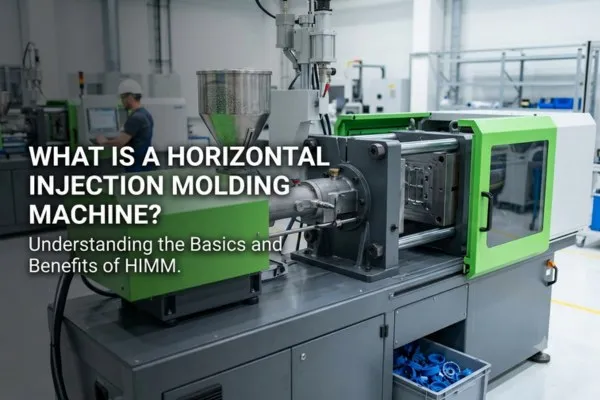

Quick answer: A horizontal injection moulding machine has its clamping unit and injection unit mounted in line on one horizontal bed. The mould is fixed to vertical platens and opens sideways, parallel to the floor. Moulded parts either drop out under gravity or are picked out by a robot. It is the standard layout for general plastic moulding, used for everything from caps and containers to appliance housings and automotive parts.
Key Takeaways
- The clamp and the injection unit share one horizontal axis. The mould opens side to side, and parts usually fall through a chute or are removed by a robot.
- Horizontal is the most common machine layout. A vertical machine is chosen mainly when the part needs inserts, overmoulding or loose metal parts placed in the mould.
- Clamp tonnage alone does not tell you whether a mould fits. Check tie-bar spacing, minimum and maximum mould height, opening stroke and daylight against the mould drawing.
- Toggle clamps suit fast, high-volume cycles. Two-platen hydraulic clamps give a shorter machine and suit large, heavy moulds.
- Size the injection unit separately from the clamp. Shot weight, injection pressure and screw diameter decide whether the part fills properly.
How Does a Horizontal Injection Moulding Machine Work?
The machine melts plastic granules in a heated barrel with a rotating screw. The clamping unit closes the mould, and the screw pushes the melt into the cavity. The machine holds pressure while the part packs, lets it cool in the mould, then opens horizontally and ejects it. The cycle then repeats automatically.
A typical cycle has six stages:
- Clamp close: the moving platen closes the mould and builds clamping force.
- Injection: the screw moves forward like a plunger and fills the cavity.
- Holding: pressure is held to pack extra material in as the part shrinks.
- Plasticising: during cooling, the screw rotates and melts the next shot.
- Cooling: the part cools until it is stiff enough to eject.
- Open and eject: the mould opens and ejector pins push the part out.
On most parts, cooling takes the largest share of the cycle. Cooling time rises roughly with the square of wall thickness. A part with walls twice as thick can therefore need close to four times the cooling time. For this reason, wall thickness often affects output more than injection speed does.
Because the mould opens sideways, the part is free to fall once it is ejected. Robots are often used for side-entry or top-entry removal, but it is more common for parts to drop out of the mould through a chute into a container. This is one reason horizontal machines are easy to run unattended on high-volume jobs.
What Are the Main Parts of a Horizontal Injection Moulding Machine?
A horizontal machine has five working systems: the injection unit, the clamping unit, the ejector, the drive (a hydraulic power pack, servo motors or both), and the controller. Safety guards around the mould area and clamp complete the machine. Each system has its own specifications, and buyers should check each one separately.
| System | What it does | What to check |
|---|---|---|
| Injection unit | Hopper, barrel, screw, heater bands and nozzle melt and inject the plastic | Screw diameter, shot weight, injection pressure, injection rate and L/D ratio |
| Clamping unit | Fixed platen, moving platen and tie bars hold the mould shut | Clamp force, tie-bar spacing, platen size, mould height range and stroke |
| Ejector | Pushes the part off the core after opening | Ejector stroke and force |
| Drive system | Powers the clamp, injection and screw rotation | Pump or servo type, connected load and oil tank capacity |
| Controller | Sets temperatures, speeds, pressures and positions | The number of mould programs, data logging and robot interface |
In a typical three-platen machine, the moving platen and the rear platen sit on either side of the stationary platen, which is fixed to the frame, and tie bars passing through the stationary platen couple the moving and rear platens.
Which Clamping System Should a Horizontal Machine Have: Toggle or Two-Platen?
Choose a toggle clamp when cycle speed and repeatability matter most, as on small and medium high-volume parts. Choose a two-platen hydraulic clamp when moulds are large and heavy, when a long opening stroke is needed, or when floor length is limited. Both are horizontal machines. They differ in how the clamp force is produced.
The toggle clamp has been used for decades, and the two-platen machine, developed over the last 20 years, has in practice replaced the older hydraulic ram clamp. The toggle and the two-platen are now the most common clamp designs.
| Feature | Toggle (three-platen) | Two-platen hydraulic |
|---|---|---|
| How force is made | A cylinder or servo drives a linkage that locks the platen | Hydraulic cylinders act directly on the moving platen |
| Speed | Fast opening and closing | Slightly slower mould movement |
| Machine length | Longer because of the toggle and rear platen | Shorter overall |
| Typical use | High-volume small and medium parts | Large parts, heavy moulds and long strokes |
One maker puts two-platen machines at often 15 to 20% shorter than toggle machines. In one simulation, a two-platen clamp took 0.6 seconds longer to close than a toggle clamp of the same specification. For medium and large parts with long cycles, that difference matters little.
How Is a Horizontal Machine Different from a Vertical Machine?
A horizontal machine opens its mould side to side and is the default choice for standard plastic parts. A vertical machine opens its mould up and down, so inserts rest on the lower mould half without falling out. Vertical machines therefore suit insert moulding and overmoulding, while horizontal machines suit high-volume parts that can drop freely.
| Feature | Horizontal | Vertical |
|---|---|---|
| Mould opening | Side to side | Up and down |
| Part removal | Gravity drop or robot | Usually by hand or robot |
| Inserts | Possible but inserts must be held in place | Inserts rest in the lower half |
| Floor space | Longer footprint | Smaller footprint |
| Best fit | Standard parts at volume | Terminals, cables, metal inserts and overmoulding |
A vertical machine suits parts that need inserts, overmoulding, metal components, cables, terminals or electronic parts. A horizontal machine suits standard plastic components that have no insert-loading requirement. Because the moving mould half travels horizontally, gravity hardly affects it, so the load on the clamp drive stays small. The trade-off is a relatively large footprint.
What Specifications Decide Whether Your Mould Fits?
Five clamp dimensions decide fit: tie-bar spacing, minimum mould height, maximum mould height, opening stroke and daylight. Tonnage comes after these. A mould that is too wide to pass between the tie bars, or too thin for the minimum mould height, will not run however much clamp force the machine has.
Tie-bar spacing, minimum and maximum mould height, stroke and daylight all need checking alongside clamp tonnage. Injection unit specifications matter just as much as clamp specifications.
- Tie-bar spacing (H × V): the clear gap the mould must pass through when it is loaded.
- Mould height range: the mould shut height must fall between the machine minimum and maximum.
- Opening stroke: how far the moving platen travels, which must be enough for the part to clear the core.
- Daylight: the maximum distance between the platens when fully open.
- Platen size: the mould clamp slots and locating ring must match the platen.
Stroke is also defined differently on toggle and hydraulic clamps, so compare the definitions as well as the numbers.
Worked Example: Checking a 4-Cavity PP Cap Mould
Illustrative example. Actual requirements depend on the component, material, mould and production conditions.
- Assumed inputs: PP cap, 4 cavities, 25 cm² projected area per cavity, runner area 10 cm². Mould 300 mm wide × 280 mm tall, shut height 220 mm. Cap depth 30 mm. Cycle time 12 s.
- Total projected area: 4 × 25 + 10 = 110 cm².
- Clamp factor: K = 0.35 t/cm², about 2.5 US tons per square inch, the middle of the 2 to 3 range commonly used for PP, PE and PS.
- Clamp force: 110 × 0.35 = 38.5 t. With a safety factor of 1.15, the requirement is about 44 t, so a clamp rated at about 45 t or more is needed.
- Mould fit: horizontal tie-bar spacing must exceed 300 mm, plus handling clearance. The machine mould height range must include 220 mm.
- Opening stroke: about 2 × 30 + 40 mm removal clearance = 100 mm minimum (the clearance is an assumption).
- Output: 4 × 3,600 ÷ 12 = 1,200 caps per hour. At 85% utilisation, that is 1,020 per hour.
The shot size check comes next. Shot weight is usually quoted for polystyrene, so a PP shot must be converted before it is compared with the machine rating. Our Clamping Force & Shot-Size Calculation Guide covers that step.
What Products Are Made on Horizontal Injection Moulding Machines?
Almost any thermoplastic part that can be ejected freely is made on a horizontal machine. Examples include packaging, household goods, electrical housings, automotive trims, crates, pipe fittings and medical disposables. Small machines run multi-cavity caps and closures. Large two-platen machines run crates, bins and bumpers.
The layout suits long unattended runs. A multi-cavity mould can drop parts onto a conveyor while a sprue picker removes the runner, so one operator can look after several machines. Parts that need metal inserts can still run horizontally with robot insert loading. The case for a vertical machine gets stronger as the number of inserts grows.
Which Safety and Support Points Should Buyers in India Check?
Ask which safety standard the machine is designed to. ISO 20430:2020 is the international standard for injection moulding machine safety. Also confirm guarding, interlocks and emergency stops, as well as installation support, operator training and local spare parts.
ISO 20430:2020 sets out the essential safety requirements for the design and construction of injection moulding machines for plastics and rubber. ISO last reviewed and confirmed it in 2025, so this edition remains current. We read the ISO scope page, not the full paid text. Confirm with your supplier how the machine meets the standard, and check whether a current Indian adoption applies to your purchase.
Frequently Asked Questions
Why Are Most Injection Moulding Machines Horizontal?
Horizontal machines are easy to load, operate and automate. Parts can fall out of the mould under gravity, so the machine can run continuously with a chute or conveyor. The low, long frame also keeps heavy moving platens stable. Most standard plastic parts have no inserts, so the main advantage of a vertical machine does not apply to them.
What Is the Difference Between Horizontal and Vertical Injection Moulding Machines?
In a horizontal machine, the mould opens side to side. In a vertical machine, it opens up and down. Vertical machines hold inserts in the lower mould half by gravity, which suits terminals, cables and overmoulded metal parts. Horizontal machines suit standard parts that can drop freely, and are the usual choice for high-volume moulding.
What Is Tie-Bar Spacing?
Tie-bar spacing is the clear horizontal and vertical distance between the tie bars that guide the moving platen. The mould must pass between them when it is loaded into the machine. If the mould is wider than the gap, it cannot be mounted, even when the clamp force is more than enough. Always compare mould width and height with both dimensions.
What Is Daylight on an Injection Moulding Machine?
Daylight is the maximum open distance between the fixed and moving platens. It must be larger than the mould shut height plus the opening needed to remove the part. Deep parts such as buckets and containers need a large daylight. On toggle machines, daylight changes with mould height, so check both values together.
How Do I Estimate the Clamping Force I Need?
Multiply the total projected area of all cavities and the runner by a clamp factor for the material, then add a safety margin. Commodity materials such as PP, PE and PS are commonly given 2 to 3 US tons per square inch. Engineering materials and thin walls may need more. Confirm the final figure with your machine supplier.
Is a Toggle or a Two-Platen Machine Better?
Neither is better for every job. Toggle machines open and close faster and suit high-volume small and medium parts. Two-platen machines are shorter, handle large and heavy moulds well, and often offer longer opening strokes. Compare them on your mould size, part depth, cycle time and available floor length.
Can a Horizontal Machine Do Insert Moulding?
Yes. The insert must be held in the vertical mould face, usually with pins, magnets or vacuum, and it is often placed by a robot. For parts with few inserts at high volume, this works well. When there are many loose inserts or the operator places them by hand, a vertical machine is usually easier.
What Materials Can a Horizontal Injection Moulding Machine Process?
Most thermoplastics, including PP, PE, PS, ABS, PC, nylon, POM and PVC. Some materials need a matched screw, barrel and nozzle. PVC needs corrosion protection and accurate temperature control. Glass-filled grades need wear-resistant parts. Hygroscopic materials such as nylon and PC need a dryer before the hopper.
How Is Shot Weight Specified on a Machine?
Shot weight is usually stated for polystyrene (PS). Materials with a different melt density give a different shot weight from the same swept volume, so the PS figure must be converted before it is compared with your part and runner weight. Check swept volume and screw diameter too, because they affect how precisely small shots can be controlled.
What Is a Hybrid or Servo-Hydraulic Horizontal Machine?
A hybrid machine combines hydraulic and electric drives. It may use servo motors driving the hydraulic pump, or electric injection with a hydraulic clamp. The aim is lower power use and better repeatability than a fixed-pump hydraulic machine. Actual savings depend on the configuration and the cycle, so compare kWh per part at your settings.
Which Safety Standard Applies to Injection Moulding Machines?
ISO 20430:2020 sets the essential safety requirements for the design and construction of injection moulding machines for plastics and rubber. It covers hazards such as platen closing movement, guarding and emergency stops. Ask your supplier how the machine meets it, and confirm the current edition and any national adoption that applies.
What Should You Send Us to Find the Right Horizontal Machine for Your Part?
Send your part drawing, material grade, part and runner weight, number of cavities, mould dimensions (width, height and shut height) and monthly volume. With these, a machine can be matched on tie-bar spacing, mould height, stroke, clamp force and shot size together, not on tonnage alone.
Sources & References
- ISO: ISO 20430:2020 Plastics and rubber machines, Injection moulding machines, Safety requirements
- Plastics Machinery & Manufacturing: A guide to sizing injection molding machines
- YIZUMI: Injection Molding Machine Clamping Systems: Toggle vs Two-Platen Compared
- YIZUMI: Two-Platen vs. Three-Platen Injection Molding Machines
- YIZUMI: Vertical vs Horizontal Injection Molding Machines: Differences, Pros, Cons, and Applications
- Huarong Plastic Machinery: Toggle Type Injection Molding Machine vs. Two-Platen Injection Molding Machine
- Huarong Group: Vertical Injection Molding vs Horizontal Injection Molding for Plastic Components
- FCS: How to Choose a Horizontal Injection Molding Machine?
- Asaclean: Setting Correct Clamp Tonnage in Injection Molding
- Design World: Injection Molding Cooling Time: A Breakdown
Technical Disclaimer
Disclaimer: The information provided in this document is for general informational and educational purposes only. It is based on technical references and industry information available at the time of preparation and may be subject to change. It does not constitute engineering, technical, commercial or professional advice, nor does it constitute a quotation, specification, warranty or contractual commitment by Pratishna Engineers.
Actual injection moulding machine and process requirements vary according to the component design, material, mould, production volume, machine configuration and operating conditions. The information, examples, calculations and recommendations provided should be independently evaluated and verified for the specific application before making any equipment, process or production decision. Information obtained from third-party sources remains subject to the accuracy and limitations of those sources.
Limitation of Liability: Pratishna Engineers makes no representation or warranty, express or implied, regarding the completeness, accuracy or suitability of the information for any particular application. To the extent permitted by applicable law, Pratishna Engineers shall not be liable for any loss, damage, cost or consequence arising from reliance on or use of the information contained in this document. Final machine selection, configuration and application suitability should be confirmed with Pratishna Engineers based on complete and accurate project requirements.

