






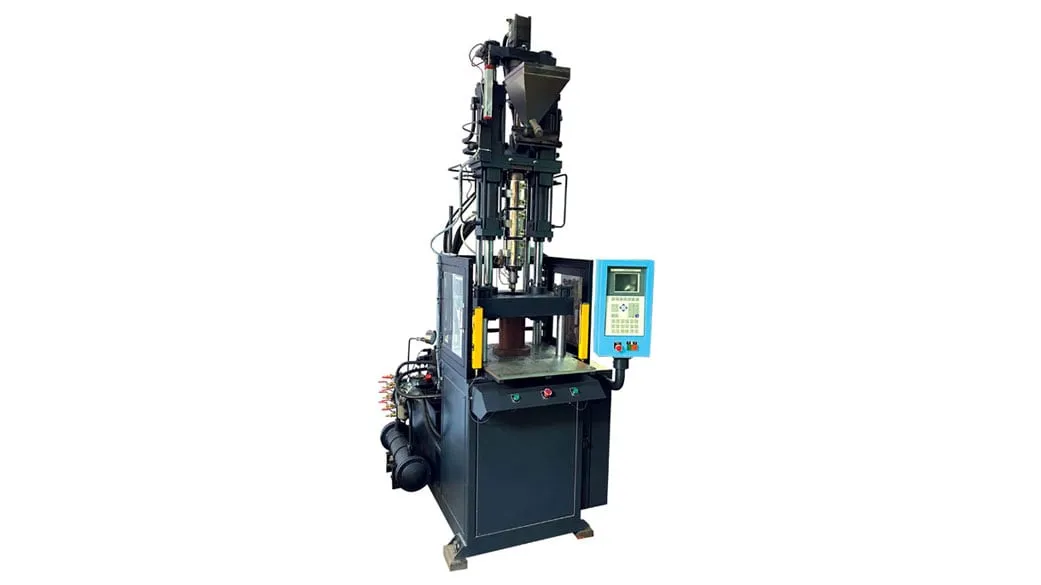

A custom injection moulding machine manufacturer earns its place when a standard catalogue machine cannot hold your mould, release your part or run your process without workarounds. Typical triggers are a part taller than the standard opening stroke allows, a mould wider than the tie bars, an insert loading or two-station layout, or a material that needs a different screw and barrel. The answer is not always a fully special machine. Often a standard frame with a changed clamp stroke, platen, injection unit or automation interface does the job. Whatever changes, insist on a trial with your own mould before the machine leaves the factory. Pratishna Engineers, a Mumbai machine builder since 1991, designs and builds special-purpose injection moulding machines alongside its standard range.
Key Takeaways
- Go custom only when a standard machine needs a workaround to hold the mould, open far enough, load inserts or process the material you have chosen.
- A custom build can change just one or two modules, such as clamp stroke, platen size, screw design or automation interface, on an otherwise proven frame.
- Recycled-content targets under the amended Plastic Waste Management Rules can change screw, filtration and runner choices for rigid packaging moulders from 2025-26 onward.
- Ask for a trial with your own mould and material before dispatch, with the cycle, part weight and dimensional checks agreed in writing in advance.
When is a standard injection moulding machine not enough?
A standard machine is not enough when your mould falls outside its envelope: it will not fit between the tie bars, the opening stroke cannot release a tall part, the shot sits outside the barrel's working window, or the cycle needs a station the frame cannot carry.
Tie-bar fit is the first check. Ideally the whole mould sits inside the tie bars. At the very least, the projected area of the parts must, because platens can pull in near the tie bars and wear the parting line. Check the mounting and ejector patterns too; a mismatch may need an ejector box.
Shut height and stroke come next. On a toggle clamp, full stroke is available at every shut height. On a piston or two-platen clamp, the available stroke shrinks as the mould gets taller. That difference decides whether a deep bucket, crate or housing can be released at all.
Then look at the process itself. Insert moulding with operator loading, two-station work, rotary tables and long core pulls all ask the frame to do something a general catalogue machine was not drawn for. Those are the jobs where a custom build pays back in fewer daily workarounds.
Signals that point to a custom build
| What you see | Why a standard machine struggles | What a custom build may change |
|---|---|---|
| Mould wider than the tie-bar spacing | Projected area falls outside the tie bars | Larger platen and tie-bar spacing |
| Tall part or deep core | Opening stroke too short to release the part | Longer stroke or higher daylight |
| Inserts loaded by hand every shot | Loading time adds to every cycle | Vertical clamp, sliding or rotary table |
| Shot below 20% or above 65% of barrel capacity | Degradation or poor melt quality | Different screw diameter or second barrel |
| Recycled or filled feed | Metal traces and out-gassing from variable feedstock | Filtration, venting and cold-runner layout |
What should a custom injection moulding machine manufacturer change, and what should stay standard?
A good custom injection moulding machine manufacturer changes only the modules your part forces it to change and keeps the proven frame, hydraulics, controls and safety systems standard. Fewer special parts means faster commissioning, simpler spares and a machine your existing operators already know how to run.
Think of the machine as modules: clamp unit, injection unit, drive, controls and automation interface. A tall-part job may need only a longer stroke. A material change may need only a new screw and barrel. Changing every module at once multiplies the drawings, the trial time and the spares you must stock.
Safety is the module that should never be redesigned casually. ISO 20430:2020 sets the safety requirements for the design and construction of injection moulding machines with hydraulic or electrical platen drives. Ask the builder how guarding, interlocks and any new access points on a special layout were checked against it.
Here is a flat view from the shop floor: do not order a custom machine to rescue a poorly designed mould. If the mould is too small for the platen, badly cooled or badly vented, fix the tool first. A special machine built around a faulty mould only makes the fault permanent.
How do recycled-content rules change a machine specification?
Recycled feed is less consistent than virgin resin, so a machine for rigid packaging with recycled content may need different filtration, venting, runner layout and temperature control. Under the amended Plastic Waste Management Rules, rigid packaging must carry rising recycled content, which makes this a specification item.
The targets are already notified. The amendment of 31 March 2026 requires rigid plastic packaging to contain at least 30% recycled material in 2025-26, rising to 60% by 2028-29. Shortfalls for 2025-26 can be carried forward up to three years, and exemptions apply where FSSAI and similar rules restrict recycled content.
On the machine side, recycled PP compounds behave differently. One compounder's guidance advises against hot runners because small metal pieces can plug hot tips, recommends larger gates and cold runners, and calls for good venting because varied feedstocks out-gas. It also sets a lower melt temperature ceiling than for virgin PP.
So if your product plan includes recycled content, say so before the machine is drawn. Screw geometry, barrel heating zones, nozzle filtration and the mould interface are far cheaper to change on paper than after the machine has been built and shipped to your plant.
What should a trial before dispatch prove?
A trial before dispatch should prove that your mould, in your material, runs on the new machine at the agreed cycle with good parts. Agree the checks in writing first: dry cycle, shot weight consistency, dimensions on critical features, clamp behaviour, safety functions and the alarm list.
The trial is your last low-cost chance to find a problem. Once the machine is on your floor, every change involves travel, downtime and a mould that is waiting to produce. Ship the mould and enough resin for a proper run, not a handful of shots.
Write the acceptance criteria as numbers you can measure on the day: part weight within an agreed band over a set run, critical dimensions within drawing tolerance, and a dry cycle close to the quoted figure. For reference, dry cycles of 1 to 2.5 s are typical for thin-wall machines and 3 to 5 s otherwise.
Attend the trial yourself or send your process engineer. Watch how the machine is set, not only the final parts, and record the settings used. If settings had to be pushed to extremes to get good parts, ask why before you sign the dispatch note. Keep a copy of the saved process sheet with the dispatch papers.
Trial before dispatch: what to check
| Check | How to measure | Why it matters |
|---|---|---|
| Dry cycle | Controller log or stopwatch, no injection | Confirms clamp and ejector speeds match the quotation |
| Shot weight | Weigh parts over an agreed run | Shows melt and screw consistency |
| Critical dimensions | Measure against the drawing | Proves the machine holds your tolerance |
| Safety functions | Open guards and test interlocks | Confirms the special layout is safe |
| Settings and alarms | Save the process sheet | Gives your team a starting recipe |
How Pratishna Engineers builds special-purpose injection moulding machines
Pratishna Engineers was founded in Mumbai in 1991 by Nandkumar R. Kushe, a first-generation engineer. The company started with machine rebuilding, indigenisation and technology adaptation before moving to complete machine design, manufacturing and automation. Design, manufacturing, assembly, testing and service are done in-house, which is what a special build depends on.
The design team works in SolidWorks, Creo and AutoCAD, and an independent QA department works to written SOPs, using accredited external labs when required. Manufacturing facilities in Mumbai cover about 25,000 sq ft, with CNC turning centres, vertical and horizontal machining centres, jig boring machines, and assembly and testing facilities.
- The range covers horizontal, vertical, vertical-horizontal combination, hydro-mechanical and hybrid machines, so a special build can start from a proven base.
- Special-purpose machines sit alongside the E, C and H horizontal series, PV and PVDL vertical series, PET, PHM two-platen and hybrid machines.
What should you send before asking for a custom build?
Send the part drawing, the mould drawing with shut height and plate sizes, the material grade, target cycle and annual volume, and a note of any inserts, slides or automation you need. With those, a builder can tell you which modules must change. See the special purpose injection moulding machine page.
Frequently Asked Questions About Custom Injection Moulding Machines
What is a special-purpose injection moulding machine?
It is a machine built or modified for one product family or process that a catalogue machine cannot handle well. Examples include longer opening strokes for tall parts, larger platens, vertical clamps for insert loading, sliding or rotary tables, and changed screws for difficult materials. The base frame and controls often stay standard.
Does a custom build take longer than a standard machine?
A custom build adds design and trial work, because every changed module needs drawings, parts and testing. How much time that adds depends on how many modules change. Ask for a dated schedule that shows design approval, manufacture, assembly and the trial with your mould as separate milestones.
Can an existing machine be modified instead of buying a custom one?
Sometimes. A longer stroke, a different screw and barrel, or an added automation interface can be retrofitted to some frames. The limit is the frame itself: tie-bar spacing, platen strength and clamp capacity cannot be stretched safely. Get the frame checked by the builder before you plan a retrofit.
What should I bring to the trial before dispatch?
Bring or ship the production mould, enough resin for a proper run, the part drawing with critical dimensions marked, and your acceptance criteria in writing. Send the person who will set the machine in your plant, so the process sheet from the trial becomes your starting recipe.
Which standard covers injection moulding machine safety?
ISO 20430:2020 specifies safety requirements for the design and construction of injection moulding machines for plastics and rubber with hydraulic or electrical platen drives. It does not cover mould design, and it does not apply to machines made before its publication. Ask how a special layout was checked against it.
Does Pratishna build special-purpose injection moulding machines?
Yes. Special-purpose machines are part of the Pratishna Engineers range, alongside horizontal, vertical, PET, two-platen and hybrid machines. Design, manufacturing, assembly, testing and service are done in-house in Mumbai. Share your part drawing, mould details and material, and the team can advise which modules need to change.
Related Articles
- Indian vs Imported Injection Moulding Machines in Mumbai
- How to Choose an Injection Moulding Machine
- Who Manufactures Injection Moulding Machines in Mumbai
- Two-Platen Machine Manufacturer in India
Sources & References
- MoldMaking Technology, B. Catoen: Machine Sizing and Specification for Optimal Mold Performance, Part 1 (Aug 2025)
- ISO: ISO 20430:2020, Plastics and rubber machines: Injection moulding machines: Safety requirements
- Polymerupdate, D. K. Jha: India eases plastic recycling regulations (8 Apr 2026)
- Entec Polymers: Processing ECHO Post-Industrial Recycled Polypropylene Compounds
Technical Disclaimer
Disclaimer: The information provided in this document is for general informational and educational purposes only. It is based on technical references and industry information available at the time of preparation and may be subject to change. It does not constitute engineering, technical, commercial or professional advice, nor does it constitute a quotation, specification, warranty or contractual commitment by Pratishna Engineers.
Actual injection moulding machine and process requirements vary according to the component design, material, mould, production volume, machine configuration and operating conditions. The information, examples, calculations and recommendations provided should be independently evaluated and verified for the specific application before making any equipment, process or production decision. Information obtained from third-party sources remains subject to the accuracy and limitations of those sources.
Limitation of Liability: Pratishna Engineers makes no representation or warranty, express or implied, regarding the completeness, accuracy or suitability of the information for any particular application. To the extent permitted by applicable law, Pratishna Engineers shall not be liable for any loss, damage, cost or consequence arising from reliance on or use of the information contained in this document. Final machine selection, configuration and application suitability should be confirmed with Pratishna Engineers based on complete and accurate project requirements.

