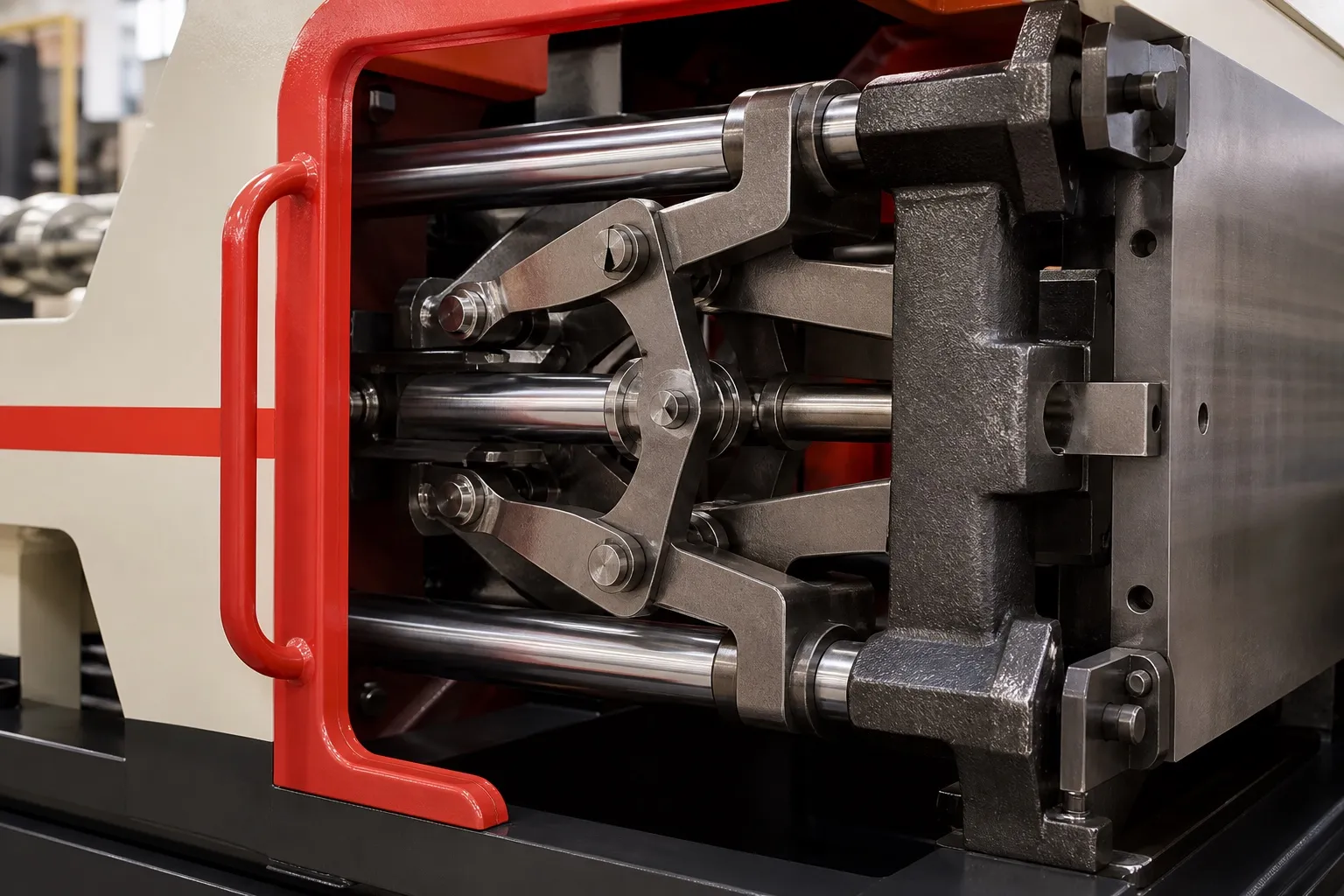
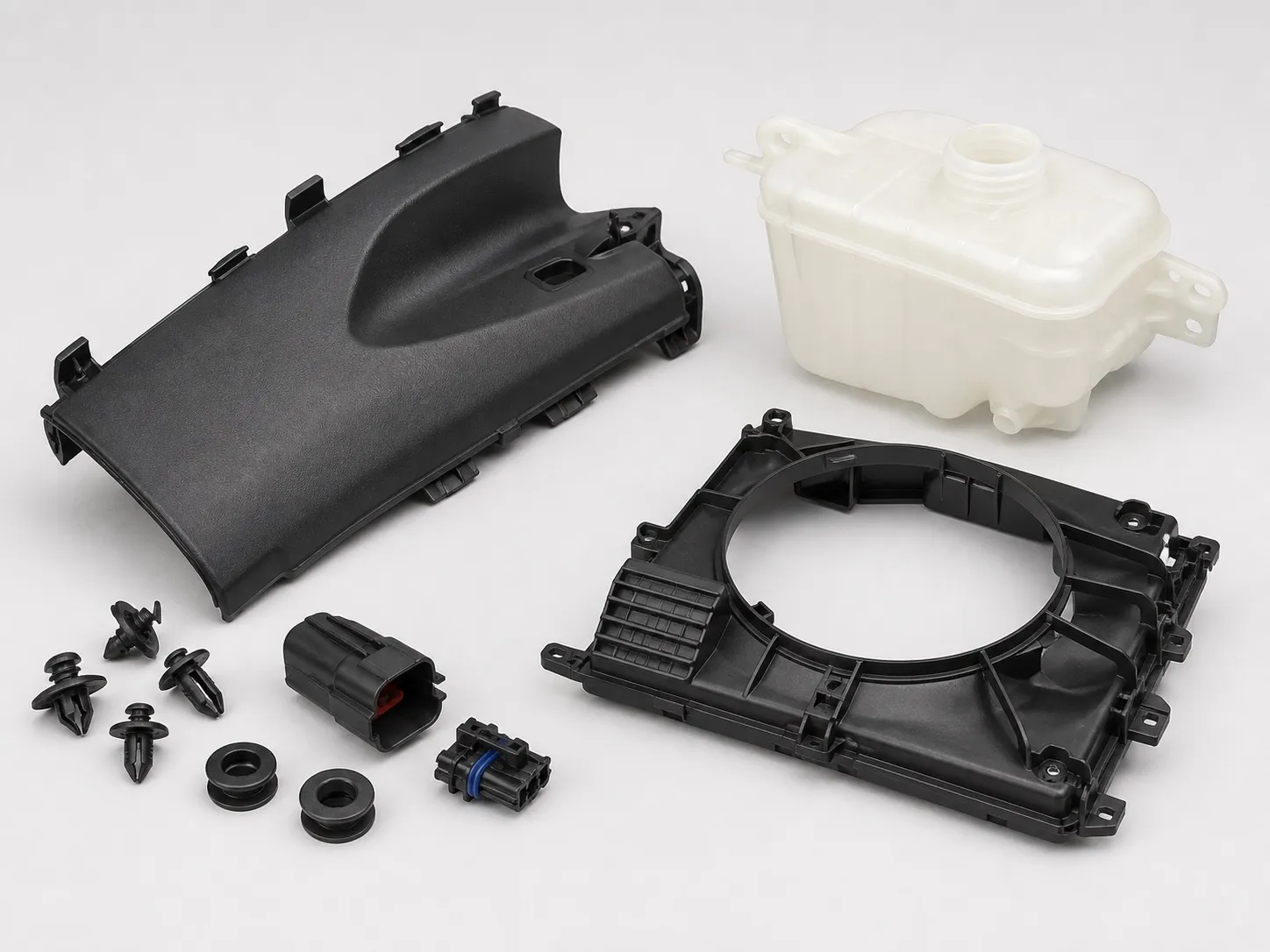
Typical 55 ton vertical machine applications are the bigger cable parts: plug bodies with long strain relief tails, connector bodies with two cable exits, strain reliefs for heavy cords, harness grommets and parts moulded onto rods or tubes. The extra clamp mostly buys a second or third cavity of these larger parts, not a new class of product.
Each part still has to pass three checks: clamp at the upper tonnage factor, shot volume against the barrel, and mould size against the platens. This article covers the first and points to the other articles in this series for the rest.
Key Takeaways
- With a 10% reserve, 55 t carries about 119 to 178 cm² of PVC parts and runner at a tonnage factor of 2 to 3 US t/in².
- Large plug bodies and two-exit connectors fit two to four cavities by clamp; small clips fit far more than an operator can load.
- Thick strain reliefs and long inserts can be limited by cooling time and mould length rather than clamp.
- Plugs on cords still answer to IS 1293, so the compound and the moulding process are approved together.
What Are Typical 55 Ton Vertical Machine Applications?
They are cable and insert parts too large, too thick or too many per shot for a smaller machine. Heavy plug bodies, connector bodies with two exits, strain reliefs for thick cords, harness grommets and parts on long inserts lead the list, in two to four cavities where loading allows.
Cavities the clamp can hold at 55 t, at a PVC tonnage factor of 2 to 3 US t/in², with a 10% reserve (a starting margin, not a rule), before any runner
| Part | Example outline across the parting line | Area per cavity | Cavities by clamp at 55 t |
|---|---|---|---|
| Heavy plug body with strain relief tail | 70 × 35 mm | 24.5 cm² | 4 to 7 |
| Strain relief for a heavy cord | 90 × 25 mm | 22.5 cm² | 5 to 7 |
| Connector body with two cable exits | 80 × 50 mm | 40.0 cm² | 2 to 4 |
| Harness grommet | 50 × 40 mm | 20.0 cm² | 5 to 8 |
| Part moulded onto a rod or tube | 120 × 15 mm | 18.0 cm² | 6 to 9 |
| Clip moulded onto a wire bundle | 40 × 20 mm | 8.0 cm² | 14 to 22 |
The lower count in each row uses the upper factor, which is the one to plan on. Counts above four are clamp limits, not production advice, because each extra cable adds loading time and needs its own exit from the mould.
How Do You Work Out the Clamp for a Cable Part?
Measure the part's outline as seen across the parting line, multiply by the cavities, add any cold runner, then multiply by a tonnage factor for the compound and add a reserve. If the total stays below 55 t at the upper factor, the clamp will keep that mould shut.
RJG's Jeremy Williams sets out this method in Plastics Technology, subtracting any through-holes from each part. He quotes typical factors of 2 to 10 US tons per square inch and recommends 3 when nothing better is known. With a hot runner, only the cavities count.
For PVC, the GEON rigid PVC guide gives 2 to 2.5 US t/in², more for thin walls or long flow. The table above runs from 2 to 3 for flexible cable compounds, which keeps the plan on the cautious side until a trial mould shows the real figure.
The factors are in US tons per square inch, and Indian machines are rated in metric tonnes. A factor of 3 US t/in² equals about 0.422 t/cm², and 2 equals 0.281 t/cm². The 10% reserve absorbs normal swings in melt temperature and injection speed from shot to shot.
Which Parts Need More Than Clamp?
Thick parts and long parts. A heavy strain relief is limited by how long its thickest section takes to cool, and a part on a long rod is limited by mould length and how the insert is supported. Neither problem is solved by adding clamp force.
Cooling time rises with the square of wall thickness, so a strain relief twice as thick needs about four times the cooling. The heavy cord strain relief article in this series works through that effect and the ways to core out thick sections.
Long inserts, such as rods, tubes or pre-assembled cable ends, need support at both ends of the mould so that injection pressure cannot bend them. The insert also sets the minimum mould length, so check it against the platen size before cutting steel.
Our view: at 55 t, choose cavities by cooling time and loading time first, then confirm the clamp. A third cavity that the clamp allows but the operator cannot load in time only lengthens the cycle.
Which Compounds and Rules Come With These Parts?
Flexible PVC remains the main compound for plugs and strain reliefs on PVC cords, because it bonds to the jacket. Harness grommets may call for TPE or TPV, and clips for nylon. Each brings its own processing window and its own customer or standard requirements.
Larger plugs moulded onto cords are still plugs under IS 1293. A BIS article on the standard lists tests for earthing, shock protection, dimensions, resistance to abnormal heat and fire, pendulum hammer strength and 10,000 insertion and withdrawal cycles. The compound and the process are approved together, so neither should change after approval.
Harness work brings different rules: customer specifications on materials, temperatures and emissions rather than a single Indian product standard. The wire harness article in this series covers those materials and how to mould onto a wire bundle.
What Should You Send Before Choosing a Machine?
Send each part drawing with cable or insert diameter and length, the compound grade, wall thickness, cavities and hourly target. Run the clamp check at the upper factor, then confirm shot volume, cooling time and mould size. See the 55 ton vertical injection moulding machine page.
Frequently Asked Questions About 55 Ton Vertical Machine Applications
Can a 55 ton vertical machine overmould a part onto a metal rod?
Yes, if the rod can lie across the parting line and the mould can support it at both ends. The rod sets the mould length, so check it against the platen size. Preheating a metal insert can help the melt fill around it before it freezes on the cold surface.
Is 55 t enough for a three-cavity heavy plug mould?
Often, on clamp alone. Three plug bodies of 24.5 cm² each plus a 6 cm² runner use about 37 t at the upper PVC factor with a reserve. The harder checks are shot volume, cooling time of the thick body and whether the operator can load three cords within the cycle.
Does a bigger machine give better plug quality?
No. Quality comes from pin location, a full pack of the body and the bond to the jacket. A larger clamp only helps if the smaller one could not hold the mould shut. Oversizing can make the barrel too large for the shot, which leaves heat-sensitive PVC sitting hot for longer.
Can I run harness grommets and cord plugs on the same machine?
Yes, with a planned changeover. Grommets in TPE or TPV and plugs in flexible PVC need different temperatures and purging. Group jobs by compound where you can, purge with the material each supplier recommends, and keep acetal away from any machine that runs PVC.
How long can a part on a cable be?
The cable itself can be any length, because only the moulded section sits in the mould. The length that matters is the moulded part along the cable, plus the shut-offs at each end. That total must fit the mould, and the free cable must have room to hang or lie without being trapped.
Related Articles
- Heavy Cord Strain Reliefs on a 55 Ton Vertical Machine
- Two-Cavity Cable Moulds on a Horizontal Clamp Vertical Machine
- Wire Harness Parts: Overmoulding Clips and Grommets
Sources & References
- Plastics Technology, J. Williams (RJG): Clamp Tonnage: More Is Better...Right?
- GEON Performance Solutions: Injection Molding Guide: GEON PVC Molding Formulations (PG0019BC, 2021)
- BIS Blog, N. Agarwal: Standards for Plugs-Socket-Outlets and Switches
Technical Disclaimer
Disclaimer: The information provided in this document is for general informational and educational purposes only. It is based on technical references and industry information available at the time of preparation and may be subject to change. It does not constitute engineering, technical, commercial or professional advice, nor does it constitute a quotation, specification, warranty or contractual commitment by Pratishna Engineers.
Actual injection moulding machine and process requirements vary according to the component design, material, mould, production volume, machine configuration and operating conditions. The information, examples, calculations and recommendations provided should be independently evaluated and verified for the specific application before making any equipment, process or production decision. Information obtained from third-party sources remains subject to the accuracy and limitations of those sources.
Limitation of Liability: Pratishna Engineers makes no representation or warranty, express or implied, regarding the completeness, accuracy or suitability of the information for any particular application. To the extent permitted by applicable law, Pratishna Engineers shall not be liable for any loss, damage, cost or consequence arising from reliance on or use of the information contained in this document. Final machine selection, configuration and application suitability should be confirmed with Pratishna Engineers based on complete and accurate project requirements.