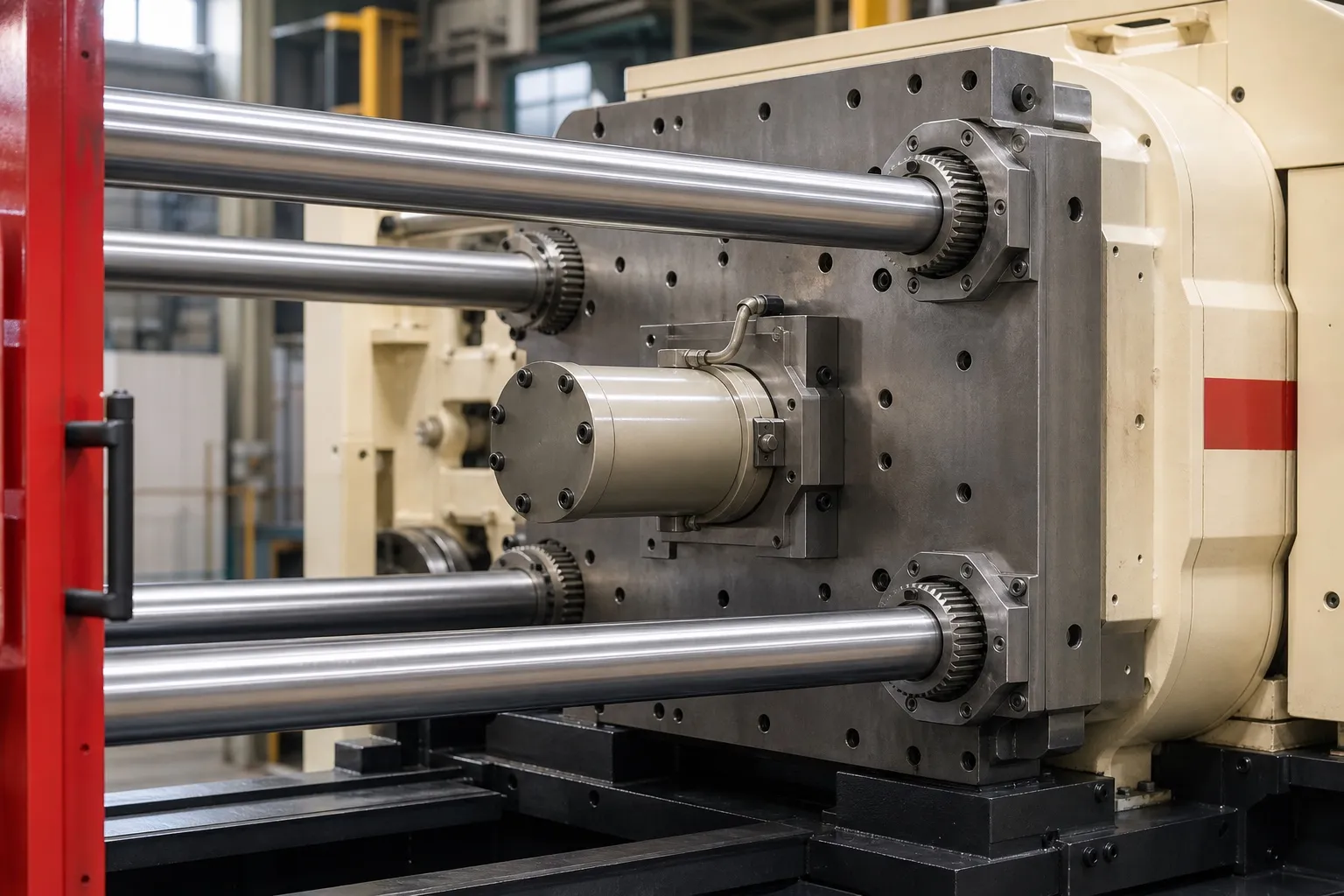
A 350 ton household moulding machine can hold PP parts with a total projected area of about 750 cm² at a tonnage factor of 3, and about 1,130 cm² where trials confirm a factor near 2. That covers 300 mm buckets at any PP factor and, at the low factor, 320 mm dustbins, stool seats, slotted laundry baskets, two-cavity bucket moulds and storage boxes up to about 380 × 280 mm. Full-size chairs and solid table tops need a larger clamp.
Both limits hold back 10% of the clamp, which this article uses as a starting margin, not a rule. Clamp is the first test, not the last: opening stroke, mould size and shot weight each have their own article in this series.
Key Takeaways
- With a 10% reserve, 350 t holds about 750 cm² of PP parts at a factor of 3 and about 1,130 cm² at a factor of 2.
- Round parts up to about 310 mm across fit at either factor; dustbins, baskets and large boxes fit only near the low end.
- Compared with 260 t, the extra clamp adds about 35% more projected area at the same factor.
- For houseware that touches food, choose a PP grade whose supplier lists compliance with IS 10910.
Which Products Fit a 350 Ton Household Moulding Machine?
Buckets and other round parts up to about 310 mm across fit at either PP factor. Dustbins with 320 mm rims, stool seats, slotted laundry baskets, two-cavity bucket moulds and boxes up to about 1,130 cm² fit only near a factor of 2. Solid trays and chairs do not.
Clamp per mould at PP factors of 2 to 3 US t/in², 10% reserve (sizes assumed for illustration; one cavity unless stated)
| Product and size | Projected area | Clamp needed | Highest PP factor that fits 350 t |
|---|---|---|---|
| Bucket, 300 mm rim | 707 cm² | 219 to 328 t | 3.20 (fits at either factor) |
| Two-cavity bucket mould, 220 mm rims, 20 cm² cold runner | 780 cm² | 241 to 362 t | 2.90 |
| Round dustbin, 320 mm rim | 804 cm² | 249 to 373 t | 2.81 |
| Stool seat, 330 mm round | 855 cm² | 265 to 397 t | 2.65 |
| Laundry basket, 450 × 350 mm, 40% open base | 945 cm² | 292 to 439 t | 2.39 |
| Storage box, 380 × 280 mm | 1,064 cm² | 329 to 494 t | 2.13 |
| Solid tray or table top, 450 × 350 mm | 1,575 cm² | 487 to 731 t | 1.44 (does not fit) |
Read the last column as a target for trials. If moulding trials, simulation or a similar mould show that the real factor for your part sits below that number, the clamp can hold it. A thin basket filled through one gate can sit higher in the range than a thick stool seat with a short flow, so the basket has less room than its figure suggests.
How Do You Check Whether a Mould Fits 350 t?
Take the part's area seen from the direction the mould opens, subtract through-holes, multiply by the cavity count and add any cold runner. Multiply that total by the resin's tonnage factor, then add your reserve. If the answer is 350 t or less, the clamp can hold the mould shut.
Jeremy Williams of RJG sets out this method in Plastics Technology. He gives typical factors of 2 to 10 US tons per square inch and recommends 3 as a starting point when nothing better is known. With a hot runner, only the cavities count, because melt in the manifold does not push on the parting line.
For PP, an SPE Plastics Engineering article by A. Urbina gives 2 to 3 US t/in², with polyethylene at the low end of the overall range and polycarbonate toward the high end. In metric, 1 US t/in² is about 0.1406 t/cm², so the PP range runs from about 0.281 to 0.422 t/cm².
With the reserve, 350 t leaves about 318 t for the parts. Divide by 0.281 and the limit is about 1,130 cm²; divide by 0.422 and it is about 750 cm². Melt flow, flow length, wall thickness and the number and size of gates all move the real factor, which is why the table shows a range rather than one figure.
Where Does a 350 t Machine Still Run Short?
On area beyond about 1,130 cm², on height, on mould size and on shot volume. Chairs and table tops exceed the clamp; tall bins need long opening strokes; wide moulds must pass between the tie bars; heavy shots can outgrow the barrel before the clamp limit is reached.
A full-size chair shows the area limit clearly. Taking an assumed outline of 440 × 500 mm, its projected area is about 2,200 cm², nearly twice what 350 t can hold even at a factor of 2. Chair moulds belong on a much larger clamp.
Height and mould size are explained in the toggle vs two platen article in this series, and barrel sizing in the shot weights article. Each can rule a product out even when the clamp check passes.
Clamping harder is not the cure for a mould that flashes. Urbina warns that excess clamp force can crack hydraulic cylinder mounting plates, deform platens and fracture the machine frame. Find the cause in the mould or the process instead.
Our view: plan a 350 t machine around parts and cavity layouts above about 750 cm², which smaller clamps cannot hold. A single bucket mould that would run on 260 t leaves the extra clamp doing nothing.
Which PP Grades Suit Large Household Parts?
Impact copolymer PP suits dustbins, buckets, baskets and stools that are dropped, kicked or sat on. Homopolymer suits stiff boxes, trays and lids. For anything that touches food, choose a grade whose supplier lists compliance with IS 10910, the Indian standard for PP in food contact.
One homopolymer example is Reliance's Repol H110MAS, a nucleated grade listed for rigid packaging, furniture and houseware. The TDS shows an 11 g/10 min MFR, 1,650 MPa flexural modulus and 110 °C HDT, states IS 10910 compliance and gives the BIS designation IS 10951-1-MBL-C.
Large parts magnify the choice. A stiff grade keeps a wide box lid from sagging, while an impact grade keeps a full dustbin from cracking at the rim. Ask the resin supplier for the compliance certificate as well as the datasheet before the first production order.
What Should You Prepare Before a 350 t Mould Check?
List each mould with part outline, through-holes, cavity count, runner type, resin grade and part weight. Run the clamp check at a factor of 3 first, then at 2 for parts that need it, and plan trials for those. See the 350 ton horizontal injection moulding machine page.
Frequently Asked Questions About a 350 Ton Household Moulding Machine
How much more does 350 t hold than a 260 t machine?
About 35% more projected area at the same tonnage factor, because 350 ÷ 260 = 1.35. At a PP factor of 2 with a 10% reserve, the limit rises from about 840 cm² to about 1,130 cm². That moves large storage boxes, slotted laundry baskets and 330 mm stool seats into range.
Why do dustbins and baskets fit only at the low factor?
Because their outlines are large. A 320 mm dustbin projects about 804 cm², above the roughly 750 cm² that 350 t holds at a factor of 3. It fits only if the real factor for that mould is about 2.8 or less, which trials, simulation or a similar mould can confirm.
Is it wasteful to run small parts on a 350 t machine?
It can be. A PlasticsToday article on measuring real energy use notes that large machines making small products are energy-inefficient, and that idling machines can draw 52% to 97.5% of their full moulding energy. Put small moulds on smaller machines and keep the 350 t machine for parts that need its clamp.
What happens if a mould is clamped at full 350 t when it needs much less?
The mould and machine can be damaged. Plastics Technology describes a mould that needed about 100 tons being clamped at a 400-ton maximum; its cavity block split in two places. Over-clamping can also crush vents, causing burns and short shots. Set clamp to the calculated need plus your reserve.
Should I buy 350 t now for larger parts I may make later?
Only if those parts are already drawn. Size the clamp for the largest mould you can specify today, with its reserve, then check stroke, tie bars and barrel against the same list. A machine bought for parts that never arrive can spend years running moulds a smaller clamp could hold.
Related Articles
- Moulding the Largest Household Articles on a 350 Ton Machine
- 350 Ton Toggle vs Two Platen Machine: Which Suits Your Mould?
- Shot Weights Near 1 kg: Screw and Barrel Choice on a 350 Ton Machine
Sources & References
- Plastics Technology, J. Williams (RJG): Clamp Tonnage: More Is Better...Right?
- SPE Plastics Engineering, A. Urbina: Mastering Clamping Force Calculation
- PlasticsToday, R. Kent: Getting to know your real energy use and cost
- Reliance Industries: Repol H110MAS Technical Data Sheet
Technical Disclaimer
Disclaimer: The information provided in this document is for general informational and educational purposes only. It is based on technical references and industry information available at the time of preparation and may be subject to change. It does not constitute engineering, technical, commercial or professional advice, nor does it constitute a quotation, specification, warranty or contractual commitment by Pratishna Engineers.
Actual injection moulding machine and process requirements vary according to the component design, material, mould, production volume, machine configuration and operating conditions. The information, examples, calculations and recommendations provided should be independently evaluated and verified for the specific application before making any equipment, process or production decision. Information obtained from third-party sources remains subject to the accuracy and limitations of those sources.
Limitation of Liability: Pratishna Engineers makes no representation or warranty, express or implied, regarding the completeness, accuracy or suitability of the information for any particular application. To the extent permitted by applicable law, Pratishna Engineers shall not be liable for any loss, damage, cost or consequence arising from reliance on or use of the information contained in this document. Final machine selection, configuration and application suitability should be confirmed with Pratishna Engineers based on complete and accurate project requirements.