






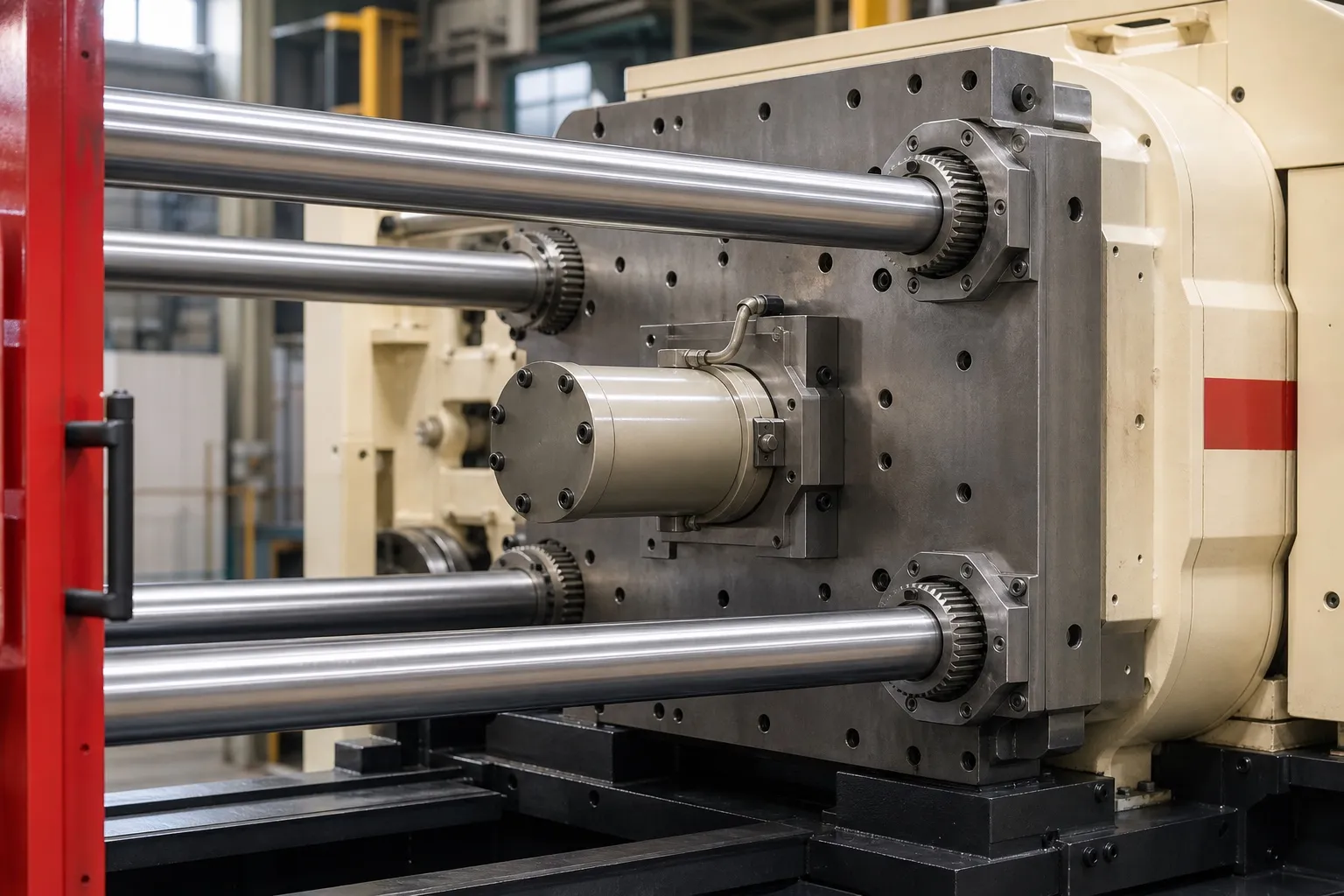

350 ton toggle vs two platen: the check that decides for each type of mould (from MoldMaking Technology and Plastics Technology)
| Your mould | Check that decides | What to look for |
|---|---|---|
| Tall bin, tub or basket | Opening stroke and daylight | Stroke of at least 2.5 × part height, and daylight that still leaves that stroke at your mould height |
| Thick mould with stripper plate or slides | Mould height range | Closed thickness inside the minimum and maximum; direct hydraulic clamps are reported to offer a greater range |
| Wide, flat mould such as a tray or table top | Tie-bar gap and platen support | Projected area fully inside the tie bars; most toggles apply force at the platen corners, reported to raise deflection risk |
| Small mould on a large machine | Platen coverage | Mould covering at least about 70% of the tie-bar distance |
| Heavy mould | Weight on both platens | Mould weight within the limit for the fixed and the moving platen |
| Thin, fast-cycling mould | Lock-up and opening | Toggles are reported to lock up slightly faster and open with more force |
In a 350 ton toggle vs two platen choice, the mould decides, not the clamp force, since both designs can deliver 350 t. A tall or thick mould points to whichever design leaves enough stroke and mould height; a short bay favours the shorter two-platen machine; a thin, fast mould can favour the toggle's quicker lock-up.
The table lists the check behind each case. The sections below explain why mould height changes the answer, how each clamp treats the mould, and where cycle time, floor space and power come in.
Key Takeaways
- On a toggle, maximum daylight equals maximum mould height plus stroke, so full stroke is available at every mould height.
- On a piston-style clamp, maximum daylight equals minimum mould height plus maximum stroke, so a thicker mould leaves less opening.
- Two-platen machines are shorter overall than toggles of similar tonnage, which can decide a crowded bay.
- Toggles are reported to lock up faster; direct hydraulic clamps to give finer tonnage control and a greater mould-height range.
How Do You Settle 350 Ton Toggle vs Two Platen for One Mould?
Check the mould against stroke, mould height, daylight, tie-bar gap and weight on both data sheets, in that order. Whichever passes all five is a candidate. If both pass, compare bay length, cycle and running cost; if neither passes, the mould needs another machine size, not another clamp type.
The clamp check from projected area is the same for both designs and is worked through in the applications article in this series. What differs is how each design opens, supports and holds the mould, and that is where a large household mould is won or lost.
Bruce Catoen's guide to machine sizing in MoldMaking Technology sets the opening stroke at a minimum of 2.5 times part height. A 400 mm tall bin therefore wants about 1,000 mm of stroke, a figure that rules machines in or out long before tonnage does.
Why Does Mould Height Change the Answer?
Because the two clamps share their opening differently. A toggle gives its full stroke at any mould height. On a piston-style clamp, where cylinders move the platen as on two-platen machines, a thicker mould uses up daylight and leaves less opening. Deep, thick household moulds sit right on that difference.
Catoen gives both relationships. For a toggle, maximum daylight equals maximum mould height plus stroke. For a piston clamp, maximum daylight equals minimum mould height plus maximum stroke. So on the toggle, stroke is fixed and maximum mould height is the limit; on the piston clamp, daylight is fixed and mould height and opening trade against each other.
The same guide asks for a mould thick enough for the minimum mould height and thin enough for the maximum, and for checks on mounting and ejector patterns and the locating ring, commonly 101.6 mm or 120 mm. A mould built for one machine can need an ejector box or a new ring to run on the other.
Our view: for deep household moulds, ask both suppliers for the opening left at your mould's closed thickness, not for maximum daylight. That one figure settles more toggle vs two-platen decisions than tonnage or price.
Does the Clamp Design Change Flash and Part Quality?
It can, through how force reaches the mould. Most toggles apply force at the platen corners, which is reported to raise platen deflection, while direct hydraulic clamping is reported to give more uniform pressure and finer control. A well-matched mould and process still matter more than clamp type.
Mikell Knights' Plastics Technology article on hybrid clamps collects these points, several of them as supplier claims. Critics of toggles also cite parallelism risk if linkages wear unevenly, grease contamination and difficulty running below full tonnage. Defenders point to reliability, simplicity and rigidity.
Platen coverage matters on both designs. A Plastics Technology article on mounting moulds gives a rule of thumb that the mould should cover at least 70% of the distance between the tie bars; smaller moulds let the platens bow, and flash appears in the centre. Catoen gives platen parallelism of 0.025 to 0.05 mm as generally acceptable below 500 t.
How Do Cycle Time, Floor Space and Power Compare?
Toggles are reported to lock up slightly faster, claimed at 0.2 s against 0.5 s, which matters on fast thin-wall cycles but little on long household cycles. Two-platen machines are shorter overall. Power depends more on the drive and its match to the job than on clamp type.
On a 60 s bin cycle, 0.3 s of lock-up is half a percent. Bay length can matter more: a shorter machine can fit a line that a toggle of the same tonnage will not, so measure the bay including room for mould loading and part take-off.
Maharashtra adds a twist. MSEDCL's kVAh billing, which MERC intended for HT consumers and LT connections above 20 kW from April 2020, charges for apparent power, so a plant running at a power factor of 0.85 pays for 15% of power that does no useful work. Capacitors or an APFC panel fix that on either design.
What Should You Send to Compare Both Designs?
Send each mould's closed thickness, outside size, weight, part height and projected area, plus the resin and your bay length. Check both designs against stroke, mould height, daylight and tie bars, then compare cycle and power. See the 350 ton horizontal injection moulding machine page.
Frequently Asked Questions About 350 Ton Toggle and Two Platen Machines
Can a mould built for a toggle machine run on a two-platen machine?
Often, if it fits. Check closed thickness against the mould height range, the locating ring size, the mounting pattern and the ejector pattern; a different ejector layout may need an ejector box. Check opening too, because a thick mould leaves less opening on a piston-style clamp than on a toggle.
How do I check platen parallelism on a used machine?
Ask a service engineer to measure the gap between the platens at all four corners, with the clamp closed on parallel blocks, using a dial gauge. MoldMaking Technology gives 0.025 to 0.05 mm as generally acceptable on machines under 500 t. A wider spread can point to worn links, bushes or guides.
Should mould height on a toggle be set with the mould hot or cold?
Set it with the mould at running temperature, or recheck it once warm. Plastics Technology reports that adjusting mould height with the mould closed can over-clamp once the mould warms and expands. Recheck after long stops, after a change in mould temperature and after any mould maintenance.
What maintenance differs between toggle and two-platen clamps?
Toggles have pins, bushes and links that wear and need lubrication; uneven wear can upset parallelism, and grease can reach the mould area. Two-platen machines replace the linkage with locking devices and short-stroke cylinders, so seals, locks and hydraulics get more attention. Ask each supplier for its planned maintenance schedule.
Is a two-platen machine always the better choice for big moulds?
No. It suits moulds that need more opening, more mould height or a shorter machine than a toggle offers. If a toggle of the right tonnage passes every check for your moulds, it remains a sound choice, valued for reliability, simplicity and rigidity. Choose on the mould list, not on clamp type.
Related Articles
- What Can You Make on a 350 Ton Household Moulding Machine?
- Moulding the Largest Household Articles on a 350 Ton Machine
- Shot Weights Near 1 kg: Screw and Barrel Choice on a 350 Ton Machine
Sources & References
- MoldMaking Technology, B. Catoen: Machine Sizing and Specification for Optimal Mold Performance, Part 1
- Plastics Technology, M. Knights: Hybrid Injection Clamps: The Best of Both Worlds?
- Plastics Technology, P. Witaszek, J. Klees, J. Fattori, E. Di Siro, J. Bozzelli: How to Mount an Injection Mold
- Maharashtra State Electricity Distribution Co. Ltd (MSEDCL): kVAh Billing: Frequently Asked Questions
Technical Disclaimer
Disclaimer: The information provided in this document is for general informational and educational purposes only. It is based on technical references and industry information available at the time of preparation and may be subject to change. It does not constitute engineering, technical, commercial or professional advice, nor does it constitute a quotation, specification, warranty or contractual commitment by Pratishna Engineers.
Actual injection moulding machine and process requirements vary according to the component design, material, mould, production volume, machine configuration and operating conditions. The information, examples, calculations and recommendations provided should be independently evaluated and verified for the specific application before making any equipment, process or production decision. Information obtained from third-party sources remains subject to the accuracy and limitations of those sources.
Limitation of Liability: Pratishna Engineers makes no representation or warranty, express or implied, regarding the completeness, accuracy or suitability of the information for any particular application. To the extent permitted by applicable law, Pratishna Engineers shall not be liable for any loss, damage, cost or consequence arising from reliance on or use of the information contained in this document. Final machine selection, configuration and application suitability should be confirmed with Pratishna Engineers based on complete and accurate project requirements.


