
A batch of hubs looks perfect on the inspection table. Then the pull test on finished needles gives a wide spread: most cannulas hold, a few slide out at low force. In needle hub moulding that pattern points to two things, where the cannula sits in the hub and how the hub grips it. Check both before you touch the process settings.
This article covers both routes: moulding the hub around the cannula on a vertical machine, and moulding a hub with a well that the cannula is bonded into afterwards. The location and material points apply either way.
Key Takeaways
- A cannula can be moulded into the hub or bonded into a moulded well; an MD+DI article calls insert-moulded cannulas time-consuming and costly.
- Pull strength rises with engagement length until the hub or the cannula becomes the weak point.
- PE and PP hubs need surface treatment for adhesive bonds: plasma raised 22-gauge pull strength from 1 to 11 lb to 17 to 52 lb.
- Disposable hypodermic needles are notified medical devices in India, and ISO 7864 sets a requirement for the hub-to-tube bond.
How Should the Cannula Be Located in Needle Hub Moulding?
Vertically, in a bore in the lower mould that fixes its depth, centres it and protects the point. The hub then forms around the exposed length. Errors show up as off-centre cannulas, wrong exposed length or leak paths, so this bore and its shut-off need the tightest fits.
A vertical clamp suits this. The cannula stands in its bore under gravity, point down and clear of the melt, with no clips holding it against a vertical face. On a horizontal machine, a long thin tube is harder to keep square while the mould closes.
The shut-off around the tube decides two faults. A loose fit lets melt creep along the tube as flash; a fit tighter than the tube's tolerance can bend or scratch it. Measure tube diameter from several lots before the bores are finished, and watch these shut-offs for wear.
The hub's conical fitting has to mate with a syringe tip, so the core that forms it and the cannula bore must share one axis. Build both into the same mould insert where the design allows.
What Decides Bond Strength Between Hub and Cannula?
Engagement length, cannula gauge, hub material and the joining method. An MD+DI article by Christine Salerni and James Serenson reports that pull strength rises with engagement length until the joint is stronger than the hub or cannula, and that finer cannulas offer less surface to bond.
Factors in hub-to-cannula pull strength reported in the MD+DI article on adhesive-bonded needles (1 lb = 4.448 N)
| Factor | What the article reports | What it means for the hub mould |
|---|---|---|
| Engagement length | Pull strength rises with length until the hub or cannula fails first | Mould a core long enough for the pull-force target |
| Cannula gauge | 27-gauge bonds often fail at the cannula; 22-gauge bonds fail at the hub | On larger cannulas, the hub wall around the core is the weak link |
| Diametrical gap | A 0.002 in (about 0.05 mm) gap is common | Hold the core bore tolerance tightly |
| Annular rings | Recesses 0.005 to 0.008 in (about 0.13 to 0.20 mm) deep, mainly in PE and PP hubs | Rings in the well need a core that can still release |
| Surface treatment | 22-gauge in PE: untreated 1 to 11 lb (4 to 49 N); plasma-treated 17 to 52 lb (76 to 231 N) | PE and PP hubs need corona or plasma treatment before bonding |
For a hub moulded around the cannula, grip comes from the plastic shrinking onto the tube and from any texture on its surface. DuPont's insert moulding guidance favours knurled or undercut inserts for pull-out, and a plain stainless tube offers little for the plastic to hold.
The MD+DI authors call insert-moulded cannulas time-consuming and expensive, because location must be accurate enough to leave no leak paths. Our view: mould the cannula in only where your own pull and leak tests show it beats a bonded hub on cost per good needle.
Which Hub Materials Are Used and How Do They Behave?
The MD+DI article lists ABS, acrylic, polycarbonate, polyethylene, polypropylene, polysulfone and polyurethane as common hub materials. For moulding, the useful split is amorphous against semi-crystalline, because the two groups shrink by different amounts onto a cannula and react differently to process changes.
LyondellBasell's shrinkage guide puts PP at 0.010 to 0.025 in/in and PE at 0.015 to 0.040, against 0.005 to 0.007 for PC and 0.004 to 0.009 for ABS. Higher shrinkage tightens the grip on a moulded-in cannula, but it also varies more with melt temperature, cooling and packing.
PP and PE are also the hard-to-bond pair. If the cannula will be glued rather than moulded in, plan corona or plasma treatment and consider annular rings in the well. PC bonds more readily but must be dried; one PC datasheet asks for 121 °C for 4 h to a maximum of 0.020% moisture.
Colour is part of the specification. ISO 7864 includes colour coding and hub colour, so masterbatch type and dosing belong on the controlled job sheet.
What Do ISO 7864 and CDSCO Require?
ISO 7864:2016 sets requirements for sterile single-use hypodermic needles, including the hub's conical fitting and colour and the bond between hub and needle tube, with an informative bonding-strength test method. In India, disposable hypodermic needles are notified medical devices regulated through CDSCO.
A CDSCO notice dated 29 June 2017 lists disposable hypodermic needles among the devices already notified under the Drugs and Cosmetics Act, and states that the Medical Devices Rules, 2017 come into force from 1 January 2018. Its annexed draft risk list places single lumen hypodermic needles in Class B.
For the moulder, this means the needle maker holds the licence and can audit you as a supplier. Expect requests for material certificates, lot traceability, process validation records and a clean, controlled moulding area. Agree these before quoting, because they change the cell, not only the price.
What Should You Send Before a Hub Trial?
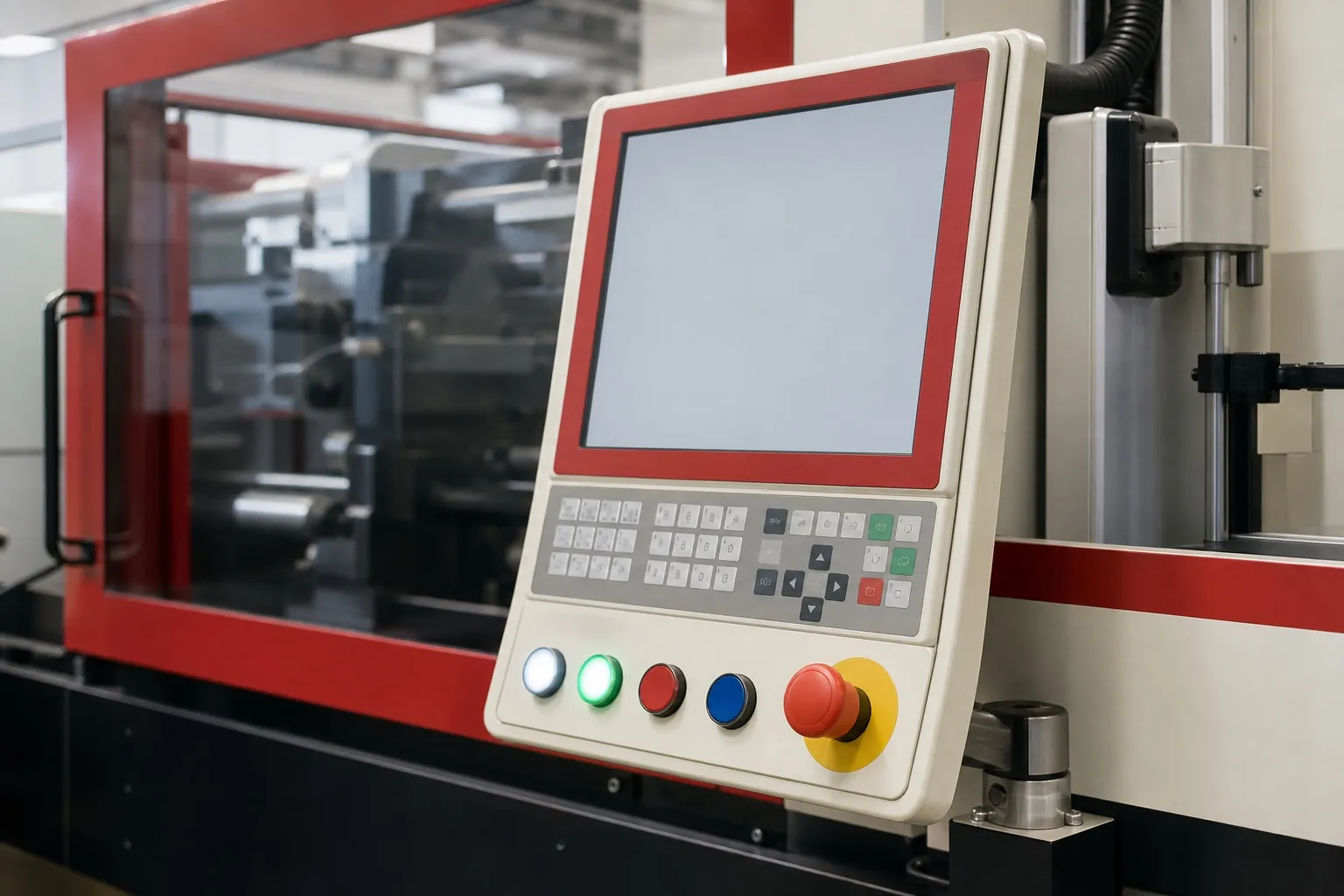
Send the hub drawing, cannula gauge, length and tolerance, the joining method, resin grade and colour, the pull-force target and the leak test your customer applies. Include cannula samples from more than one lot. See the 40 ton vertical injection moulding machine page.
Frequently Asked Questions About Needle Hub Moulding
Should the cannula be moulded in or bonded afterwards?
Compare both on cost per good needle. Moulding in removes the adhesive step but needs accurate location and leak-free shut-offs. Bonding uses a simpler mould plus a dispensing and curing station; the MD+DI article gives 3 to 6 s cures for light-cure cyanoacrylates and 6 to 20 s for light-cure acrylics.
Why does pull strength vary between cavities?
Different engagement length, a worn shut-off letting flash form along the tube, or uneven shrinkage between cavities can all cause it. Run pull tests by cavity, not on a mixed sample, and check the cavity with the lowest results for bore wear and cannula seating first.
Does needle gauge change the hub mould?
Yes. A finer cannula has less surface to grip or bond, and the MD+DI authors report that 27-gauge bonds often fail at the cannula while 22-gauge bonds fail at the hub. Each gauge needs its own bore size and shut-off, and ISO 7864 includes requirements for colour coding and hub colour.
How clean does a needle hub moulding area need to be?
Clean enough to meet your customer's specification and licence conditions, which they set. Plan for closed material handling, dedicated purge material, covered regrind or none, and clothing and glove rules at the mould. Agree the area class and how it is monitored before the cell is built.
Can regrind be used for needle hubs?
Only if your customer's approved specification allows it. Regrind adds heat history and makes lot traceability harder, and a medical device customer will want both controlled. If it is allowed, keep it to the same lot and colour, and record the share used for every batch.
Related Articles
- What Can You Make on a 40 Ton Vertical Insert Moulding Machine?
- Moulding Plug Pins and Terminals on a 40 Ton Vertical Machine
- Small Insert Moulding Cells: Manual or Automated Loading?
Sources & References
- MD+DI, C. M. Salerni and J. A. Serenson: Light-Cure Adhesives for Needle Assembly (Sept/Oct 2003)
- ÚNMS SR (Slovak standards office), preview of STN EN ISO 7864:2017: Sterile hypodermic needles for single use: Requirements and test methods (ISO 7864:2016)
- Central Drugs Standard Control Organisation: Notice No. DCG (I)/Misc./2017 (68), 29 June 2017, with draft risk class list
- LyondellBasell: Technical Tip: Mold Shrinkage
Technical Disclaimer
Disclaimer: The information provided in this document is for general informational and educational purposes only. It is based on technical references and industry information available at the time of preparation and may be subject to change. It does not constitute engineering, technical, commercial or professional advice, nor does it constitute a quotation, specification, warranty or contractual commitment by Pratishna Engineers.
Actual injection moulding machine and process requirements vary according to the component design, material, mould, production volume, machine configuration and operating conditions. The information, examples, calculations and recommendations provided should be independently evaluated and verified for the specific application before making any equipment, process or production decision. Information obtained from third-party sources remains subject to the accuracy and limitations of those sources.
Limitation of Liability: Pratishna Engineers makes no representation or warranty, express or implied, regarding the completeness, accuracy or suitability of the information for any particular application. To the extent permitted by applicable law, Pratishna Engineers shall not be liable for any loss, damage, cost or consequence arising from reliance on or use of the information contained in this document. Final machine selection, configuration and application suitability should be confirmed with Pratishna Engineers based on complete and accurate project requirements.