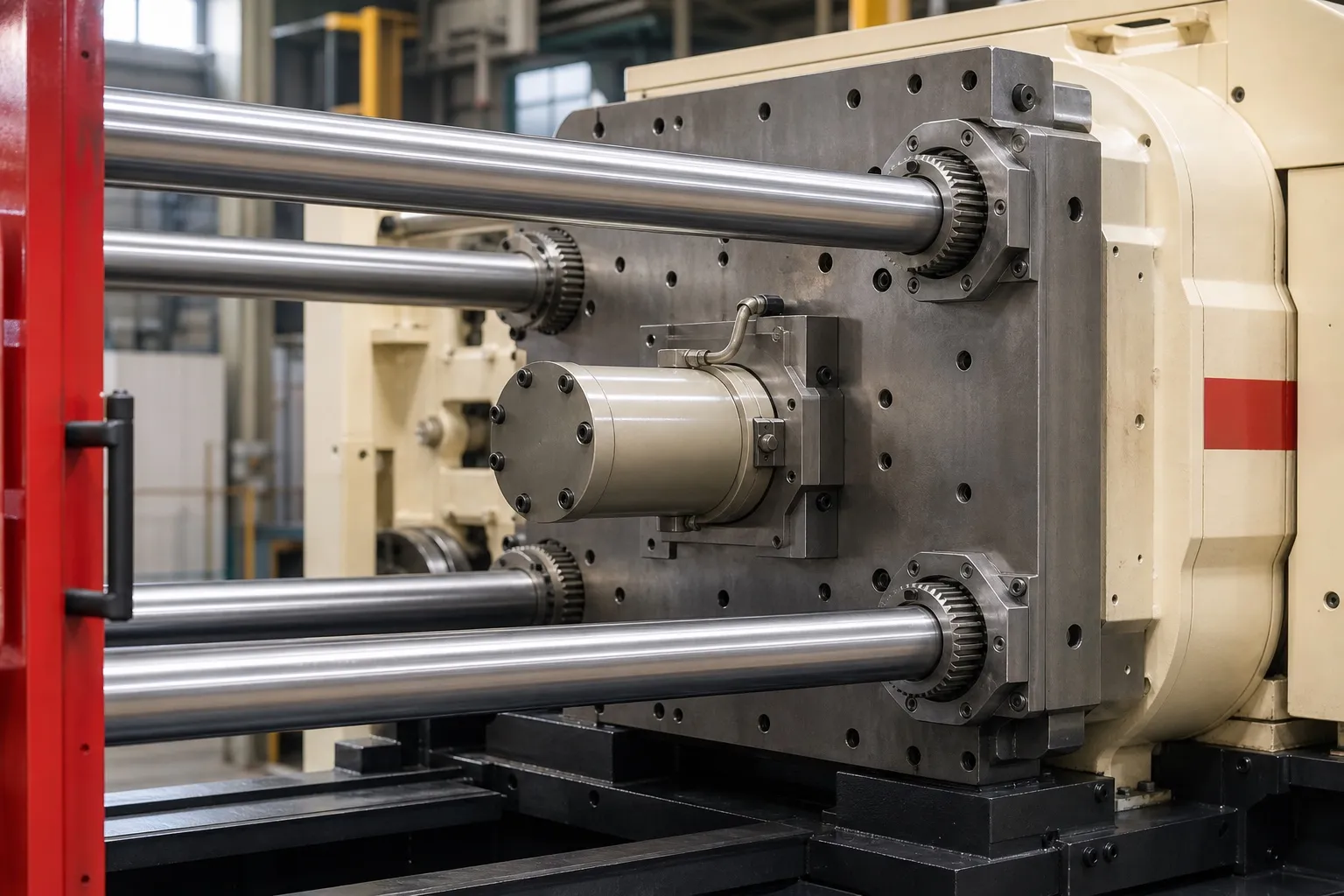
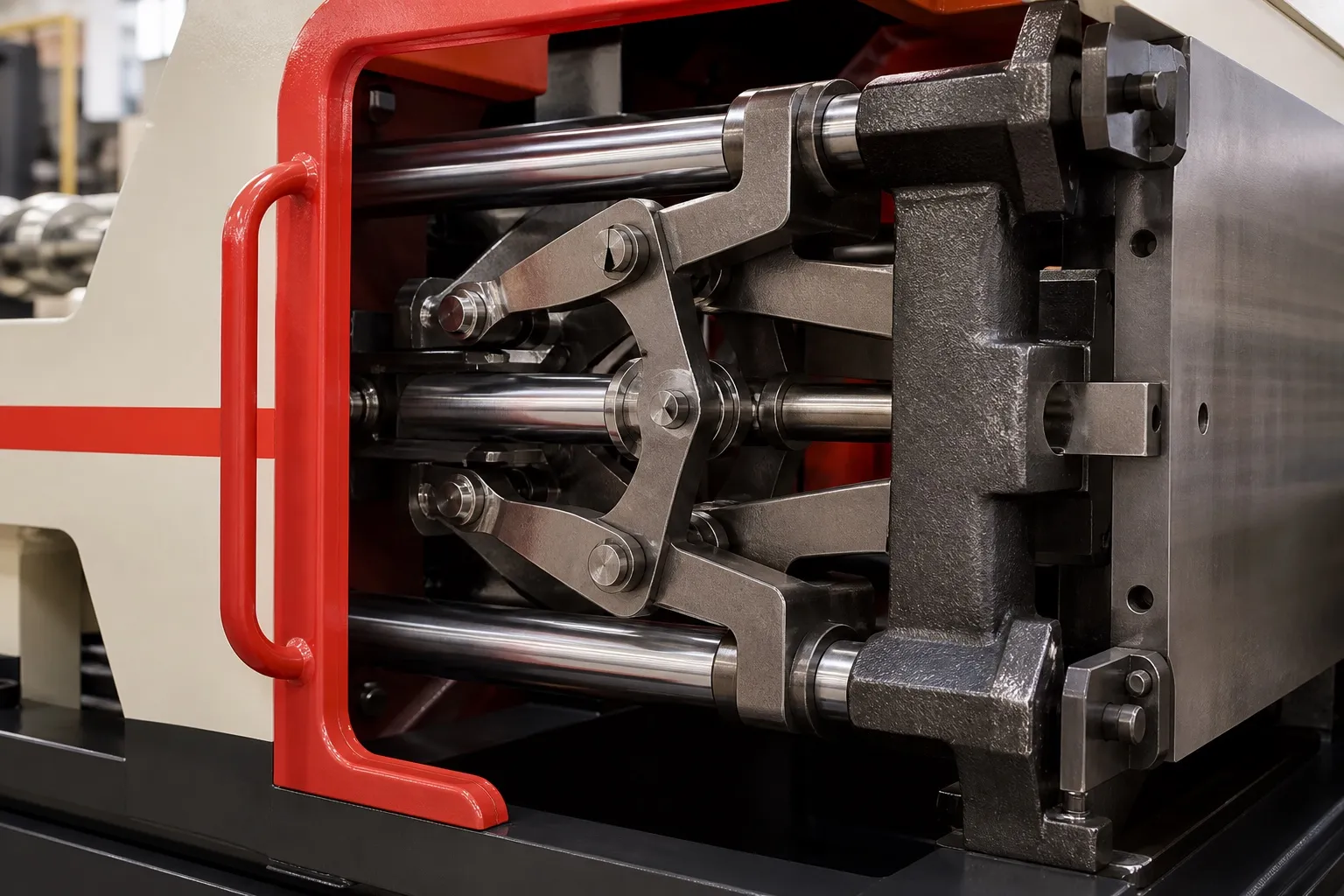
A plant has a new paint pail mould and a crate mould arriving in the same month. The toggle machine on the floor has enough clamp for both, but it cannot open far enough to drop the pail off its core, and the crate mould is wider than its tie-bar gap allows. This is the point where a bucket and crate moulding machine with a two platen clamp makes sense. Buckets, crates and dustbins are tall, open-topped PP parts with deep cores or large projected areas. They need a long opening, a wide tie-bar gap and steady clamp force, and two platen machines offer all three in a shorter frame.
Key Takeaways
- Size buckets and dustbins by opening stroke first: at least 2.5 times the part height, plus room to remove the part.
- Size crates by clamp force: projected area minus the open grid, times a PP tonnage factor.
- Use PP impact copolymer where drop strength matters, and check the grade sheet for food-contact compliance on food pails.
- Check shot weight against barrel capacity in volume, not in grams of polystyrene.
What should a bucket and crate moulding machine offer?
These parts combine height with area. A bucket or dustbin is deep, so the part needs a long opening to clear the core. A crate is wide, so it needs tonnage and tie-bar room. Two platen machines offer long opening, wide platens and adjustable tonnage together.
The clamp-type comparison is covered in the two platen vs toggle article in this series. For this family of parts, the practical points are the ones operators feel every shift: deep cores, heavy moulds and bulky parts that must leave the mould without hanging on the core.
Ejection is where deep parts give trouble. Pails and dustbins can be pushed off the core by a stripper ring at the rim, which ejects on the perimeter and avoids pin marks on the inside. Air through the core top breaks the vacuum that forms as the part shrinks onto the core. Flash at the stripper line is a maintenance signal, not a clamp problem.
What tends to limit the machine for each part
| Part | Main limit | Main check | Resin starting point |
|---|---|---|---|
| Bucket or paint pail | Opening stroke, core depth | Opening at least 2.5 × part height; stripper ejection | PP impact copolymer |
| Crate | Clamp force over a wide area | Net projected area × tonnage factor; tie-bar gap | PP impact copolymer |
| Dustbin | Mould height plus opening | Mould height + opening within daylight | PP copolymer or HDPE, by duty |
| Lid | Even clamp on a flat face | Flash at the rim; mould coverage of tie-bar gap | PP |
How much clamp force does a crate or bucket mould need?
Take the projected area of the part as seen from the press, subtract the through openings in a crate grid, add any cold runner, then multiply by a tonnage factor. For PP, Plastics Engineering gives 2 to 3 US tons per square inch, about 0.281 to 0.422 t/cm².
Crates are where the open grid pays off. A crate with 40% open area clamps only on the remaining 60%. A bucket clamps on the full circle at its rim, so a 300 mm rim alone is about 707 cm². At the same PP factors that comes to roughly 219 to 328 t once you add 10%, a starting margin, not a rule.
Thin walls and long flow paths push the factor up. A crate rib far from the gate fills at higher pressure than one beside it, so start at the PP figure and adjust using the mould maker's flow analysis rather than guessing. How to set the clamp once the mould is running, and why more tonnage is not a flash cure, is in the hydro-mechanical clamping article in this series.
Which PP grades suit pails, crates and dustbins?
Where drop and cold impact matter, pails and crates are moulded in PP impact copolymer rather than homopolymer. The Repol listing on UL Prospector names C080MA and C120MN for paint pails, and B030MG and MI3530 for crates and furniture. For food pails, pick a grade that states food-contact compliance.
Reliance's PP grade sheets state compliance with IS 10910, the standard that the FSSAI packaging regulations call up for PP food containers. Check the specific grade sheet, because a grade listed for industrial pails may not carry the same statement. Dustbins face sunlight and rough handling, so ask the resin supplier about a UV-stabilised grade or masterbatch for outdoor bins.
What shot weight and barrel size does a large PP part need?
Work in volume, not grams of polystyrene. Machine shot ratings are given in PS, and PP melt is lighter, so a barrel rated for 1,000 g of PS gives a good PP shot of only about 142 to 463 g. Keep the shot between 20% and 65% of barrel capacity.
Plastics Technology sets out the method: convert part weight to melt volume using melt density (PP about 0.74 g/cm³, PS 0.945), add 10% for check-valve leakage and melt uniformity, then size the barrel so the shot sits at or below 65%. Below about 20%, residence time grows and the melt can degrade, which shows up on long bucket cycles.
For buckets and dustbins, choose the machine by opening stroke first and tonnage second. A clamp that cannot open far enough is of no use for that mould, however much tonnage it has. The full opening method is in the mould height and daylight article in this series.
What should you send when planning bucket, crate or dustbin production?
Send the part drawing with height, rim or footprint size and the open area of any grid, the part weight and resin grade, the mould height and width if the mould exists, and the output you need per shift. With those, a supplier can check opening, clamp force, tie-bar gap and shot size together instead of matching tonnage alone. Compare the two platen injection moulding machine range against your own figures.
Frequently Asked Questions About Moulding Buckets, Crates and Dustbins
Can one machine run both bucket and crate moulds?
Yes, if it covers the larger need on each check: the bucket's opening stroke and mould height, and the crate's clamp force, tie-bar gap and shot size. Bucket moulds tend to be tall and crate moulds wide, so check both moulds against the same spec sheet before committing to one machine.
What material is used for plastic dustbins?
Dustbins can be moulded in PP copolymer, chosen for impact resistance, or in HDPE. For outdoor bins, ask the resin supplier for a UV-stabilised grade or masterbatch. Choose the grade by drop strength, cold impact and sunlight exposure, then confirm its tonnage factor and processing window on the data sheet.
Why do buckets stick on the core?
A deep core and a thin wall can form a vacuum as the part shrinks onto the core. Without enough draft, air assist or a stripper ring, the part hangs on or tears. Check draft on the core, add an air valve at the core top and make sure the stripper ring pushes evenly around the rim.
How many crates per hour can a two platen machine make?
Output per hour equals 3,600 divided by cycle seconds, times cavities, times the good-shot share. A one-cavity crate on a 45 s cycle at 98% good shots gives about 78 crates an hour. The cycle depends heavily on wall thickness and cooling, so treat any figure as conditional on your part and mould.
Can I use recycled PP for crates and buckets?
Yes, with care. Recycled PP can vary in flow and colour from lot to lot, and small metal particles can block hot-runner tips, so cold runners and larger gates are safer where possible. Vent well to handle out-gassing. Recycled-content rules for rigid packaging are covered in the hydro-mechanical clamping article in this series.
Related Articles
- Two Platen vs Toggle Injection Moulding Machines: Which Suits Large Moulds?
- Hydro-Mechanical Clamping Explained: Balanced Force and Flash-Free Parts
- Deep Moulds and Long Opening Strokes: Planning Mould Height and Daylight
Sources & References
- SPE Plastics Engineering, A. Urbina: Mastering Clamping Force Calculation (Mar 2024)
- Plastics Technology, J. Bozzelli: A Simpler Way to Calculate Shot Size vs. Barrel Capacity (2017, updated 2022)
- UL Prospector: Polypropylene (PP): REPOL grade listing
- MoldMaking Technology, B. Catoen: Machine Sizing and Specification for Optimal Mold Performance, Part 1 (Aug 2025)
Technical Disclaimer
Disclaimer: The information provided in this document is for general informational and educational purposes only. It is based on technical references and industry information available at the time of preparation and may be subject to change. It does not constitute engineering, technical, commercial or professional advice, nor does it constitute a quotation, specification, warranty or contractual commitment by Pratishna Engineers.
Actual injection moulding machine and process requirements vary according to the component design, material, mould, production volume, machine configuration and operating conditions. The information, examples, calculations and recommendations provided should be independently evaluated and verified for the specific application before making any equipment, process or production decision. Information obtained from third-party sources remains subject to the accuracy and limitations of those sources.
Limitation of Liability: Pratishna Engineers makes no representation or warranty, express or implied, regarding the completeness, accuracy or suitability of the information for any particular application. To the extent permitted by applicable law, Pratishna Engineers shall not be liable for any loss, damage, cost or consequence arising from reliance on or use of the information contained in this document. Final machine selection, configuration and application suitability should be confirmed with Pratishna Engineers based on complete and accurate project requirements.