
A dustbin 350 mm tall needs about 875 mm of opening to clear its core, at 2.5 times the part height. If its mould is 630 mm tall, a two platen machine must offer at least 630 + 875 = 1,505 mm of daylight. A toggle would need 875 mm of stroke and a maximum shut height above 630 mm. That one sum is the core of planning mould height and daylight for deep moulds: the opening the part needs, plus the mould height, must fit inside what the clamp can give at that mould height.
Key Takeaways
- Plan an opening of at least 2.5 times the part height, before adding room for a robot arm or a hand.
- On a two platen machine, usable opening is maximum daylight minus mould height; on a toggle it is the fixed stroke.
- Check the minimum mould height too, because a thin mould can fall below what the clamp can close on.
- Ejector stroke must push the part fully clear of the core, so check it alongside platen opening.
What is the difference between mould height and daylight?
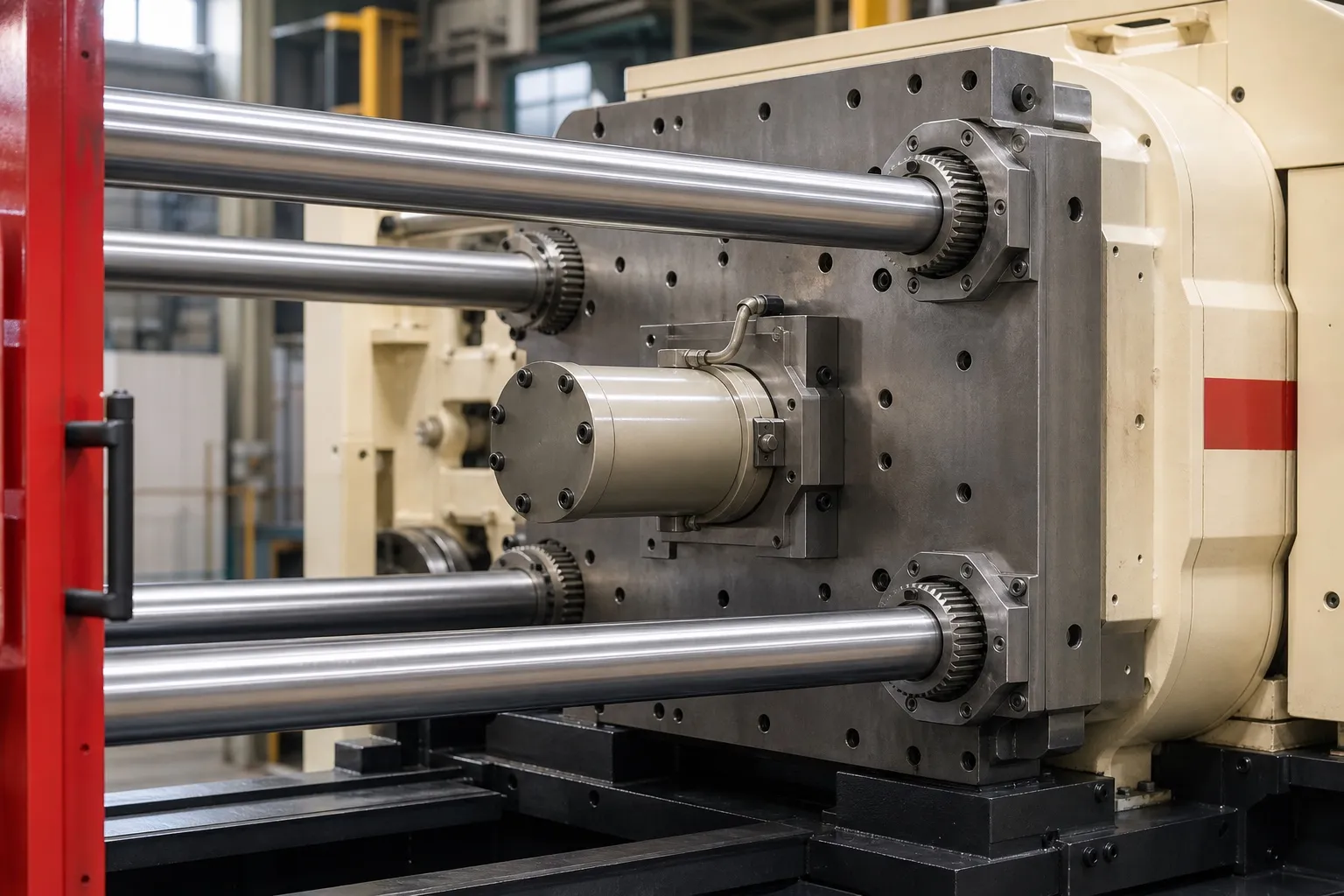
Mould height, or shut height, is the closed thickness of the mould from back plate to back plate. Daylight is the distance between the platens. Maximum daylight is the widest the platens can open. The opening left for the part is daylight minus mould height.
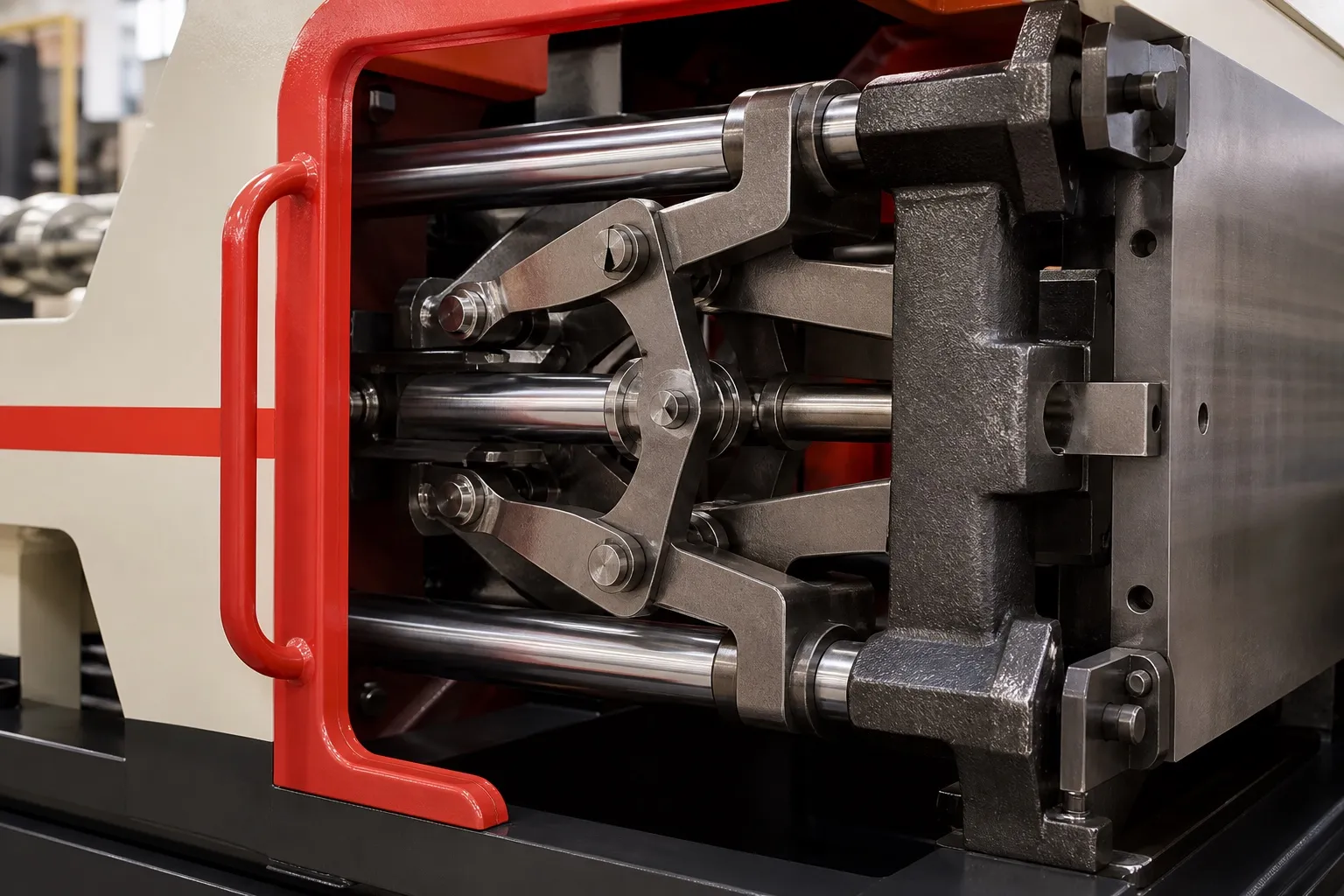
Spec sheets give these as maximum and minimum mould height, opening stroke and maximum daylight, and how they relate depends on the clamp. MoldMaking Technology sets out both cases. On a toggle, maximum daylight equals maximum shut height plus stroke, and the full stroke is available at every shut height. On a piston-type clamp, which includes two platen machines, maximum daylight equals minimum shut height plus maximum stroke, so the available stroke falls as the mould gets taller and peaks only at minimum shut height.
Usable opening by mould height (assumed: two platen daylight 1,500 mm; toggle stroke 700 mm, maximum mould height 650 mm)
| Mould height | Two platen opening | Toggle opening | Tallest part on two platen (opening ÷ 2.5) |
|---|---|---|---|
| 400 mm | 1,100 mm | 700 mm | 440 mm |
| 500 mm | 1,000 mm | 700 mm | 400 mm |
| 600 mm | 900 mm | 700 mm | 360 mm |
| 700 mm | 800 mm | Mould too tall | 320 mm |
| 800 mm | 700 mm | Mould too tall | 280 mm |
Read the table from the top down. With these assumed figures the two platen machine gives more opening at every mould height the toggle accepts, and keeps running moulds the toggle cannot take at all. The crossover point, two platen daylight minus toggle stroke, is 800 mm here, above the toggle's 650 mm limit, so the toggle never catches up.
How much opening stroke does a deep part need?
Allow at least 2.5 times the part height so the part can clear the core and fall or be picked. Add space for a robot arm or the operator's hand, and for any part that tilts as it leaves. Measure part height along the opening direction, including rims and lugs.
The 2.5 figure comes from MoldMaking Technology's machine-sizing guidance. The reason it is so much more than the part height is that the part first slides off a core about as long as itself, then needs roughly its own height again to pass between core and cavity, plus a margin to drop or be gripped.
Ejector stroke is the second check. On a deep pail, the ejectors or stripper ring must push the rim far enough off the core that the part releases fully; a short ejector stroke leaves the part hanging even with the platens wide open. Deep, thin-walled parts can also need air blow at the core top to break the vacuum.
What limits mould height on a two platen machine?
Two limits apply. The mould must be no thinner than the minimum mould height, or the clamp cannot close on it. At the top end, the useful limit is set by the opening the part needs, not by the quoted maximum mould height.
Turn the 2.5 rule around and you get a quick planning formula. If mould height is the part height plus an allowance for plates, core support and cooling, and the opening must be 2.5 times the part height, the daylight needed is 3.5 times the part height plus that allowance. So daylight, not tonnage, decides the tallest part a two platen machine can run.
Tall moulds are also heavy. Check the maximum mould weight for both platens, and keep the mould level and parallel; MoldMaking Technology gives 0.025 to 0.05 mm as generally acceptable on machines under 500 t.
Lead-acid battery containers show why this matters in India. They are deep, ribbed boxes, and BIS has published IS 1146:2026, the third revision of the specification for rubber and plastics battery containers, replacing the 1981 edition. When a container design changes, the mould height usually changes with it, so rerun the daylight sum before moving a revised mould onto an existing machine.
Never release a mould design until it has been drawn in the open position on the target machine's daylight, with the part and the take-out hand in the gap.
What should you send to plan a deep mould?
Send the part height along the opening direction, the planned or actual mould height, the mould width and weight, the ejection method and the take-out method. If the mould exists, add its locating ring size and ejector pattern. A supplier can then check opening, mould height and ejector stroke on one drawing. Machines built for deep moulds are in the two platen injection moulding machine range.
Frequently Asked Questions About Mould Height and Daylight
What is opening stroke on an injection moulding machine?
Opening stroke is how far the moving platen travels from closed to fully open. On a toggle it is fixed and available at any mould height within range. On a two platen machine the useful opening is the maximum daylight minus the mould height, so a taller mould leaves less stroke for the part.
Can I add a spacer plate to a thin mould?
Yes. If a mould is thinner than the machine's minimum mould height, a parallel riser or spacer plate can bring it into range. The plate must be flat, parallel and strong enough for full clamp force. On a two platen machine it also reduces the opening left for the part, so recheck the daylight sum.
Does ejector stroke matter if the platen opening is long enough?
Yes. The platens can be wide open while the part still sits on the core, because the ejectors or stripper have not pushed it far enough. Check the machine's ejector stroke and force against the core depth, and plan air blow or stripper ejection for deep, thin-walled parts that grip the core.
How do I measure mould height correctly?
Measure the closed mould from the back face of the fixed-half clamp plate to the back face of the moving-half clamp plate, leaving out the locating ring and any sprue bush that projects. Include insulation plates or risers you will run with. Measure at more than one corner to confirm the plates are parallel.
Why does a robot need extra opening?
A side-entry or top-entry robot arm has to enter the gap, grip the part and leave without touching the core. The gripper and arm add their own thickness to the part height, so plan the opening with the take-out tool drawn in. Manual removal needs room for a hand and wrist as well.
Related Articles
- Two Platen vs Toggle Injection Moulding Machines: Which Suits Large Moulds?
- Hydro-Mechanical Clamping Explained: Balanced Force and Flash-Free Parts
- Moulding Buckets, Crates and Dustbins on Two Platen Machines
Sources & References
- MoldMaking Technology, B. Catoen: Machine Sizing and Specification for Optimal Mold Performance, Part 1 (Aug 2025)
- MoldMaking Technology, B. Catoen: Machine Sizing and Specification, Part 1, digital edition p. 29 (Aug 2025)
- BIS: Know Your Standards: IS 1146:2026, Rubber and Plastics Containers for Lead-Acid Storage Batteries
Technical Disclaimer
Disclaimer: The information provided in this document is for general informational and educational purposes only. It is based on technical references and industry information available at the time of preparation and may be subject to change. It does not constitute engineering, technical, commercial or professional advice, nor does it constitute a quotation, specification, warranty or contractual commitment by Pratishna Engineers.
Actual injection moulding machine and process requirements vary according to the component design, material, mould, production volume, machine configuration and operating conditions. The information, examples, calculations and recommendations provided should be independently evaluated and verified for the specific application before making any equipment, process or production decision. Information obtained from third-party sources remains subject to the accuracy and limitations of those sources.
Limitation of Liability: Pratishna Engineers makes no representation or warranty, express or implied, regarding the completeness, accuracy or suitability of the information for any particular application. To the extent permitted by applicable law, Pratishna Engineers shall not be liable for any loss, damage, cost or consequence arising from reliance on or use of the information contained in this document. Final machine selection, configuration and application suitability should be confirmed with Pratishna Engineers based on complete and accurate project requirements.