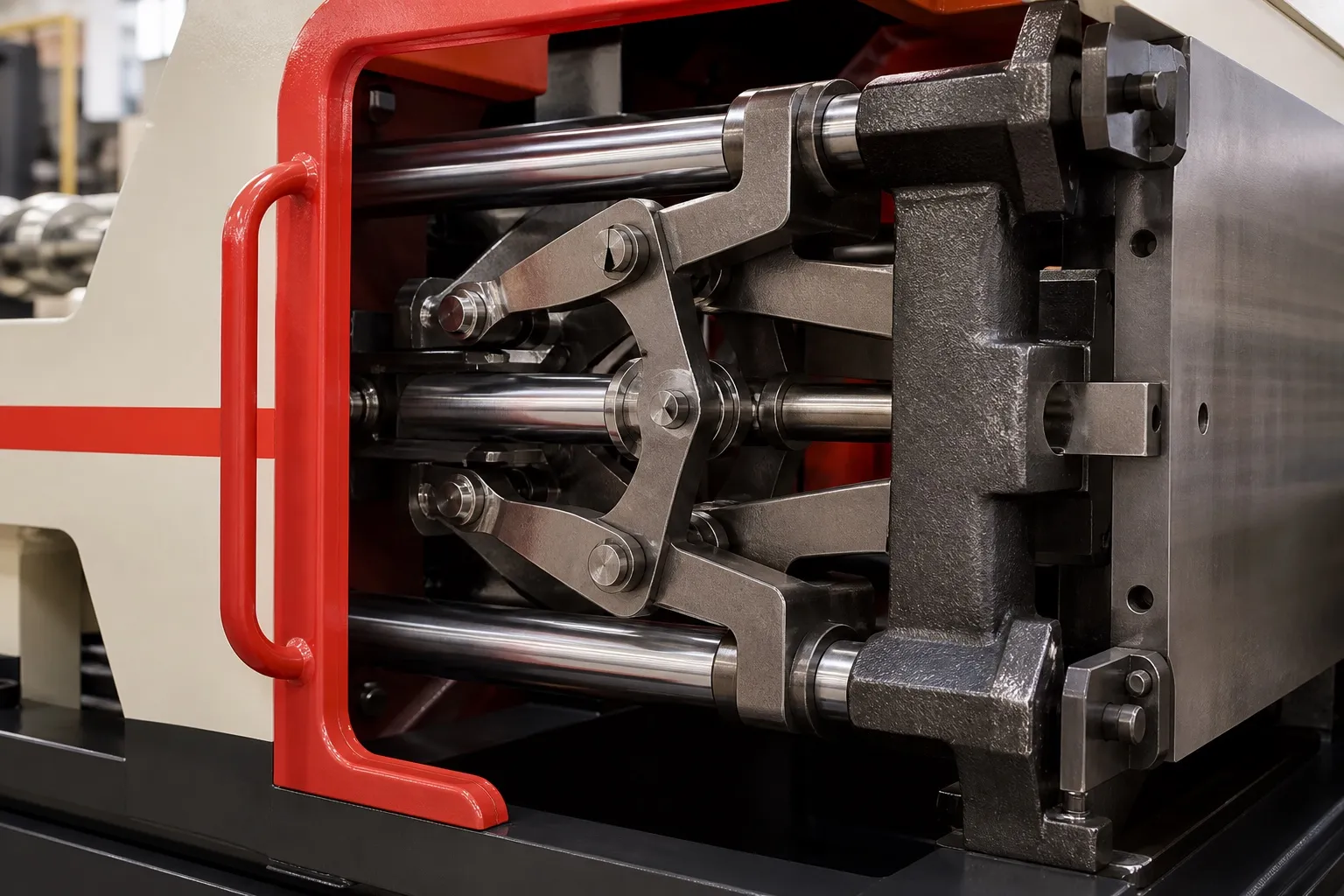
Plan an injection moulding machine upgrade when the same limit keeps recurring across your planned work, not when one mould is tight. Four signs matter: the clamp calculation lands above a 180 t rating with its reserve, regular shots run above 65% of the largest barrel, moulds will not pass the tie bars or open far enough, or thin-wall jobs are held back by fill speed.
Containers then point to a fast, long-stroke container machine. Buckets, tubs and storage boxes point to a large-shot houseware machine. Both kinds can overlap a 180 t machine on clamp force, so the deciding question is which limit you keep hitting, not tonnage alone.
Key Takeaways
- Move up when a limit repeats across moulds you have won or quoted, not for one tight job that fewer cavities or a hot runner could fix.
- Clamp, shot, mould size and fill speed are separate limits, and each points to a different kind of machine.
- A machine that is too large has its own cost: on a standard hydraulic machine, base load can be 75% or more of total energy.
- Rigid plastic packaging in India must reach at least 30% recycled content in 2025-26, rising to 60% by 2028-29, which can change how container jobs run.
Which Signs Show You Have Outgrown a 75 to 180 Ton Machine?
You have outgrown it when clamp, shot or mould size keeps falling short across several planned moulds. One tight mould can often be fixed with fewer cavities or a hot runner. Repeated shortfalls on new work are the signal to plan a larger or different machine.
Keep a simple log for each new enquiry: required clamp with reserve, shot as a share of the largest barrel, mould width against tie-bar spacing, and part depth against opening stroke. When the same column fails again and again, it names the limit you need to buy past.
For the shot, use the working range set out in the screw diameter article in this series. Regular shots above about 65% of the largest barrel are a clear sign.
Cycle can be a sign too. If cooling is already short and the machine still cannot fill a thin part fast enough, the limit is injection speed, and a bigger clamp alone will not fix it.
When Does Container Work Call for a Faster Machine?
Container work calls for a faster machine when thin walls must fill before the melt freezes and deep parts need a long opening stroke. A general-purpose machine may clamp a thin-wall tub easily, yet fill it too slowly or fail to open far enough to eject it.
Williams' clamp tonnage column in Plastics Technology suggests that a flow length to wall thickness ratio below 150:1 carries a low risk of sinks, short shots and dimensional problems. Thin-wall containers can sit well above that, which is why fill speed and pressure can decide the machine rather than clamp.
Deep parts need room to leave the mould. A container must clear the cavity and then strip off the core, so the opening stroke grows with part depth.
Indian rules can change container jobs as well. Polymerupdate reports that under the Plastic Waste Management Rules as amended on 31 March 2026, rigid plastic packaging must contain at least 30% recycled material for 2025-26, rising to 60% by 2028-29, with exemptions where food rules restrict recycled content. Recycled resin can vary in flow from lot to lot, so leave pressure and speed in hand.
When Do Household Articles Need a Larger Platen and Shot?
Buckets, tubs, storage boxes and large trays outgrow a 180 t machine on area, shot weight and mould size together. Their wide rims add projected area, their weight needs a large barrel, and their moulds are wide and tall. When all three rise, a large-shot houseware machine fits.
Work through the checks in order. Rim area sets clamp, as the worked example below shows. Part weight plus about 10% sets the barrel. Mould width and height, including cooling connections and lifting points, must pass the tie bars.
Depth matters here too. A bucket or tall storage box needs the same long opening as a deep container, so check daylight together with platen size.
Which limit points to which kind of machine
| Limit you keep hitting | Typical parts | Machine type it points to |
|---|---|---|
| Fill speed on thin walls | Thin-wall tubs, cups, lids | Container machine with fast injection |
| Opening stroke and daylight | Deep containers, pails | Container machine with long stroke |
| Shot weight and platen size | Buckets, tubs, storage boxes, large trays | Houseware machine with large shot and wide tie bars |
| Clamp only, small moulds | Same parts, more output needed | A second machine of the current size |
Is an Injection Moulding Machine Upgrade Better Than a Second Smaller Machine?
It depends on the part. If the part needs more clamp, shot or opening than a 180 t machine offers, only a larger machine will do. If you only need more output of parts that already fit, a second machine of the same size can be the better buy.
Size affects running cost. The ExxonMobil, AMI and Tangram energy guide for moulders notes that a standard hydraulic machine's base load can be 75% or more of its total energy, and that a high base load can mean the machine is too large for the job. It also finds that ten-year energy cost exceeds purchase cost in almost every case.
Small moulds on a large clamp carry risk as well. Williams describes a mould needing about 100 t that was clamped at the 400 t machine maximum; its cavity block split in two places, a repair costing upwards of $100,000. He lists burns, short shots, gloss changes, crushed vents and broken inserts among the effects of over-clamping.
Our view: do not move up for one mould. Move up when the signs repeat across work you have won or quoted, and keep the smaller machines for the parts they suit.
What Should You Send Before Planning the Move?
Send drawings or samples of the parts driving the move, resin grades, cavity plans, mould sizes and monthly quantities, plus the jobs that will stay on your current machines. The limit can then be named before a machine type is chosen. See the 75 to 180 ton horizontal injection moulding machine page.
Frequently Asked Questions About an Injection Moulding Machine Upgrade
Can I add clamp force to my existing machine?
No, not in any practical way. Rated clamp force is set by the platens, tie bars and clamp unit, which are designed together. A mould that needs more force than the rating will flash and load the structure beyond its design. The usual fixes are fewer cavities, a hot runner or a larger machine.
What is base load, and why does it matter when moving up?
Base load is the energy a machine draws regardless of how much plastic it processes, from pumps, heaters and controls. The ExxonMobil, AMI and Tangram guide puts it at 75% or more for standard hydraulic machines and about 10 to 20% for all-electric and hybrid machines. A larger machine running small jobs carries that load every hour.
How do I tell whether the machine or the mould limits my cycle?
Look at where the time goes. If cooling takes most of the cycle, the mould and wall thickness set the pace. If the machine reaches its injection speed or pressure limit before the part fills, the machine is the limit. A cycle breakdown from the controller usually shows which one.
Does recycled content change the machine I need?
It can. Recycled resin can vary in melt flow and contamination between lots, so a process set close to the machine's speed or pressure limit has little room to adjust. For rigid packaging moving toward the higher recycled shares in the Plastic Waste Management Rules, size with pressure and speed in reserve.
Is daylight the same as opening stroke?
No. Daylight is the largest gap between the platens when the clamp is fully open. Opening stroke is how far the moving platen travels. For a given mould, usable opening is limited by the stroke and by daylight minus the mould's shut height. Check both against the depth of the part.
Related Articles
- Injection Moulding Machine Tonnage Selection: Matching 75 to 180 Tons to Your Part
- Screw Diameter Choice: Shot Weight vs Injection Pressure on 75 to 180 Ton Machines
- Getting the Most From Multi-Cavity Moulds on 75 to 180 Ton Machines
Sources & References
- Plastics Technology, J. Williams (RJG): Clamp Tonnage: More Is Better...Right?
- Plastics Technology, J. Bozzelli: A Simpler Way to Calculate Shot Size vs. Barrel Capacity
- ExxonMobil, AMI and Tangram Technology: An Energy Saving Guide for Injection Moulders
- Polymerupdate, D. K. Jha: India eases plastic recycling regulations (8 April 2026)
Technical Disclaimer
Disclaimer: The information provided in this document is for general informational and educational purposes only. It is based on technical references and industry information available at the time of preparation and may be subject to change. It does not constitute engineering, technical, commercial or professional advice, nor does it constitute a quotation, specification, warranty or contractual commitment by Pratishna Engineers.
Actual injection moulding machine and process requirements vary according to the component design, material, mould, production volume, machine configuration and operating conditions. The information, examples, calculations and recommendations provided should be independently evaluated and verified for the specific application before making any equipment, process or production decision. Information obtained from third-party sources remains subject to the accuracy and limitations of those sources.
Limitation of Liability: Pratishna Engineers makes no representation or warranty, express or implied, regarding the completeness, accuracy or suitability of the information for any particular application. To the extent permitted by applicable law, Pratishna Engineers shall not be liable for any loss, damage, cost or consequence arising from reliance on or use of the information contained in this document. Final machine selection, configuration and application suitability should be confirmed with Pratishna Engineers based on complete and accurate project requirements.