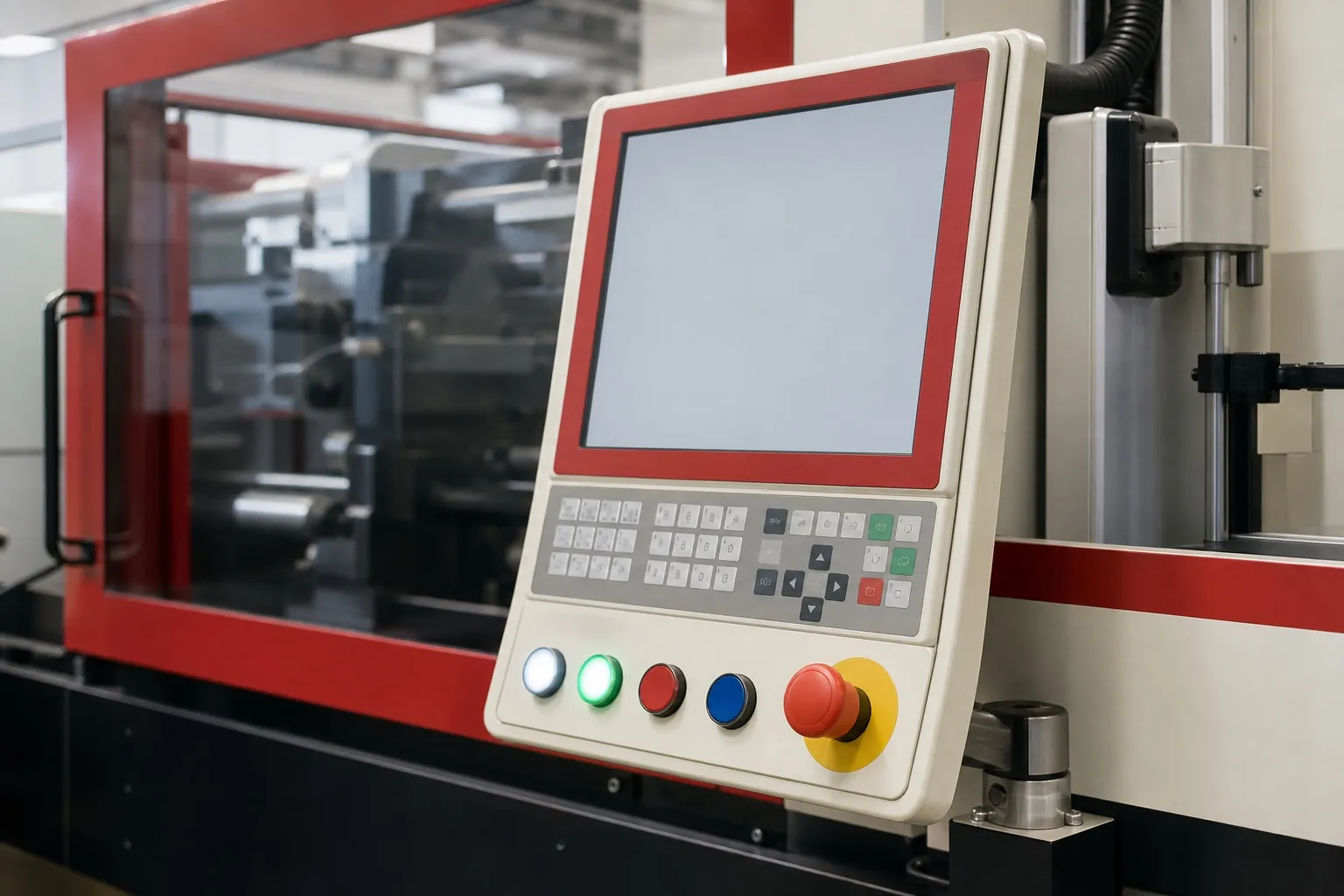
A six-cavity mould making 32 g edible oil bottle preforms on a 22 s cycle runs about 164 shots an hour. At 97% good shots that is about 952 preforms an hour, and it pulls about 31 kg of dry PET through the machine every hour. On a 125 t machine the clamp holds such a mould easily. The cycle, the shot and the resin supply decide whether the job pays.
Every figure in that paragraph is an assumption you will replace with your own. The method behind them, and the checks that come before them, are what this article sets out.
Key Takeaways
- Edible oil packaging falls under the FSSAI Packaging Regulations, which list IS 12252 for PET and suggest PP or HDPE caps for fats and oils.
- Preform cycle time follows wall thickness far more than weight, so quote oil preforms by wall.
- Mould cooling after hold typically runs about 1 to 3 seconds depending on wall, with mould water at 7 to 10 °C.
- A five-litre jar preform shifts the limit from clamp to shot weight and cooling time.
Which Rules Apply to Edible Oil Bottles in India?
The FSSAI Packaging Regulations, 2018 require plastics in food containers to meet listed Indian Standards, with IS 12252 named for PET. Their Schedule IV suggests PP or HDPE caps for fats and oils. Your preform neck must therefore suit a PP or HDPE closure from the start.
The same regulations set an overall migration limit of 60 mg/kg, or 10 mg/dm², tested to IS 9845, and require food businesses to hold a certificate of conformity from an NABL lab for packaging in direct food contact. Your oil customer carries that duty, but will ask you for the resin documents behind it.
Recycled plastics may be used for food only as FSSAI frames standards and guidelines for them. Treat any recycled PET in an oil preform as your customer's decision, in writing, before it reaches your dryer.
How Do Oil Preforms Differ From Water Preforms?
Oil bottles carry no carbonation and are not judged on taste the way still water is, so the preform design centres on wall strength, neck fit and appearance. Five-litre jars bring heavier preforms with larger necks, and that changes the shot, the cooling and the cavity count.
Ottmar Brandau, in his preform guide extracted in PETplanet Insider, ties acetaldehyde's taste problem to still water and notes that other preform makers still track it as a sign of screw and barrel wear. For oil, treat it as a process check rather than a taste limit.
The neck deserves the same care as in any food container. Agree the finish with the closure supplier, since the closure will be PP or HDPE, and gauge it on the first trial before blowing any bottles. A neck that does not seal leaks oil long after dispatch.
How Do Wall and Weight Set the Cycle for Edible Oil Bottle Preforms?
Wall thickness sets the cycle, not weight. Brandau notes that two preforms with the same wall, one twice as heavy as the other, may differ in cycle time by only 1 or 2 seconds. A heavier preform with the same wall costs little time; a thicker wall costs a lot.
RJG explains why: wall thickness is squared in the cooling equation. A 3.5 mm wall needs about 36% more cooling than a 3.0 mm wall, since (3.5 ÷ 3.0)² is about 1.36. Wall choices on the drawing move your output more than any setting on the machine.
Rick Unterlander and Brandau's troubleshooting guide puts mould cooling after hold at typically about 1 to 3 seconds, depending on wall thickness, with mould water at 7 to 10 °C and water flow at the mould maker's rating. The rest of the cooling continues after ejection, in the take-out receptacles, whose water flow the same guide also asks you to check.
Our view: quote oil preforms by wall thickness, not by weight. Two drawings with the same gram weight can differ by seconds in cycle, and those seconds are the margin in the job.
What Does a Five-Litre Oil Jar Preform Need?
A heavier shot, a wider neck and fewer cavities. The clamp at 125 t still has room for two or more cavities, so check the shot weight against the barrel and the wall against the cycle first. Those two numbers decide whether the jar runs well on 125 t.
Shot weight converts to barrel volume through PET's melt density, a step worked through in the 125 ton vs 150 ton sizing article in this series. The worked example below compares the output of a one-litre and a five-litre oil mould on the same machine.
One-litre and five-litre oil preforms on a 125 t machine: what changes
| Point | One-litre oil preform | Five-litre oil jar preform |
|---|---|---|
| Cavity limit | Clamp allows many; shot and mould width decide | Clamp allows two or more; shot weight decides |
| Weight per cavity | Lighter | Several times heavier |
| Neck | Narrow, for a PP or HDPE closure | Wider, for a larger PP or HDPE closure |
| Cycle driver | Wall thickness | Wall thickness, with a thicker wall cooling longer |
| First check on trial | Cavity weight balance and neck fit | Shot share of the barrel and stable cycle |
Weigh jar preforms from both cavities on the first trial. With only two cavities, one underfilled cavity halves your good output for that shot.
What Should You Send for an Edible Oil Preform Quote?
Send the preform drawings with weight, wall thickness and neck finish, the closure drawing, the resin grade and your hourly or daily output for each size. Shot, cycle and resin supply can then be checked for each mould. See the 125 ton PET injection moulding machine page.
Frequently Asked Questions About Edible Oil Bottle Preforms
Can the same machine run one-litre and five-litre oil preforms?
Yes, as separate moulds. In the worked example the shots are similar, about 180 to 192 g, so one barrel can suit both if both sit inside its working range. The five-litre mould runs fewer, heavier preforms on a longer cycle, so plan production by preforms needed, not shots.
Do oil bottles need a special PET grade?
Not always a special one, but a bottle grade that its supplier lists for food packaging, with the compliance papers your customer needs. Ask whether the grade suits the bottle size and blowing method you plan, and keep the data sheet and certificates with every lot.
Why does the closure type matter to the preform maker?
The neck is moulded to final size and never blown, so it must match the closure exactly. With FSSAI suggesting PP or HDPE caps for fats and oils, the closure supplier's drawing sets the thread and sealing surface your neck inserts must hit.
Can I add colour to edible oil preforms?
You can, through a masterbatch suited to PET and approved for food contact by its supplier. Colour adds a dosing step and a purge at every change, and the masterbatch must be dried or kept dry like the PET it goes into. Run colour trials and check the neck and wall before production.
What output can a two-cavity five-litre jar mould reach?
In the worked example, about 233 good jar preforms an hour at a 30 s cycle. Your real figure depends on the wall thickness, which drives cooling, and on how quickly preforms can leave the mould. Measure the stable cycle on trial before promising a daily quantity.
Related Articles
- What PET Products Can You Make on a 125 Ton Machine?
- PET 125 Ton vs 150 Ton: Sizing by Shot Weight and Mould Size
- Controlling Haze and Acetaldehyde in PET Preforms
Sources & References
- FSSAI: Food Safety and Standards (Packaging) Regulations, 2018, compendium
- PETplanet Insider, O. Brandau: Bottles, Preforms and Closures extract, 3.6 Acetaldehyde in PET Bottles (Vol. 16, 03/2015)
- PETplanet Insider, R. Unterlander and O. Brandau: The Rapid Guide to Perfect Preforms, part 34: Wavy Body (Vol. 13, 11/2012)
- RJG Inc.: How to Determine Injection Molding Cooling Time
Technical Disclaimer
Disclaimer: The information provided in this document is for general informational and educational purposes only. It is based on technical references and industry information available at the time of preparation and may be subject to change. It does not constitute engineering, technical, commercial or professional advice, nor does it constitute a quotation, specification, warranty or contractual commitment by Pratishna Engineers.
Actual injection moulding machine and process requirements vary according to the component design, material, mould, production volume, machine configuration and operating conditions. The information, examples, calculations and recommendations provided should be independently evaluated and verified for the specific application before making any equipment, process or production decision. Information obtained from third-party sources remains subject to the accuracy and limitations of those sources.
Limitation of Liability: Pratishna Engineers makes no representation or warranty, express or implied, regarding the completeness, accuracy or suitability of the information for any particular application. To the extent permitted by applicable law, Pratishna Engineers shall not be liable for any loss, damage, cost or consequence arising from reliance on or use of the information contained in this document. Final machine selection, configuration and application suitability should be confirmed with Pratishna Engineers based on complete and accurate project requirements.