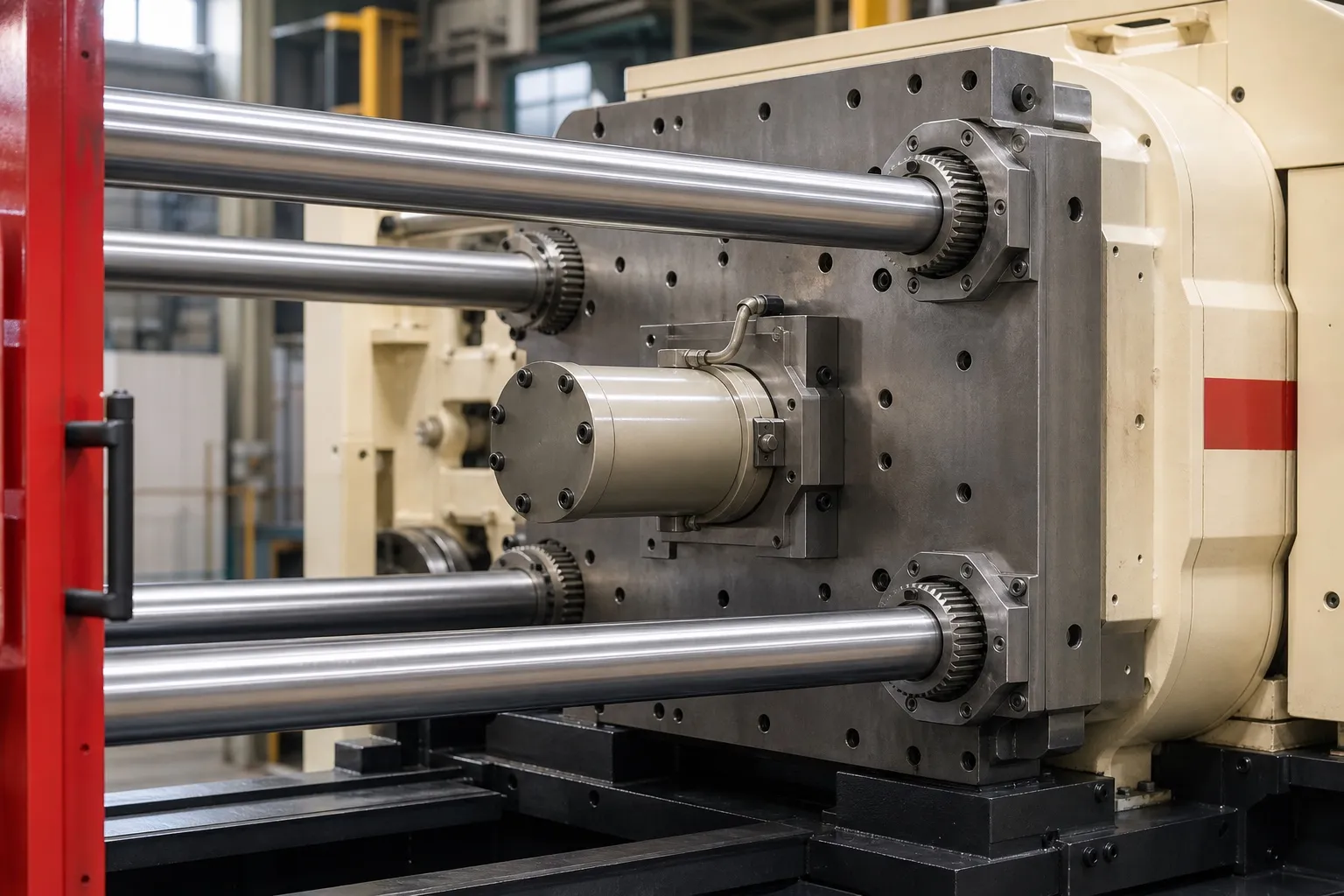
A container making machine is sized on three numbers, in this order: the injection rate that fills the thinnest wall before it freezes, the opening stroke that lets the deepest container leave the core, and the clamp force that holds the mould shut against a fast, high-pressure fill. Tonnage comes last, because a thin-wall container can need a high clamp per cm² yet only a small shot.
Take all three from the container drawing and the mould layout and the choice follows. Start from tonnage alone and you can end up with a press that clamps the mould but fills it too slowly.
Key Takeaways
- Injection rate is shot volume divided by fill time. Thin-wall parts can need fill times under one second, so rate can decide the machine before clamp does.
- Opening stroke grows with container depth, because the part must clear the cavity and then come off the core.
- Thin-wall work can call for 5 to 8 US t/in² of clamp, against 3 to 5 in conventional moulding, according to a Sabic engineer writing in PlasticsToday.
- Rigid plastic packaging in India faces rising recycled-content targets under the amended Plastic Waste Management Rules, with exemptions where food rules restrict recycled content.
How Fast Must a Container Making Machine Inject?
Fast enough to fill the whole container before the melt front freezes in the thin wall. Divide the shot volume in cm³ by the fill time the mould needs, and you have the injection rate in cm³/s. Thin-wall containers can need the full shot delivered in well under one second.
In a PlasticsToday article on thin-wall moulding, Sabic engineer Greg Tremblay reports fill times of less than one second and injection velocities above 3 in/s, about 76 mm/s, with many jobs needing 6 in/s, about 152 mm/s. Speeds like that need close control of speed, pressure and position, so check the controller as well as the pump.
Work in melt volume. Plastics Technology columnist John Bozzelli gives a melt density of about 0.74 g/cm³ for PP, so a 50 g PP shot is about 68 cm³ of melt. Delivered in half a second, that is about 135 cm³/s.
Rate equals screw area times screw speed, so the same unit delivers more cm³/s with a larger screw at the same speed. The thin-wall container article in this series covers the trade between screw size, speed and barrel use.
How Much Opening Stroke Does a Container Need?
Enough for the container to clear the cavity, come off the core and fall or be picked cleanly. A common rule of thumb is twice the container depth plus about 50 mm, used here as a starting margin, not a rule. Check every container drawing against it.
Daylight is the other half of the check. The mould's shut height plus the opening stroke must fit inside the machine's maximum daylight, and a deep container mould is tall before it even opens.
Stack moulds and stripper-plate designs add height again. Ask the toolmaker for the shut height before you shortlist machines, because it can rule out a press that would clamp the mould comfortably.
Opening speed matters as much as distance. A long stroke at a slow platen speed adds time to every cycle, which the deep container mould article in this series works through.
If a robot takes the containers out, add the space its gripper needs between the open mould halves to the stroke check.
Container type and the number that usually decides the machine
| Container type | Deciding number | Why |
|---|---|---|
| Thin-wall tubs and cups | Injection rate | Thin walls freeze quickly, so the shot must arrive fast |
| Deep containers and pails | Opening stroke and daylight | The part must clear a tall core before it can drop |
| Multi-cavity lids | Clamp force and tie-bar space | Wide, flat parts add projected area quickly |
| Caps and closures | Mould size and cooling | Small parts, but many cavities and thick sections |
Why Does Thin-Wall Packaging Need More Clamp per cm²?
Fast, high-pressure filling pushes harder on the mould faces than a conventional fill. That higher cavity pressure has to be held by the clamp, so the tonnage factor for thin-wall work sits well above the figures used for thicker parts in the same resin.
Tremblay puts the factor for thin-wall work at 5 to 8 US t/in², against 3 to 5 in conventional moulding, or about 0.70 to 1.12 t/cm² in metric. The clamp method is unchanged: cavity projected area, plus any cold runner, times the factor, as RJG's Jeremy Williams sets out in Plastics Technology.
A hot runner takes the runner out of that sum, which can be the difference between two tonnage classes on a multi-cavity container mould.
Indian rules add a variable. Polymerupdate reports that under the Plastic Waste Management Rules as amended on 31 March 2026, rigid plastic packaging must contain at least 30% recycled material in 2025-26, rising to 60% by 2028-29, with exemptions where FSSAI and similar rules restrict recycled content. Where recycled resin is allowed, its flow can vary between lots, so keep speed and pressure in reserve.
Our view: for container work, size the machine on injection rate and stroke first, and treat clamp as the check, not the starting point. A press chosen on tonnage alone can hold the mould shut and still be too slow to fill it.
What Should You Send for a Container Machine Check?
Send the container drawing with wall thickness and depth, the resin grade, the cavity count and runner type, the mould's shut height and outside size, and your target output. Rate, stroke and clamp can then be worked out together. See the 140 to 320 ton container injection moulding machine page.
Frequently Asked Questions About Container Making Machines
Is injection rate the same as injection speed?
No. Injection speed is how fast the screw moves forward, in mm/s. Injection rate is the melt volume delivered per second, in cm³/s, and equals screw speed times screw area. Two machines with the same screw speed deliver different rates if their screws differ in diameter, so compare rate for container work.
Can a general-purpose machine make containers?
It can make thicker-walled containers that fill easily. Thin-wall packaging is harder: Tremblay advises that adapting conventional machines for it is usually unwise, because thin-wall work needs higher speeds, pressures, clamp per cm² and platen stiffness. Check your container's wall and flow length before you decide.
Why does the mould's shut height matter so much for containers?
Because daylight must hold the shut height plus the opening stroke. Deep container moulds are tall, so a machine with enough clamp can still lack the daylight to open far enough. Get the shut height from the toolmaker before shortlisting, and check the machine's minimum mould height as well.
Should container moulds use a hot runner?
It is worth pricing. A hot runner removes runner scrap, takes runner area out of the clamp sum and can shorten the cycle where the runner is the thickest section. It adds cost, temperature control and maintenance, so compare those with your resin saving and output gain over the mould's life.
What output data should I give when asking for a container machine?
Give the monthly quantity, the working hours per day and days per month, the cavity count and the target cycle if you have one. Output per hour is 3,600 divided by cycle seconds, times cavities, times the good-shot share, so these figures let the cycle requirement be worked back.
Related Articles
- Thin-Wall Container Moulding on 140 to 320 Ton Machines
- Caps and Closures Moulding on 140 to 320 Ton Machines
- Deep Container Moulds: Daylight, Ejector Stroke and Cycle Time
Sources & References
- PlasticsToday, G. Tremblay (Sabic Innovative Plastics): Never too thin (October 2007)
- Plastics Technology, J. Bozzelli: A Simpler Way to Calculate Shot Size vs. Barrel Capacity
- Plastics Technology, J. Williams (RJG): Clamp Tonnage: More Is Better...Right?
- Polymerupdate, D. K. Jha: India eases plastic recycling regulations (8 April 2026)
Technical Disclaimer
Disclaimer: The information provided in this document is for general informational and educational purposes only. It is based on technical references and industry information available at the time of preparation and may be subject to change. It does not constitute engineering, technical, commercial or professional advice, nor does it constitute a quotation, specification, warranty or contractual commitment by Pratishna Engineers.
Actual injection moulding machine and process requirements vary according to the component design, material, mould, production volume, machine configuration and operating conditions. The information, examples, calculations and recommendations provided should be independently evaluated and verified for the specific application before making any equipment, process or production decision. Information obtained from third-party sources remains subject to the accuracy and limitations of those sources.
Limitation of Liability: Pratishna Engineers makes no representation or warranty, express or implied, regarding the completeness, accuracy or suitability of the information for any particular application. To the extent permitted by applicable law, Pratishna Engineers shall not be liable for any loss, damage, cost or consequence arising from reliance on or use of the information contained in this document. Final machine selection, configuration and application suitability should be confirmed with Pratishna Engineers based on complete and accurate project requirements.