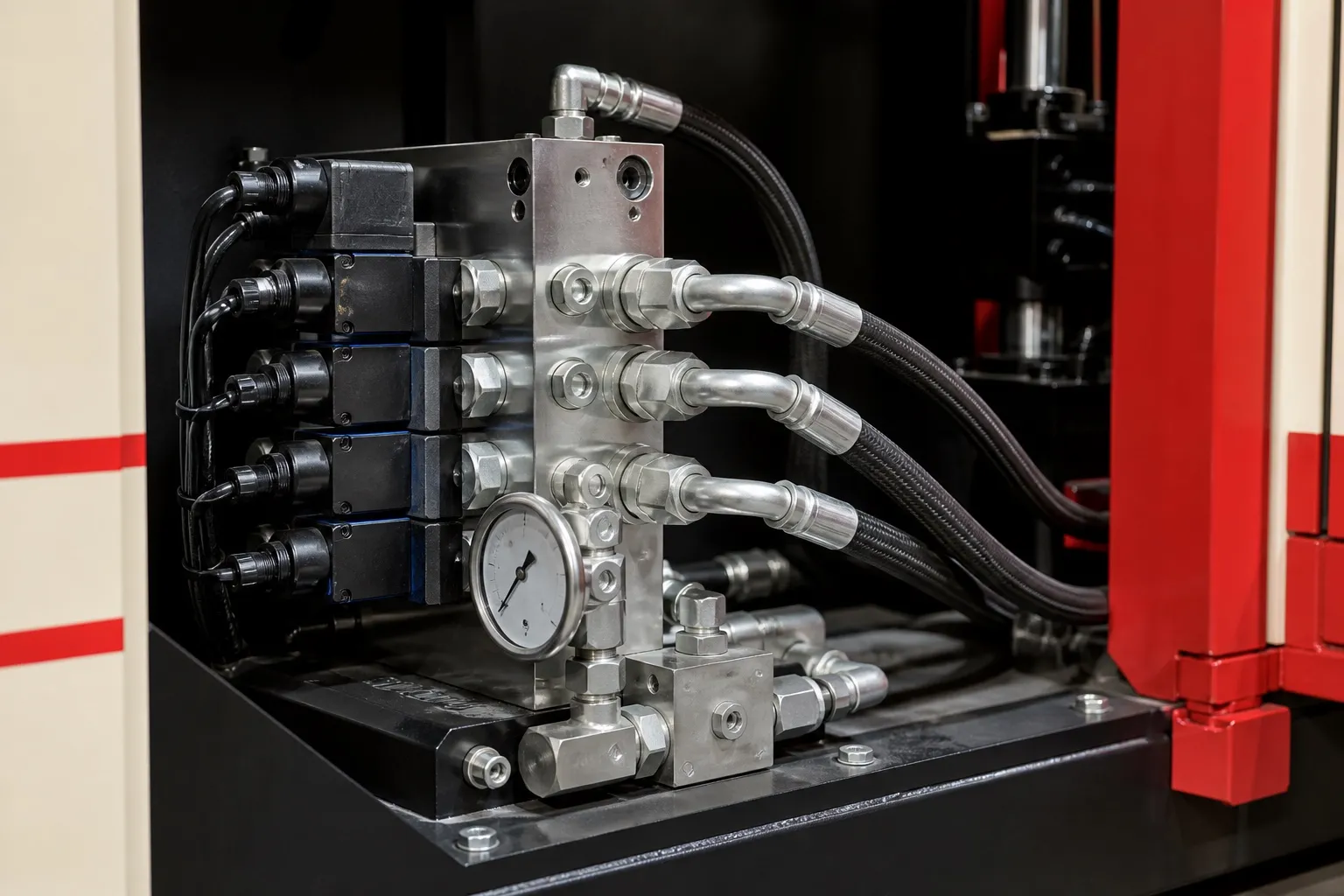
Typical 40 ton vertical machine applications: cavities the clamp can hold at a PVC tonnage factor of 2 to 3 US t/in², with a 10% reserve (a starting margin, not a rule), before any runner
| Cable part | Example outline across the parting line | Area per cavity | Cavities by clamp at 40 t |
|---|---|---|---|
| Moulded plug body on a power cord | 45 × 30 mm | 13.5 cm² | 6 to 9 |
| Strain relief on a cord | 60 × 15 mm | 9.0 cm² | 9 to 14 |
| Cable grommet | 30 × 20 mm | 6.0 cm² | 14 to 21 |
| Small harness clip moulded onto wire | 30 × 15 mm | 4.5 cm² | 19 to 28 |
| Cable end cap or sleeve | 25 × 12 mm | 3.0 cm² | 28 to 43 |
| Small connector body on a cable | 70 × 45 mm | 31.5 cm² | 2 to 4 |
Typical 40 ton vertical machine applications are parts moulded straight onto a cable or wire: plug bodies on power cords, strain reliefs, grommets, harness clips, end caps and sleeves. On clamp alone, 40 t holds many cavities of these small parts. In practice, loading the cables sets the cavity count long before the clamp does.
The table counts cavities by clamp only. Treat any count above four as theoretical until you have timed a real loading cycle. The sections below explain the clamp method, why these parts suit a machine that injects at the parting line, and which compounds and rules apply.
Key Takeaways
- These machines suit parts moulded onto a cable that lies across the parting line: cord plugs, strain reliefs, grommets, clips, end caps and sleeves.
- Clamp needed is projected area across the parting line, times cavities, plus any cold runner, times a tonnage factor for the compound.
- At a PVC factor of 2 to 3 US t/in² and a 10% reserve, 40 t carries about 86 to 129 cm² of parts and runner.
- Cable handling and operator loading time usually cap the cavity count well before the clamp does.
What Are Typical 40 Ton Vertical Machine Applications?
They are small parts formed directly on a cable or wire. The cable lies across the parting line, the mould halves close on its jacket, and melt enters from above. Plug bodies, strain reliefs, grommets, harness clips, end caps and sleeves are the core work at this size.
Moulded plugs on power cords are the best-known example. The pins are crimped to the conductors first, then held in the mould while the body forms around them. The plug article in this series covers that process and the IS 1293 checks a finished plug must pass.
Strain reliefs and grommets protect the point where a cord leaves a housing or passes through a panel. They are small in outline but can be long along the cable, so mould length and cable spacing matter more than their area. Harness clips, end caps and sleeves are smaller still.
Larger connector bodies sit at the top of the range. Two cavities of a 70 × 45 mm connector fit 40 t comfortably, while a third may not, depending on the compound. The 40 ton vs 55 ton article in this series works through that boundary.
Why Does the Cable Decide the Machine Type?
Because the cable must lie in the mould and leave it without being cut or crushed. A horizontal clamp with injection from above lets the cable run across the parting face and out of the mould, while the nozzle feeds the parting line clear of the cable.
On a standard horizontal machine the nozzle enters through the centre of the fixed platen, square to the parting face. A cable can leave the mould sideways, but a long cord then hangs between moving platens and gets caught. Injecting from above keeps the feed path out of the cable's way.
A vertical clamp with an upward-facing lower mould suits a different job: loose inserts such as pins, terminals and bushes that sit in pockets under gravity. If your part is mainly a metal insert with no long tail, that layout can be easier to load.
Our view: choose the machine layout by how the operator will hold the cable, not by the part drawing. Walk through one loading cycle with a real cord before you fix the mould design or the machine.
How Much Clamp Does a Cable Part Really Use?
Usually far less than 40 t. Take the part's outline across the parting line, multiply by cavities, add any cold runner, then multiply by a tonnage factor for the compound. A plug body of 13.5 cm² needs under 7 t per cavity at 3 US t/in², reserve included.
This is the method set out in a Plastics Technology column by RJG's Jeremy Williams: projected area of one part, minus through-holes, times cavities, plus the full cold-runner area, times a tonnage factor. He gives typical factors of 2 to 10 US tons per square inch and suggests 3 as a starting point.
For PVC, the GEON rigid PVC moulding guide puts typical clamp at 2 to 2.5 US t/in², more for thin walls or long flow. The table above spans 2 to 3 to stay on the safe side for flexible cable compounds. Confirm the factor on the first trial mould.
Factors are published in US tons per square inch, while Indian machines are rated in metric tonnes. One US t/in² is about 0.141 t/cm², so 3 US t/in² is 0.422 t/cm². The 10% reserve covers shot-to-shot swings in melt temperature and fill speed.
Which Compounds and Indian Rules Apply?
Flexible PVC compounds are the usual choice for plugs, strain reliefs and grommets on PVC cords, because they bond to a PVC jacket. TPE, PP and nylon run on these machines where the part, the jacket and the product standard call for them. Check the grade against that standard first.
Bonding is the reason to match the compound to the jacket. A PVC overmould fuses to a PVC jacket at moulding temperature and forms one sealed piece. A PP or nylon body on a PVC jacket grips only mechanically, so it needs ribs, grooves or a separate seal.
The cord itself is a regulated product. BIS lists PVC cables to IS 694 under compulsory ISI certification through the Electrical Wires, Cables, Appliances and Protection Devices and Accessories (Quality Control) Order, 2003, alongside switches to IS 3854. Your moulded part has to suit the certified cable it goes on.
Flexible PVC is heat sensitive, and its melt window depends on hardness. The grommet and strain relief article in this series covers melt temperatures, back pressure and how long the compound can sit in the barrel.
What Should You Send Before Choosing a Machine?
Send the part drawing with the cable diameter and length, the compound grade, the cavities you want and your hourly target. Note how the operator will load each cable. Then run the clamp check at the upper factor and confirm shot size and mould size. See the 40 ton vertical injection moulding machine page.
Frequently Asked Questions About 40 Ton Vertical Machine Applications
Can one mould form both the plug body and its strain relief?
Yes. On a moulded cord plug, the outer shot can form the body and the tapered strain relief tail together, in the same flexible compound. That saves a second operation, but it makes the cavity longer along the cable, so check that the mould length and the cable exit positions suit the machine.
Do these cable parts need a dryer?
Flexible PVC compounds typically need no drying, according to compound suppliers' processing guides. Nylon is different: it is hygroscopic, and moisture degrades it during moulding. If you plan nylon clips or bodies on the same machine, budget for a dryer and dry the material to the supplier's moisture limit.
How many cavities should a first cable mould have?
Start with the number one operator can load comfortably within the cycle, then check that the clamp and shot allow it. One or two cavities are easier to balance and cheaper to build. Add cavities in a second mould once you have timed real loading cycles and proven the part.
Can the same machine run PVC and TPE parts?
It can, with a clean changeover. Purge thoroughly between compounds with the purge material each supplier recommends, and drop barrel temperatures to suit the more heat-sensitive compound while switching. Keep acetal well away from any machine that runs PVC, because the two must never meet at processing temperature.
Does cable length affect the machine choice?
Yes. A short lead can be handled at the mould, but a full-length power cord has to be coiled, hung or laid on a table while the plug is moulded. Plan space around the mould for the cable, and check that it cannot be trapped by moving parts during the cycle.
Related Articles
- Moulding Power Cord Plugs on a 40 Ton Vertical Machine
- Cable Grommets and Strain Reliefs: Mould and Machine Setup
- 40 Ton vs 55 Ton Vertical Machine: Which Suits Your Cable Part?
Sources & References
- Plastics Technology, J. Williams (RJG): Clamp Tonnage: More Is Better...Right?
- GEON Performance Solutions: Injection Molding Guide: GEON PVC Molding Formulations (PG0019BC, 2021)
- Bureau of Indian Standards: Scheme I (ISI Mark Scheme): products under compulsory certification
Technical Disclaimer
Disclaimer: The information provided in this document is for general informational and educational purposes only. It is based on technical references and industry information available at the time of preparation and may be subject to change. It does not constitute engineering, technical, commercial or professional advice, nor does it constitute a quotation, specification, warranty or contractual commitment by Pratishna Engineers.
Actual injection moulding machine and process requirements vary according to the component design, material, mould, production volume, machine configuration and operating conditions. The information, examples, calculations and recommendations provided should be independently evaluated and verified for the specific application before making any equipment, process or production decision. Information obtained from third-party sources remains subject to the accuracy and limitations of those sources.
Limitation of Liability: Pratishna Engineers makes no representation or warranty, express or implied, regarding the completeness, accuracy or suitability of the information for any particular application. To the extent permitted by applicable law, Pratishna Engineers shall not be liable for any loss, damage, cost or consequence arising from reliance on or use of the information contained in this document. Final machine selection, configuration and application suitability should be confirmed with Pratishna Engineers based on complete and accurate project requirements.