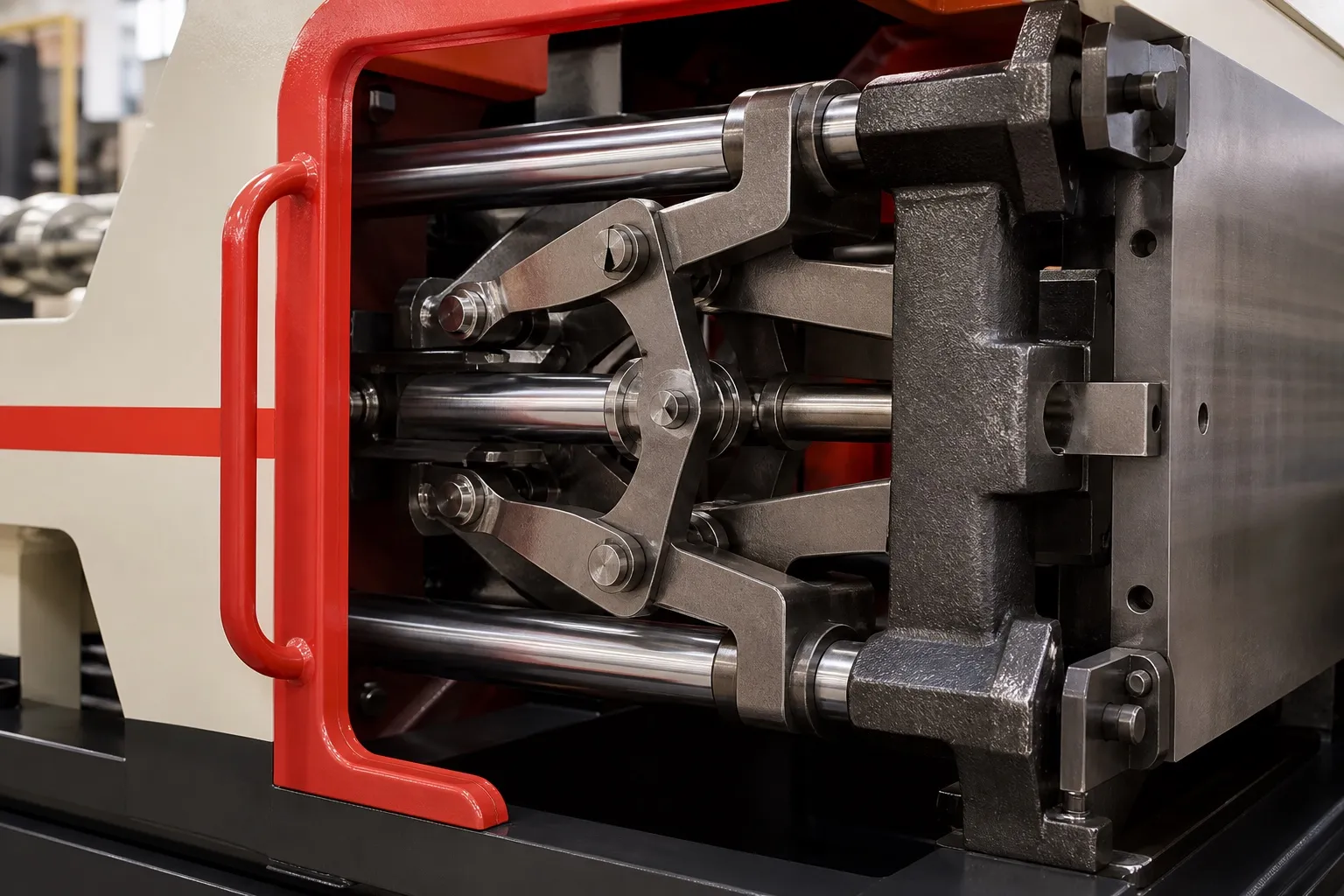
A 24-cavity cap mould arrives from the toolmaker, and the first question on the shop floor is whether the 125 t press can hold it. On clamp alone it usually can: 24 caps of 30 mm outside diameter in HDPE need roughly 53 to 79 t. For a closure mould machine at this size, mould fit, shot and cooling set the limit first.
This article works through cavity count, runner choice, resin grade and output for multi-cavity closure moulds.
Key Takeaways
- A 30 mm cap has a projected area of about 7.1 cm², so 32 cavities on a hot runner need about 70 to 105 t with a 10% reserve.
- Hot runners keep the runner out of the clamp calculation and out of the regrind bin, which matters more as cavity count rises.
- Closure grades can have a low MFR. Reliance lists 1.6 g/10 min for its bimodal HDPE cap grade Relene 54GC016.
- Cooling time grows with the square of wall thickness, so the cap's thickest section sets the cycle and the hourly output.
How Many Cavities Can a Closure Mould Machine at 125 t Carry?
On clamp alone, a 125 t machine can carry about 32 cavities of a 30 mm HDPE cap at a cautious tonnage factor, and more at a low one. In practice, tie-bar space, mould height, shot volume and cooling can stop you before clamp does, so check those first.
Clamp needed for a 30 mm OD cap on a hot runner, with a 10% reserve (a starting margin, not a rule)
| Cavities | Total projected area | At 2 US t/in² (0.281 t/cm²) | At 3 US t/in² (0.422 t/cm²) |
|---|---|---|---|
| 16 | 113 cm² | 35 t | 53 t |
| 24 | 170 cm² | 53 t | 79 t |
| 32 | 226 cm² | 70 t | 105 t |
| 48 | 339 cm² | 105 t | 157 t |
A cap's projected area is the circle of its outside diameter, because the mould sees the top of the cap face on. A 30 mm cap gives about 7.1 cm² per cavity. Polyethylene sits at the low end of published tonnage factors, which is why closures need so little clamp per cavity.
We would still start a closure job at 3 US t/in², not 2. Closure grades are often stiff-flowing, caps have thin skirts and fine threads, and the extra reserve costs nothing if the mould fits the platens. The method behind these numbers is in the projected area article in this series.
Mould size is the real constraint. A 32-cavity layout with a hot runner manifold and an unscrewing or strip-off ejection system can be physically large, so confirm the mould's outside dimensions against the tie-bar gap and its shut height against the machine's range.
Should a Multi-Cavity Closure Mould Use a Hot Runner?
From about 16 cavities up, we would choose a hot runner. It removes the runner from the clamp calculation, cuts the shot weight, avoids regrind and lets every cavity fill under similar conditions. A cold runner can still suit short runs, frequent colour changes or a tight tooling budget.
With a cold runner, the runner's projected area adds to the cavities, because melt in the runner also pushes the mould open. On a 24-cavity layout, a long cold runner system can add a large share of the total area and push a comfortable job close to the clamp limit.
Balance matters as much as heat. Every cavity should see the same flow length and pressure drop, or the outer caps short-fill while the inner ones flash. Ask the toolmaker for the runner balance study and the nozzle temperature map before the mould is shipped.
Ejection also shapes the mould. Caps with deep internal threads may need unscrewing cores, while shallow threads in a flexible resin can often be stripped off. The unscrewing route adds motors or racks and makes the mould longer, which brings shut height back into question.
Which Resin Grades Suit Closures in India?
PP and HDPE are the usual choices. FSSAI's packaging regulations suggest PP or HDPE caps for milk, fats and oils and several other food categories. HDPE closure grades can be bimodal, with low melt flow for stiffness and stress-crack resistance, while PP suits hinged and flip-top designs.
Reliance's Relene 54GC016 is one example of an Indian closure grade. Reliance describes it as a bimodal HDPE for injection and compression moulded caps, with an MFR of 1.6 g/10 min, density of 0.954 g/cm³ and processing temperatures of 180 to 220 °C.
The same data sheet lists compliance with IS 10146 for polyethylene in contact with food and drinking water, and with IS 16738:2018, the positive list of constituents for PE and PP. FSSAI also requires food businesses to hold an NABL lab certificate for packaging in direct food contact, so keep the resin documents on file.
A low-MFR grade resists flow more than a general moulding grade of the same polymer. Expect higher injection pressure in thin skirts and fine threads, and confirm the tonnage factor with the resin supplier for your wall thickness.
What Sets Cycle Time and Output on a Closure Mould?
Cooling can take most of the cycle. In an RJG trial on a 3.3 mm ABS part, it took about 85%, and RJG notes that wall thickness enters the cooling equation squared. On a cap, the top panel or thickest thread root decides when the part can be ejected.
That square is why small changes matter. A wall 20% thinner needs about 36% less cooling, because 0.8 squared is 0.64. RJG also suggests adding about 20% to a calculated cooling time as a safety factor, so plan output on the padded figure, not the theoretical one.
Hourly output is 3,600 divided by the cycle in seconds, times cavities, times the share of good shots. Cooling water flow matters as much as temperature: steady, turbulent flow through every core keeps caps from the outer cavities as consistent as those near the sprue.
What Should You Confirm Before Ordering a Closure Mould?
Confirm the cap drawing, resin grade, cavity count, runner type, ejection method, the mould's outside size and shut height, and your target daily output. Then check clamp, tie-bar fit, shot volume and cooling together, not one at a time. See the 125 ton horizontal injection moulding machine page.
Frequently Asked Questions About Closure Mould Machines
Why not put a 48-cavity cap mould on a 125 ton machine?
At a cautious tonnage factor, 48 cavities of a 30 mm cap need about 157 t with a 10% reserve, which exceeds 125 t. Even at the low factor the clamp would run at about 84% of its rating. A mould that size is also likely to exceed the tie-bar space of a 125 t machine.
Are PP or HDPE caps better for edible oil bottles?
Both can work. FSSAI's packaging regulations suggest PP or HDPE caps for fats and oils, so the choice depends on the cap design, seal type and bottle material. Confirm the grade's food-contact compliance, such as IS 10146 for PE or IS 10910 for PP, and test the seal on real bottles.
Does a closure mould need chilled water?
Closure moulds can run on chilled or cooled water, because cooling can take most of the cycle on a thin cap. What matters is enough flow through every core and cavity, steady supply temperature and clean channels. Scale in the cooling lines slows heat removal and can add seconds to every cycle.
How often should a closure mould's hot runner be maintained?
There is no single interval. Nozzle tips, heaters and thermocouples wear with resin, colour changes and hours run. Track short shots and temperature drift by cavity, and schedule cleaning when a pattern appears rather than waiting for a full stoppage. Your hot runner supplier's manual should set the baseline.
Can one closure mould machine run two cap sizes?
Yes, by changing moulds, provided both moulds fit the tie-bar space and shut height range and both shots suit the barrel. A cap that weighs much less than the other may leave the barrel underused, which hurts melt quality. Check both shot sizes against the same screw before planning.
Related Articles
- What Can You Make on a 125 Ton Injection Moulding Machine?
- 125 Ton vs 150 Ton: Sizing a Machine by Projected Area
- Moulding Automotive Clips and Fasteners on a 125 Ton Machine
Sources & References
- Reliance Industries: Relene 54GC016 HDPE for caps and closures, technical data sheet (Feb 2026)
- Food Safety and Standards Authority of India: Food Safety and Standards (Packaging) Regulations, 2018, compendium
- RJG Inc.: How to Determine Injection Molding Cooling Time
- Plastics Engineering (SPE), A. Urbina: Mastering Clamping Force Calculation
Technical Disclaimer
Disclaimer: The information provided in this document is for general informational and educational purposes only. It is based on technical references and industry information available at the time of preparation and may be subject to change. It does not constitute engineering, technical, commercial or professional advice, nor does it constitute a quotation, specification, warranty or contractual commitment by Pratishna Engineers.
Actual injection moulding machine and process requirements vary according to the component design, material, mould, production volume, machine configuration and operating conditions. The information, examples, calculations and recommendations provided should be independently evaluated and verified for the specific application before making any equipment, process or production decision. Information obtained from third-party sources remains subject to the accuracy and limitations of those sources.
Limitation of Liability: Pratishna Engineers makes no representation or warranty, express or implied, regarding the completeness, accuracy or suitability of the information for any particular application. To the extent permitted by applicable law, Pratishna Engineers shall not be liable for any loss, damage, cost or consequence arising from reliance on or use of the information contained in this document. Final machine selection, configuration and application suitability should be confirmed with Pratishna Engineers based on complete and accurate project requirements.