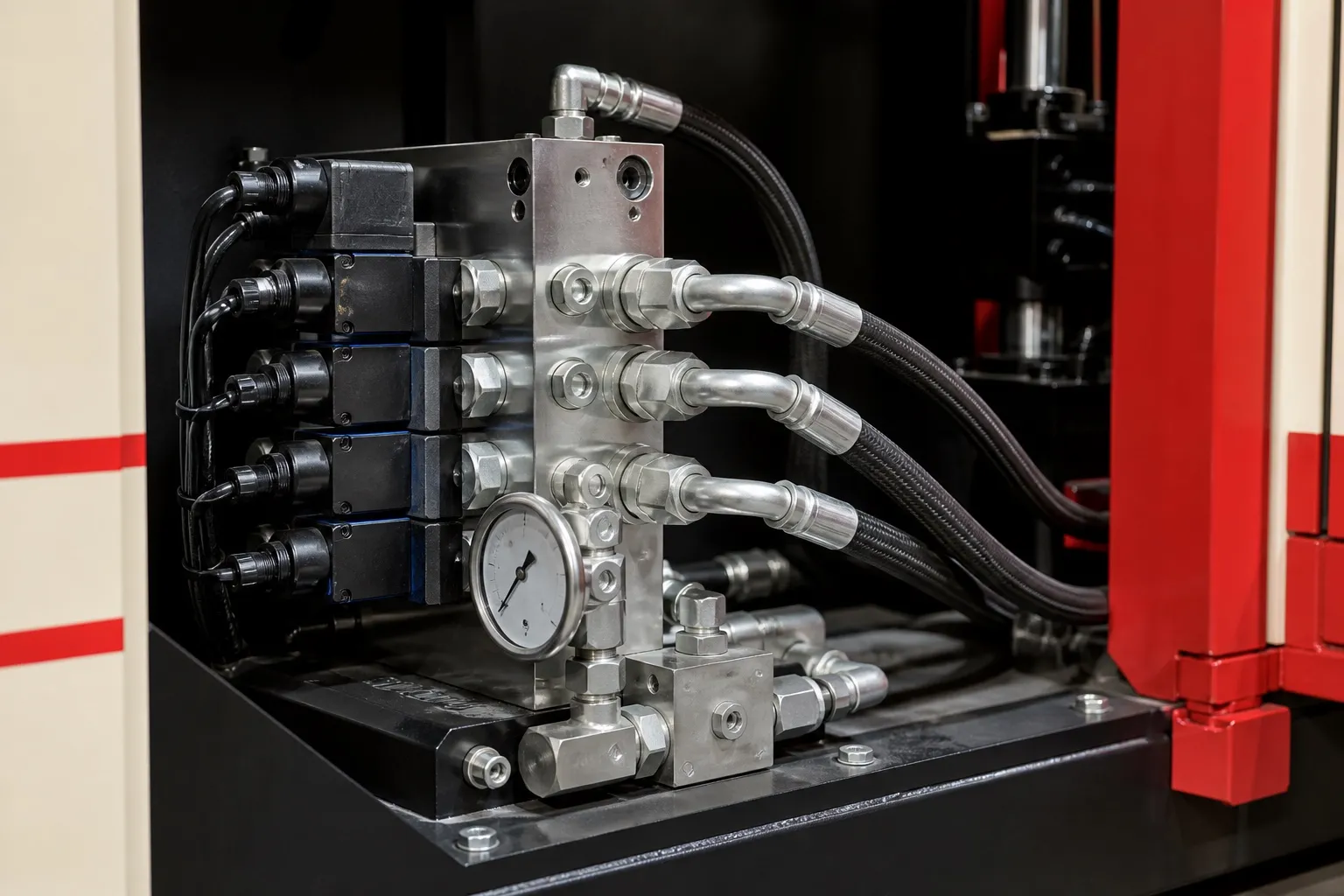
Hybrid vs hydraulic vs all-electric machines at a glance
| Point | Hydraulic | Hybrid | All-electric |
|---|---|---|---|
| Injection drive | Hydraulic cylinder fed by a pump | Often a servo motor and ball screw; designs vary | Servo motor and ball screw |
| Clamp | Hydraulic cylinder or cylinder-driven toggle | Usually hydraulic, sometimes two-platen with hydromechanical locking | Servo-driven toggle |
| Base load (share of total energy) | Can be 75% or more on standard machines | About 10 to 20%, mostly barrel heating | About 10 to 20%, mostly barrel heating |
| Injection pressure read as | Hydraulic pressure times the intensification ratio | Plastic pressure, where injection is electric | Plastic pressure, read directly |
| Hydraulic oil | Full system with oil cooling | Smaller system for clamp and ejector | None on the main axes |
The hybrid vs hydraulic vs all-electric choice comes down to which machine movements are driven by servo motors and which by pumped oil. A hydraulic machine moves everything with oil, an all-electric machine moves everything with servo motors, and a hybrid mixes the two, commonly an electric injection unit with a hydraulic clamp.
That mix decides energy use, how finely injection is controlled, what maintenance looks like and what you pay up front. This article compares the three on those points and shows how to test whether a price difference pays back on your own job.
Key Takeaways
- A hybrid is not one fixed design, so ask which axes are electric before you compare offers.
- Hybrid and all-electric machines have a base load of about 10 to 20% of their energy, against 75% or more on some standard hydraulics.
- Electric injection reads plastic pressure directly, which makes pressure settings easier to transfer and compare.
- Judge any price premium by measured kWh saved on your job, not by a brochure percentage.
What Exactly Counts as a Hybrid Machine?
Any machine that combines electric and hydraulic drives. The most common pairing is servo-electric injection and screw rotation with a hydraulic clamp and ejector, but the word is also used for hydraulic machines with an electric screw drive and for two-platen hydraulic clamps with mechanical locking.
Because the label is used loosely, compare machines axis by axis. Ask four questions of every offer: what drives injection, what drives screw rotation during recovery, what drives the clamp, and what drives the ejector. Two machines both called hybrid can give different results on the same mould.
Plastics Technology's Mark Knights reported in 2010 that most new hybrid clamps were then two-platen designs with hydromechanical locking: split nuts lock the moving platen, then short-stroke cylinders apply tonnage. Two-platen designs also shorten the machine compared with toggles or fully hydraulic clamps, which can matter on a crowded shop floor.
Retrofits blur the line further. In an SPE energy tip, Robin Kent of Tangram Technology lists variable-speed motors, variable-volume pumps and servo motors on fixed pumps as upgrades for older hydraulic machines, and notes that an electric screw drive can reduce peak power and allow a smaller main motor.
Hybrid vs Hydraulic vs All-Electric: Which Uses Less Power?
All-electric and hybrid machines usually use less, because their base load is small. The ExxonMobil, AMI and Tangram energy guide puts their base load at about 10 to 20%, mostly barrel heating, while a standard hydraulic machine can carry 75% or more as base load.
Base load is the power drawn whether or not any axis is moving. On a fixed-speed hydraulic machine, the motor and pump keep turning through cooling and mould-open time. A servo axis draws little when it is still. The same guide puts possible all-electric savings at up to 60%.
Hydraulics have closed some of the gap. Kent writes that much of the progress over about 20 years has come from slowing the motor when oil is not needed, and that some new hydraulic machines are not far from all-electric energy use. So compare a hybrid with a modern servo-pump hydraulic, not with a 20-year-old press.
How to measure and cut the bill is covered in the power costs article in this series.
Where Does Each Machine Type Fit Best?
Hydraulic machines suit large moulds, long strokes and jobs where first cost matters most. All-electric machines suit precise, clean, fast-cycling work. Hybrids sit between them, giving electric injection control with hydraulic clamp force, which fits thin-wall, multi-cavity and tight-weight jobs on moulds that need a strong clamp.
The pressure reading is one practical difference. On a hydraulic machine, the gauge shows oil pressure, and plastic pressure is that figure multiplied by the machine's intensification ratio, which differs from machine to machine and changes with screw size. An electric injection unit reads plastic pressure directly, so settings move more cleanly between machines. The ball screw article in this series explains why.
The clamp matters too. Knights reports supplier claims that toggles may lock up slightly faster and give more opening force for deep-draw parts, while direct hydraulic clamping is said to give finer pressure control, more uniform pressure, mould protection and a wider die-height range. Treat these as reported claims and test them on your mould.
Maintenance differs as well. Hydraulic systems need oil, filters, seals and oil cooling. Ball screws and toggle linkages need correct lubrication and are wear parts in their own right. A hybrid carries a smaller version of both lists.
Our view: decide on the injection side first. If your parts are judged on weight, wall or fill balance, an electric injection unit earns its place before any other upgrade, and the clamp choice can follow the mould.
How Should You Shortlist a Machine Type for Your Job?
Write down the part, resin, cavity count, weight tolerance, run length and running hours, and log your current machine's power on that job. Then ask each supplier which axes are electric and what saving they expect, in kWh per hour. See the hybrid injection moulding machine page.
Frequently Asked Questions About Hybrid, Hydraulic and All-Electric Machines
Is a hybrid machine always cheaper to run than a hydraulic one?
Not always. A modern hydraulic machine with a servo or variable-speed pump can come close to electric energy use, while an old fixed-pump machine cannot. Compare the actual machines on your job with a power logger, and include hours of idle and mould-open time, where fixed-speed motors waste most.
Why choose a hybrid instead of going all-electric?
A hybrid keeps hydraulic force where it is useful, usually the clamp and ejector, while giving electric control of injection. That can suit large or heavy moulds, long strokes or core pulls driven by hydraulics. All-electric suits work where clean running and electric control on every axis matter more.
Do hybrid machines still need hydraulic oil?
Usually yes, for the clamp, ejector and any hydraulic core pulls, though the system is smaller than on a fully hydraulic machine. Plan for oil changes, filters, seals and oil cooling on that circuit, plus lubrication of the ball screw and bearings on the electric injection side.
Can I move a mould between hydraulic and electric machines?
Yes, if the clamp, tie-bar space, stroke and shot size suit it, but do not copy pressure numbers blindly. A hydraulic machine shows oil pressure, which must be multiplied by its intensification ratio to give plastic pressure. Convert first, then fine-tune speeds and transfer position on the new machine.
How can I compare energy claims from different suppliers?
Ask for figures in kWh per hour or kWh per kg on a named part, resin and cycle, not as a percentage. Then log your own machine on the same job for at least half an hour. A percentage without a baseline cannot be checked against your bill.
Related Articles
- Servo-Electric Ball Screw Injection: Why Shot Repeatability Improves
- Cutting Power Costs in Injection Moulding With Hybrid Machines
- Thin-Wall and Multi-Cavity Moulding on Hybrid Machines
Sources & References
- ExxonMobil, AMI and Tangram Technology: An Energy Saving Guide for Injection Moulders
- SPE Plastics Engineering, R. Kent (Tangram Technology): Energy-Saving Tip 67: Injection Molding: get the right motor (Sept 2016)
- Plastics Technology, M. Knights: Hybrid Injection Clamps: The Best of Both Worlds? (June 2010)
- Deccan Chamber of Commerce, Industries and Agriculture, Pune: Circular No. 085: MERC Order dated 25 March 2026 (27 Mar 2026)
Technical Disclaimer
Disclaimer: The information provided in this document is for general informational and educational purposes only. It is based on technical references and industry information available at the time of preparation and may be subject to change. It does not constitute engineering, technical, commercial or professional advice, nor does it constitute a quotation, specification, warranty or contractual commitment by Pratishna Engineers.
Actual injection moulding machine and process requirements vary according to the component design, material, mould, production volume, machine configuration and operating conditions. The information, examples, calculations and recommendations provided should be independently evaluated and verified for the specific application before making any equipment, process or production decision. Information obtained from third-party sources remains subject to the accuracy and limitations of those sources.
Limitation of Liability: Pratishna Engineers makes no representation or warranty, express or implied, regarding the completeness, accuracy or suitability of the information for any particular application. To the extent permitted by applicable law, Pratishna Engineers shall not be liable for any loss, damage, cost or consequence arising from reliance on or use of the information contained in this document. Final machine selection, configuration and application suitability should be confirmed with Pratishna Engineers based on complete and accurate project requirements.