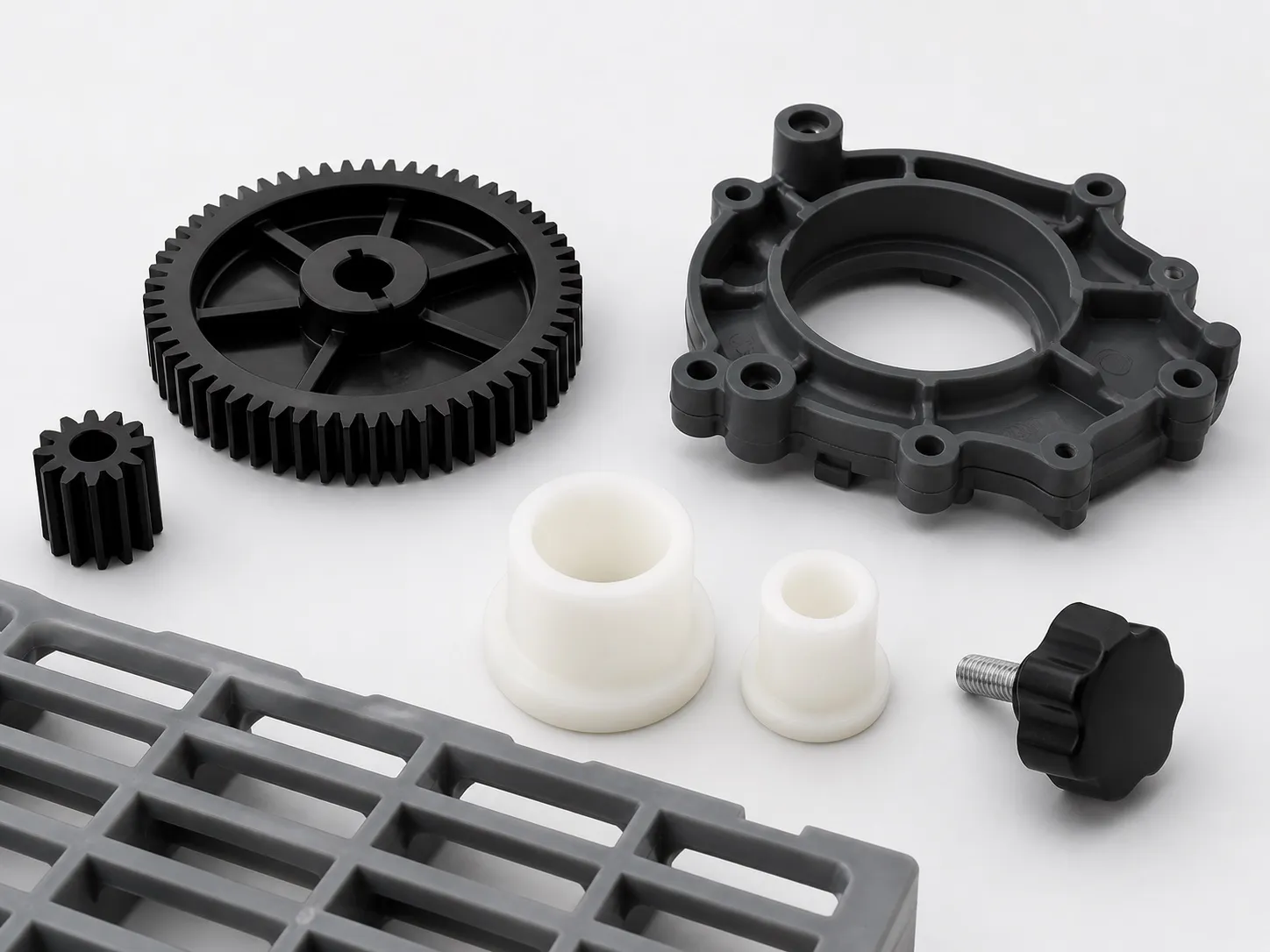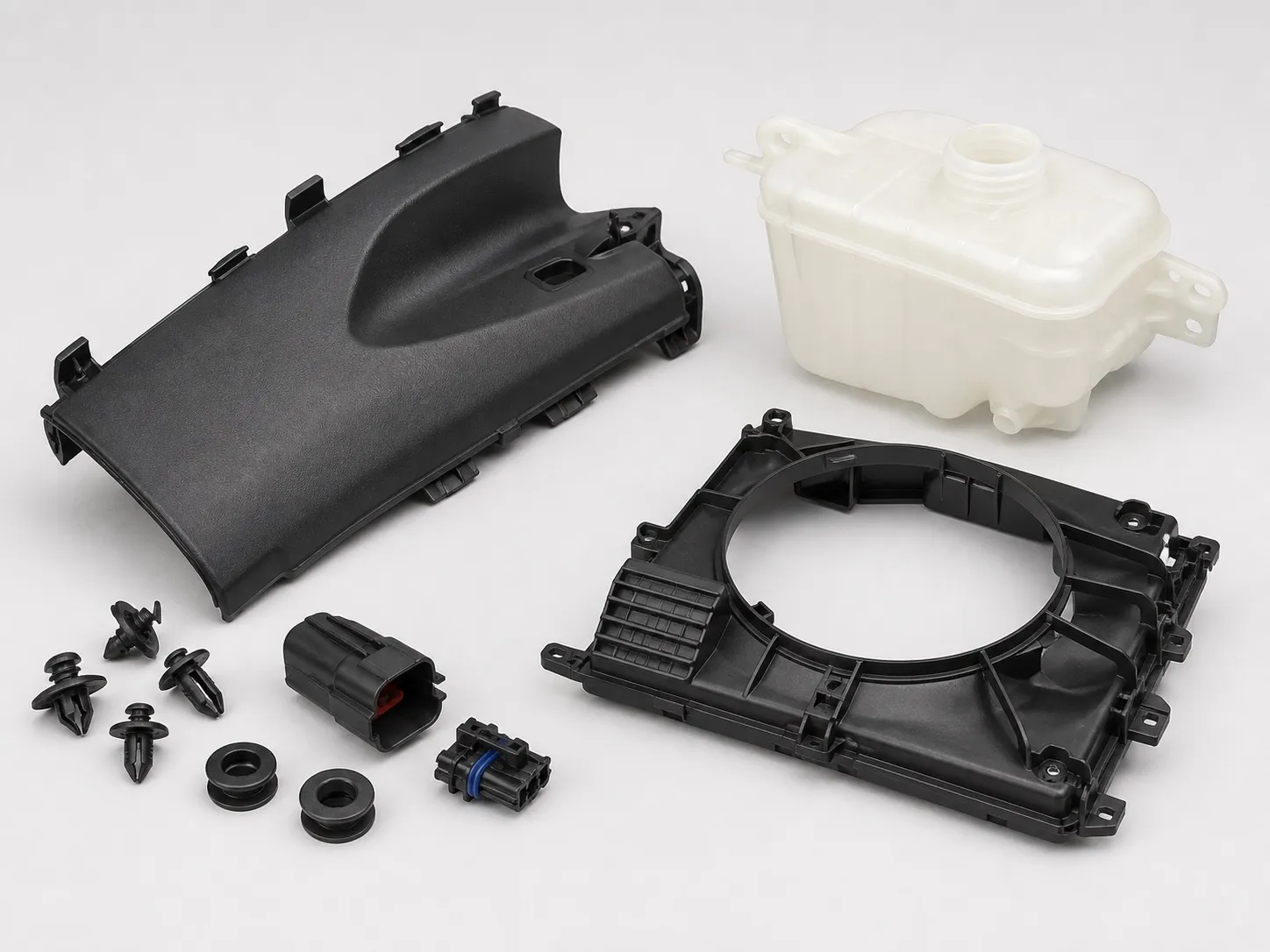

A tier-2 supplier receives a drawing for an under-bonnet sensor housing: three brass terminals and one bush, moulded in glass-filled PBT, with a field-return clause in the contract. The questions that follow come up on every automotive insert moulding job of this kind. Which resin? How are the inserts held and checked? Will the plastic around each insert crack after the part leaves the plant?
Vertical machines suit this work because the lower mould faces up, so terminals and bushes sit in their pockets under gravity while the mould closes. This article covers the parts, the resins, cracking around inserts and checking each insert before the shot.
Key Takeaways
- Sensor housings, connector bodies, bushed brackets and terminal carriers can all be insert moulded on a vertical machine.
- One hydrolysis-resistant PBT-GF30 grade is listed by its maker for automotive connectors and under-bonnet electronic housings, and must be moulded below 0.04% moisture.
- A rough hoop-stress estimate for that grade reaches about 87% of its break stress across the flow, so preheat inserts and size bosses with margin.
- Check that every insert is present and seated before injection, and keep rejected parts inside the cell.
Which Automotive Parts Are Insert Moulded?
Sensor housings with moulded-in terminals, connector bodies carrying several contacts, brackets and clips with metal bushes for bolted joints, and terminal carriers in wiring systems. In each, a metal part carries current, load or a thread, and the plastic around it holds, seals or insulates it.
Automotive insert-moulded parts, inserts, resin choices and main risks (resin choices are examples)
| Part | Insert | Resin choice | Main risk |
|---|---|---|---|
| Sensor housing | Terminals, bush | Hydrolysis-resistant PBT-GF30 | Leak path along terminals; cracking at the bush |
| Connector body | Several contacts | PBT-GF30 or PA66 | Contact position; flash on contact faces |
| Bracket or clip with bush | Steel or brass bush | Impact-modified PA66 | Pull-out; hoop cracking |
| Interior part with threaded insert | Brass threaded insert | PP impact copolymer | Thread flash; insert float |
Glass-filled parts shrink differently along and across the flow, so terminal positions depend on where the gate is. Ask the mould maker for a flow analysis before the terminal pockets are finished.
Which Resins Suit Automotive Insert Moulding?
Glass-filled PBT and PA66 suit connectors and housings that see heat and load; PP impact copolymers suit cooler interior parts. Choose the grade from the resin maker's datasheet for the service conditions, then take drying, melt and mould temperatures from the same sheet, not from habit.
BASF lists a hydrolysis-resistant PBT-GF30 grade, Ultradur B 4300 G6 HR, for automotive connectors and housings for electronic units under the hood. Its product sheet asks for less than 0.04% moisture at processing, a melt of 250 to 275 °C and a mould of 60 to 100 °C. Shrinkage is 0.50% along the flow and 1.30% across it.
The same sheet notes that a 25 kg bag stored at 5 °C took 48 hours to reach 20 °C in the processing area, and that bags from unheated stores should be opened only once warm, to avoid condensation.
For PP parts, Reliance lists Repol B300MN, a high-crystalline impact copolymer with an MFR of 30 g/10 min, for automotive and appliance parts. Its datasheet says the fast crystallisation suits large articles with lower cycle times.
Will the Plastic Crack Around the Inserts?
It can. Moulded plastic shrinks onto a metal insert that does not shrink, leaving hoop stress in the ring around it. The DuPont guidance summarised in PlasticsToday calls delayed cracking from this stress the most common insert moulding complaint, and stiff glass-filled grades leave little margin.
The guide estimates hoop stress as mould shrinkage multiplied by flexural modulus. For acetal it gives about 52.4 MPa, roughly 75% of the material's tensile strength. Glass- and mineral-filled grades shrink less, 0.005 to 0.010 mm/mm, but they are far stiffer, and heavily filled weld lines may keep only 60% of unfilled strength.
Temperature makes it worse. The PBT-GF30 sheet gives thermal expansion of 20 × 10⁻⁶/K along the flow and 150 × 10⁻⁶/K across it, so heating and cooling in service keeps working the joint with the metal.
Our view: do not release an automotive insert part on room-temperature pull tests alone. Run temperature cycling on finished parts, as the DuPont guide advises, before the first lot ships.
How Do You Check Every Insert Before Injection?
Confirm that each insert is present and seated before the mould closes, by sensor or by vision, and keep bad parts inside the cell. A Robotic Industries Association case study describes a cell that checked each cavity was free of debris and each insert seated before moulding.
In that cell, a SCARA robot unloaded four parts and the runner, placed the parts on an index table for inspection and loaded new inserts from a vibratory bowl feeder. The manual routine it replaced took 30 s for unloading, checking and loading. Consistent mould-open times also ended swings in mould temperature, which matters on a part with a 60 to 100 °C mould window.
A missing or tilted terminal does not always show on the outside. Where the part seals, check it with a leak or electrical test as well as by eye.
What Should You Send for an Automotive Insert Part?
Send the part and insert drawings, the insert material and plating, the resin grade and its datasheet, the cavities, the annual volume and the tests your customer will run. Clamp size follows the method in the applications article in this series. See the 80 ton vertical injection moulding machine page.
Frequently Asked Questions About Automotive Insert Moulding
Why choose a hydrolysis-resistant PBT grade?
PBT is a polyester, and polyesters can lose strength when heat and moisture act together. Parts under the bonnet see both. Hydrolysis-resistant grades are made for those conditions, and the resin maker's datasheet states the intended use. Confirm the grade against the vehicle maker's material specification.
Do glass-filled resins wear the machine and mould?
Yes. Glass fibres are abrasive, so screws, check rings, nozzles and gates wear faster than with unfilled resins. Specify a wear-resistant screw and barrel and hardened steel at the gates when you order. Watch shut-offs around terminals too, because wear there shows up as flash.
What causes flash on terminal faces?
A gap between the terminal and its shut-off in the mould. Terminal thickness varies from lot to lot, and shut-offs wear. Measure terminals from several lots before the pockets are finished, and inspect the shut-offs at set intervals rather than waiting for flash to appear on parts.
Should mould temperature be held tightly on these parts?
Yes. Shrinkage, crystallinity and stress around inserts all follow mould temperature. Hand loading with uneven open times lets the mould cool between shots. Use a temperature controller, log it, and keep the open time steady, by automation if the volume justifies it.
Can one mould run both PBT-GF30 and PA66?
Not without checking. The cavity is cut for one resin's shrinkage, and glass-filled PBT shrinks differently along and across the flow from PA66. Terminal positions and snap features can move out of tolerance. Treat a resin change as a new mould trial, with dimensional checks and fresh drying settings.
Related Articles
- What Can You Make on an 80 Ton Vertical Insert Moulding Machine?
- Multi-Insert Housings on an 80 Ton Vertical Machine
- When to Use a Sliding Mould on an 80 Ton Vertical Machine
Sources & References
- BASF: Ultradur B 4300 G6 HR Product Information (02/2026)
- PlasticsToday (IMM), summarising A. Miller, DuPont: Design and material advice from the pros, Part 3: Insert molding essentials (Sept 2005)
- Robotic Industries Association via Smart Molding, J. Clark: Automated injection molding operation
- Reliance Industries: Repol B300MN TDS (July 2024)
Technical Disclaimer
Disclaimer: The information provided in this document is for general informational and educational purposes only. It is based on technical references and industry information available at the time of preparation and may be subject to change. It does not constitute engineering, technical, commercial or professional advice, nor does it constitute a quotation, specification, warranty or contractual commitment by Pratishna Engineers.
Actual injection moulding machine and process requirements vary according to the component design, material, mould, production volume, machine configuration and operating conditions. The information, examples, calculations and recommendations provided should be independently evaluated and verified for the specific application before making any equipment, process or production decision. Information obtained from third-party sources remains subject to the accuracy and limitations of those sources.
Limitation of Liability: Pratishna Engineers makes no representation or warranty, express or implied, regarding the completeness, accuracy or suitability of the information for any particular application. To the extent permitted by applicable law, Pratishna Engineers shall not be liable for any loss, damage, cost or consequence arising from reliance on or use of the information contained in this document. Final machine selection, configuration and application suitability should be confirmed with Pratishna Engineers based on complete and accurate project requirements.