
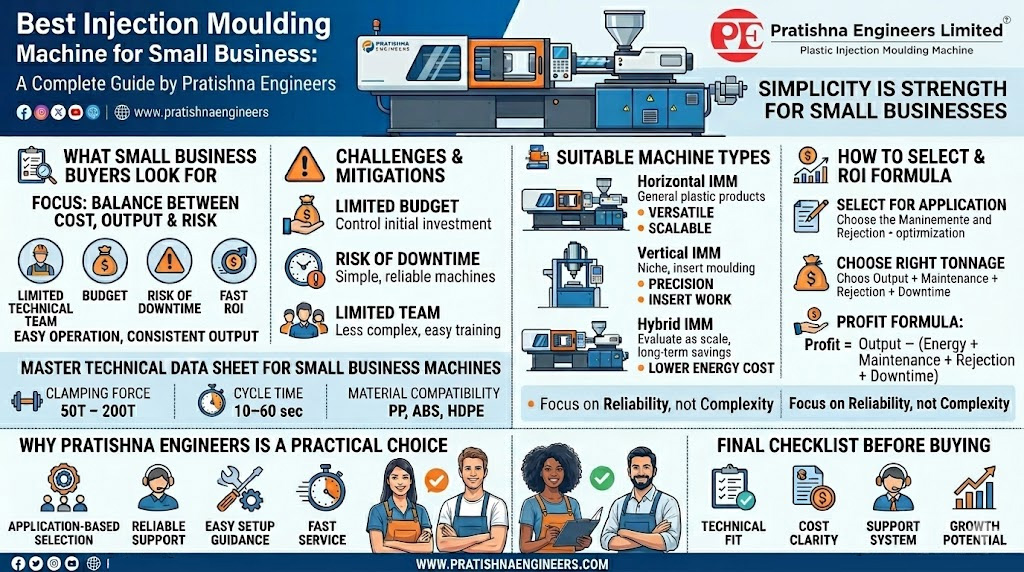
What Small Business Buyers Actually Look for in an Injection Moulding Machine
When a small business searches for the best injection moulding machine, the requirement is very different from large-scale industrial buyers.
Here the focus is not just performance — it is balance between cost, output, and risk.
Most small business buyers are:
- starting a new manufacturing unit
- shifting from job work to own production
- expanding into plastic component manufacturing
- working with limited investment
At this stage, the real concern is:
- how much investment is required
- how quickly the machine will generate returns
- how easy it is to operate and maintain
That is why most buyers begin by exploring basic configurations of
injection moulding machines
to understand what fits their production scale.
👉 Practical insight:
For small businesses, the best machine is not the most advanced — it is the one that starts generating output quickly with minimal risk.
Key Challenges Faced by Small Business Owners
Small-scale buyers face very practical challenges that directly impact machine selection.
Limited Budget
Initial investment must be controlled while ensuring production viability.
Limited Technical Team
Machines must be:
- easy to operate
- easy to maintain
- less dependent on complex settings
Risk of Downtime
Breakdowns can:
- stop production completely
- impact cash flow
- delay deliveries
Need for Fast ROI
The machine must:
- start production quickly
- generate consistent output
- recover cost within a reasonable time
👉 Real-world observation:
Small businesses succeed when they choose simple, stable, and cost-efficient machines, not overly complex systems.
Types of Injection Moulding Machines Suitable for Small Businesses
Selecting the right machine type is critical for smaller operations.
Small Tonnage Horizontal Machines
- suitable for general plastic products
- easier to operate
- scalable
Most small manufacturers begin with
horizontal injection moulding machines
for flexibility.
Vertical Machines (For Specialized Work)
- used for insert moulding
- suitable for electrical components
Small units working in niche segments often use
vertical injection moulding machines
for precision applications.
Hybrid Machines (For Long-Term Savings)
- higher initial cost
- lower energy consumption
Businesses planning long-term operations may evaluate
hybrid injection moulding machines
to reduce operating cost.
👉 Practical takeaway:
Start with a machine that fits your current production — not future assumptions.
How Production Type Affects Machine Selection
Different small businesses require different machine setups.
Consumer Products
- buckets, containers, household items
- require flexible machines
Electrical Components
- precision parts
- insert moulding required
Packaging
- caps, closures
- high speed required
Some packaging-focused units may later evaluate
PET injection moulding machines
as they scale.
👉 Practical insight:
Your product decides your machine — not the other way around.
Why Simplicity Matters More Than Advanced Features
Many small businesses make the mistake of buying feature-heavy machines.
Problems with Over-Advanced Machines:
- difficult to operate
- higher maintenance
- unnecessary cost
Advantages of Simple Machines:
- easier training
- stable operation
- lower cost
- faster ROI
👉 Practical advice:
For small businesses, simplicity is a strength, not a limitation.
How to Select the Right Injection Moulding Machine for a Small Business
Once the basics are clear, the next step is selection — and this is where small business owners need to be very practical.
The goal is not to buy the “best machine in the market.”
The goal is to buy the right machine for your current production capacity.
Step 1: Define Your Product Clearly
Before selecting any machine, be clear about:
- product size
- material type
- production volume
Without this clarity, machine selection becomes guesswork.
Step 2: Match Machine Type with Application
Different applications require different machine setups.
For general production, most small businesses start with
horizontal injection moulding machines
because they are versatile and easier to scale.
For precision or insert-based products,
vertical injection moulding machines
are more suitable.
Step 3: Choose the Right Tonnage
Avoid selecting:
- too small → limits production
- too large → increases cost
👉 Practical insight:
Correct tonnage selection directly impacts both cost and efficiency.
Cost vs ROI – What Small Businesses Must Understand
For small businesses, investment decisions are directly linked to survival and growth.
What Most Buyers Do
- compare machine prices
- choose lowest quotation
What Smart Buyers Do
- calculate operating cost
- evaluate energy consumption
- estimate output and revenue
Key ROI Factors:
Production Output
Higher output = faster revenue generation
Energy Consumption
Machines with lower power usage reduce monthly expenses.
Many businesses consider
hybrid injection moulding machines
for long-term savings.
Maintenance Cost
Frequent breakdowns increase:
- downtime
- repair cost
- production loss
Rejection Rate
Poor machine selection increases rejection, which reduces profit.
👉 Practical formula:
Profit = Output – (Energy + Maintenance + Rejection + Downtime)
New vs Used Machines – What Small Businesses Should Choose
This is one of the most common decisions for small buyers.
Used Machines
Advantages:
- lower initial cost
- faster availability
Risks:
- unknown machine condition
- higher maintenance
- inconsistent performance
New Machines
Advantages:
- reliable performance
- warranty support
- lower maintenance
Limitations:
- higher upfront investment
👉 Practical insight:
Used machines reduce initial cost but increase long-term risk.
Common Mistakes Small Businesses Must Avoid
Over-Investing Too Early
Buying a large or advanced machine without sufficient demand.
Choosing Only Based on Price
Ignoring operating cost and performance.
Ignoring Support
Selecting a supplier without reliable service.
Not Planning for Expansion
Choosing a machine that cannot scale with growth.
👉 Practical advice:
Small businesses should aim for balanced investment, not aggressive expansion.
Why Pratishna Engineers is a Practical Choice for Small Businesses
For small and growing businesses, the focus is on reliability, simplicity, and cost control.
Pratishna Engineers provides solutions aligned with these requirements.
What Small Business Buyers Get:
Application-Based Selection
Machines are recommended based on:
- product
- material
- production scale
Flexible Machine Options
Buyers can evaluate:
- general
injection moulding machines - scalable
horizontal injection moulding machines - specialized
vertical injection moulding machines
Cost-Efficient Operation
- lower energy consumption
- stable production
- reduced rejection
Reliable Support
- easy setup guidance
- fast service response
- spare availability
👉 Practical takeaway:
Small businesses grow faster when they start with the right machine, not the biggest machine.
Real Small Business Scenarios – What Works in Practice
In small-scale manufacturing, machine decisions directly affect business growth.
Scenario 1: Low-Cost Machine Purchase
A small unit selected a machine based only on lowest price.
Issue:
- frequent breakdown
- unstable production
- higher maintenance
Result:
- delayed orders
- loss of customer trust
- reduced profitability
Scenario 2: Balanced Investment Approach
Another business selected a machine based on application and ROI.
Approach:
- correct tonnage selection
- energy efficiency considered
- supplier support evaluated
Result:
- stable production
- lower operating cost
- faster return on investment
Scenario 3: Growth-Oriented Startup
A startup planned for future expansion while selecting the machine.
They evaluated machine options through the
official website
and chose a scalable setup.
Result:
- easy expansion
- no need for early replacement
- better long-term planning
👉 Key takeaway:
The right machine helps your business grow — the wrong one slows it down.
Final Checklist Before Buying a Machine for Small Business
Before finalizing your purchase, validate these points carefully.
Technical Fit
- machine matches your product
- suitable for material
- correct tonnage selection
Cost Clarity
- machine price
- power consumption
- maintenance cost
Support System
- installation guidance
- service response
- spare availability
Growth Potential
- scalability
- automation compatibility
- future expansion
👉 Practical advice:
For small businesses, clarity at this stage prevents costly mistakes.
Master Technical Data Sheet for Small Business Machines
| Parameter | Typical Range | Production Impact | Buyer Focus |
|---|---|---|---|
| Clamping Force | 50T – 200T | Suitable for small products | Match mould size |
| Injection Pressure | Application-based | Filling accuracy | Important for quality |
| Shot Capacity | Low to medium | Part size | Align with product |
| Cycle Time | 10–60 sec | Output | Impacts revenue |
| Power Consumption | Moderate | Cost | Energy-efficient preferred |
| Machine Type | Hydraulic / Hybrid | Efficiency | Choose based on budget |
| Control System | Basic / PLC | Ease of use | Simple preferred |
| Maintenance | Low to moderate | Downtime | Important for small teams |
| Material Compatibility | PP, ABS, HDPE | Flexibility | Must be verified |
| Automation Support | Optional | Growth | Future-ready setup |
👉 Practical insight:
Small businesses should focus on ease of operation and reliability, not complexity.
When Should a Small Business Upgrade Its Machine
Growth brings new requirements. Upgrade your machine when:
- production demand increases
- rejection rates rise
- energy cost becomes high
- machine downtime increases
Some businesses move toward
hybrid injection moulding machines
to improve efficiency as they scale.
👉 Real-world observation:
Upgrading at the right time improves profitability significantly.
Frequently Asked Questions
Which injection moulding machine is best for small business?
A machine that balances cost, ease of use, and production efficiency.
What is the ideal tonnage for small businesses?
Usually between 50T to 200T depending on product size.
Should I buy a new or used machine?
New machines are more reliable; used machines reduce initial cost but increase risk.
What is the cost of a small injection moulding machine?
Depends on tonnage, type, and configuration.
Is energy consumption important?
Yes, it directly affects monthly expenses.
Which machine type is best for beginners?
Simple hydraulic or entry-level hybrid machines.
Can one machine handle multiple products?
Yes, with proper mould and setup.
What industries can small businesses target?
Packaging, consumer goods, electrical components.
How long do these machines last?
Typically 10–15 years with proper maintenance.
What is cycle time?
Time required to produce one component.
Do I need automation initially?
Not always — it can be added later.
How do I reduce production cost?
By choosing the right machine and optimizing parameters.
Is after-sales support important?
Yes, especially for small businesses.
Can I scale production later?
Yes, with the right machine selection.
How do I choose the right supplier?
Based on support, experience, and application understanding.
Start Your Manufacturing with the Right Machine
If you are planning to start or expand your manufacturing business, choosing the right injection moulding machine is one of the most important decisions.
Pratishna Engineers supports small and growing businesses by:
- understanding your production requirement
- recommending suitable machines
- ensuring smooth setup and operation
For guidance and quotation, connect through the
contact page
to discuss your requirement.
You can also explore available machine options through
injection moulding machines
to find the right fit for your business.
👉 Final advice:
Start with a machine that supports your business — not one that complicates it.